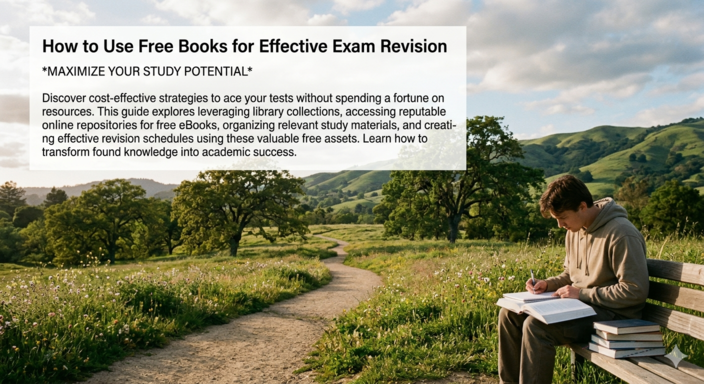
How to Use Free Books for Effective Exam Revision
Exam revision often feels overwhelming, but research in educational psychology consistently shows that how students study matters more than how much they spend. Free books when used strategically can be just as powerful as paid resources, especially when combined with proven techniques like active reading, retrieval practice, and spaced revision.
A growing body of evidence demonstrates that students who engage actively with study materials through practice testing, summarizing, and self-quizzing achieve significantly better exam results than those who rely on passive reading alone (Agarwal et al., 2021; Roediger & Butler, 2011). Free books provide the structure and content needed to apply these high-impact strategies effectively.
Why Free Books Are Valuable for Exam Revision
Free books today are often developed by universities, educators, and open-learning platforms, ensuring both quality and academic alignment.
Key Benefits:
- Accessibility: Available anytime on digital devices
- Structured content: Organized chapters, summaries, and exercises
- Practice opportunities: Built-in questions for self-testing
- Up-to-date material: Frequently revised and improved
- Cost-free learning: Removes financial barriers
Research shows that consistent access to learning materials improves engagement and academic outcomes, making free books a powerful tool for revision success.
Step 1: Choose the Right Free Books
Not all resources are equally effective. Selecting the right material is critical.
What to Look For:
- Alignment with your syllabus
- Clear explanations and worked examples
- Practice questions with solutions
- Updated editions
- Credible authors or institutions
Trusted Sources:
- OpenStax
- Open Textbook Library
- Khan Academy
- CK-12 Foundation
- MIT OpenCourseWare
- Government education portals
📌 Key Insight: Research emphasizes that quality and relevance of materials directly influence learning efficiency, more than the quantity of resources used.
Step 2: Create a Structured Revision Plan
A well-organized plan ensures consistent progress and avoids last-minute cramming.
How to Build Your Plan:
- List all exam topics
- Break them into smaller sections
- Assign study sessions to each topic
- Include time for practice tests
- Set weekly goals
Spacing your study sessions over time known as distributed practice has been shown to significantly improve long-term retention (Carpenter et al., 2022).
Step 3: Focus on Active Reading
Passive reading is one of the least effective study methods. Instead, adopt active learning techniques.
Effective Strategies:
- Highlight key ideas
- Take handwritten notes
- Summarize concepts in your own words
- Create flashcards
- Ask and answer questions
Studies confirm that active engagement enhances comprehension and memory, making revision faster and more effective.
Step 4: Use Chapter Summaries for Quick Revision
Most free books include:
- End-of-chapter summaries
- Key terms
- Review questions
How to Use Them:
- Reinforce understanding after studying
- Quickly revise before exams
- Identify weak areas
Summaries reduce cognitive load and improve recall efficiency, especially during final revision stages.
Step 5: Practice with Questions and Exercises
Practice is one of the most powerful learning strategies.
Why It Works:
- Strengthens memory through retrieval practice
- Improves problem-solving skills
- Identifies knowledge gaps
- Builds exam confidence
A meta-analysis found that practice testing produces greater learning gains than many other study techniques (Adesope et al., 2017). Another study showed that retrieval-based strategies can improve exam performance by up to 16% (Dobson, 2025).
Step 6: Use Past Exam Papers Alongside Free Books
Past papers are essential for exam preparation.
How to Use Them:
- Practice under timed conditions
- Analyze marking schemes
- Identify frequently tested topics
- Track recurring question patterns
Then, revisit your free book to strengthen weak areas. This targeted approach maximizes efficiency.
Step 7: Apply the 3-Stage Revision Method
Combine free books with this proven cycle:
1. Understand
Read and fully grasp the concept
2. Practice
Test yourself using exercises
3. Review
Correct mistakes and revisit weak points
This method aligns with research showing that retrieval and feedback loops significantly enhance learning outcomes (Agarwal et al., 2012).
Step 8: Use Digital Features to Save Time
Digital free books offer tools that improve efficiency:
- Keyword search
- Highlighting and annotations
- Bookmarks
- Hyperlinks to additional resources
These features reduce time spent navigating content and allow faster, targeted revision.
Step 9: Avoid Common Mistakes
Many students misuse free resources. Avoid:
- Downloading too many books
- Passive reading without engagement
- Ignoring practice questions
- Skipping difficult topics
- Last-minute cramming
Research shows that ineffective study habits not lack of resources are the main cause of poor performance.
Step 10: Combine Free Books with Other Study Methods
Free books are most effective when paired with:
- Group discussions
- Teaching others (peer learning)
- Flashcards
- Educational videos
- Mind maps
Using multiple methods reinforces understanding through different cognitive pathways.
How Free Books Support Different Learning Styles
Visual Learners
Use diagrams, charts, and highlighted notes
Auditory Learners
Read aloud and explain concepts verbally
Kinesthetic Learners
Solve problems and write notes actively
Free books provide flexibility to adapt learning strategies based on individual preferences.
Benefits of Using Free Books for Exam Revision
- 💰 Reduces financial stress
- 📚 Encourages independent learning
- 📱 Enables flexible study anytime, anywhere
- 🔄 Offers multiple explanations of concepts
- 🎯 Supports focused and efficient revision
Most importantly, they empower students to take control of their learning process.
Final Thoughts
Free books can be incredibly effective for exam revision but only when used strategically. The real advantage comes from combining these resources with evidence-based study techniques like active reading, retrieval practice, and spaced learning.
Success in exams is not determined by expensive materials, but by how effectively you engage with what you have. With a structured plan, consistent practice, and smart use of free books, students can significantly improve performance and approach exams with confidence.