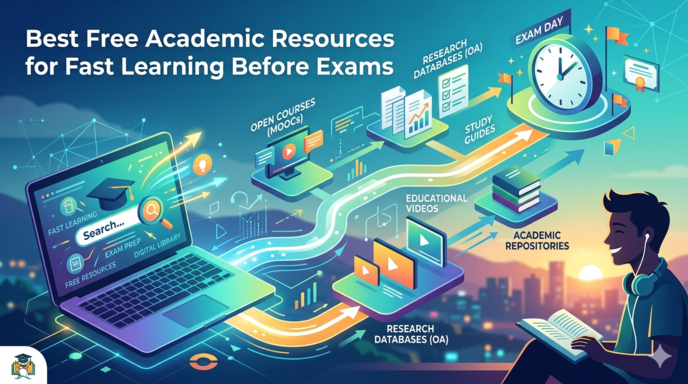
Best Free Academic Resources for Fast Learning Before Exams
When exams are approaching, many students make the mistake of trying to “cover everything.” That usually leads to panic, shallow reading, and poor retention. The smarter strategy is to focus on high-yield topics, practice the exact kind of questions that appear in exams, and identify weak areas quickly.
The good news is that you do not need expensive textbooks, private tutoring, or paid revision platforms to do this effectively. There are free academic resources that can help students learn faster and perform better if used strategically.
This guide explores the best free academic resources for fast learning before exams, explains how to combine them into a high-performance study system, and shows how to maximize your revision time in the final days or weeks before an exam.
1. What “Fast Learning” Really Means Before Exams
Fast learning does not mean rushing through materials.
It means learning in a way that gives the highest return on study time.
Before exams, “fast learning” is based on four principles:
1. Syllabus Targeting
Instead of studying every page, focus only on what the exam can test—especially the topics that carry the most marks or appear frequently.
This means prioritizing:
- Frequently tested chapters
- Core formulas and definitions
- Standard question types
- Examiner “favorite” topics
A student who studies strategically for 2 hours often outperforms one who studies randomly for 6.
2. Active Recall
Reading notes repeatedly feels productive, but it produces weak memory.
Active recall means forcing your brain to retrieve information through:
- Practice questions
- Flashcards
- Self-testing
- Writing answers from memory
This strengthens retention far faster than rereading.
3. Deliberate Practice
The fastest improvement comes from doing exam-style questions under pressure.
This develops:
- Accuracy
- Speed
- Familiarity with question patterns
- Confidence under timed conditions
4. Immediate Feedback
If you do not review mistakes quickly, errors repeat.
Fast learners improve by:
- Marking answers immediately
- Logging errors
- Reattempting missed questions
- Identifying weak patterns
This creates a tight learning loop that rapidly improves exam readiness.
2. The Three Types of Free Resources Every Student Needs
To learn quickly before exams, every student should use three categories of academic resources.
Without all three, revision becomes inefficient.
A. A Clear Explainer
This helps you understand the concept quickly.
Examples include:
- OpenStax
- Khan Academy
- CK-12
- MIT OpenCourseWare
These resources simplify difficult topics and explain concepts clearly.
Use them when:
- You are learning a topic for the first time
- You forgot a concept
- You need quick clarification
B. A Practice Resource
This converts knowledge into exam marks.
Examples:
- Textbook exercises
- Topic questions
- Practice banks
- Past papers
Understanding a concept is only half the job practice teaches you how that concept appears in exams.
C. An Exam Blueprint
This shows what matters most.
Examples:
- Syllabus guides
- Mark schemes
- Rubrics
- Examiner reports
These resources help you identify:
- Frequently tested areas
- Common mistakes
- Mark allocation
- Expected answer structure
This lets you study smarter.
3. Best Free Academic Resources for Fast Learning
A. Free Textbooks and Revision Books
These are best for structured learning.
They provide:
- Organized chapters
- Clear explanations
- Practice exercises
- Summary sections
They are excellent for quickly covering a syllabus.
OpenStax
Best for:
- Mathematics
- Physics
- Chemistry
- Biology
- Economics
- Psychology
- Sociology
Why it works fast:
OpenStax books are structured for learning efficiency. Each chapter includes:
- Definitions
- Worked examples
- Review questions
- Summaries
This helps students learn and practice in one place.
Fast-use tip:
Skip lengthy explanations. Focus on summaries, formulas, and review exercises.
CK-12
Best for:
- Middle school math
- High school science
- Quick concept refresh
Why it works fast:
Its explanations are shorter and easier to digest, making it ideal for last-minute review.
LibreTexts
Best for:
- STEM subjects
- Topic-specific revision
Why it works fast:
Instead of reading full chapters, students can jump directly to weak topics.
Open Textbook Library
Best for:
- Finding subject-specific textbooks quickly
Why it works fast:
Instead of searching randomly online, it gives access to organized free textbooks.
B. Free Video-Based Learning Platforms
Videos help students understand confusing concepts quickly.
They are useful when:
- You are stuck on a topic
- Reading feels slow
- You need visual explanation
Khan Academy
Best for:
- Math
- Science
- Economics
Why it works fast:
It combines:
- Short lessons
- Examples
- Practice exercises
This allows students to learn and test immediately.
Fast-use tip:
Watch at 1.25x to 1.75x speed and pause only for examples.
MIT OpenCourseWare
Best for:
- Advanced math
- Engineering
- Science
- Computer science
Why it works fast:
It offers:
- Lecture notes
- Practice sets
- Exams
This makes it ideal for university students.
OpenLearn
Best for:
- Quick structured modules
Why it works fast:
Short academic units help students focus on only what matters.
NPTEL
Best for:
- Engineering
- Computer science
- Management
Why it works fast:
It provides university-level explanations for technical subjects.
C. Past Papers and Official Practice Materials
This is the highest-impact resource category.
Nothing improves exam performance faster than practicing the actual style of questions you will face.
Why past papers are powerful:
They reveal:
- Repeated question patterns
- Important topics
- Marking methods
- Time pressure expectations
Students often discover that exams repeat the same logic with slightly different wording.
Best sources:
- Official exam board websites
- School portals
- Past paper repositories
- Mark schemes
- Examiner reports
Fast-use tip:
Start with topic-based past questions, then move to timed mixed papers.
D. Practice Problem Libraries
These help students build speed.
Paul’s Online Math Notes
Best for:
- Algebra
- Calculus
Why it works fast:
It combines short explanations with targeted practice.
OpenIntro
Best for:
- Statistics
Why it works fast:
It provides free statistical examples and exercises.
E. Free Writing and Study Skills Guides
For essay subjects, improving answer structure can boost marks rapidly.
Purdue OWL
Best for:
- Essays
- Grammar
- Academic writing
- Citations
Why it works fast:
It teaches students how to organize answers clearly.
University Learning Centers
Many universities publish excellent guides on:
- Active recall
- Revision planning
- Essay writing
- Time management
These are often practical and free.
F. Flashcards and Memory Tools
Retention is critical before exams.
Anki
Best for memorizing:
- Definitions
- Formulas
- Processes
- Vocabulary
Why it works fast:
It uses spaced repetition, which shows you information right before you are likely to forget it.
This improves long-term retention quickly.
Fast-use tip:
Create flashcards from:
- Mistakes in past papers
- High-yield facts
- Key formulas
This makes revision more targeted.
G. Free Resources by Subject
For Mathematics
Best stack:
- Khan Academy
- OpenStax
- Paul’s Notes
Focus on:
- Repeating methods
- Timed practice
- Formula application
Math improves fastest through repetition.
For Physics and Chemistry
Best stack:
- OpenStax
- LibreTexts
- Past papers
Focus on:
- Formula selection
- Units
- Standard setups
These subjects reward repeated problem patterns.
For Biology
Best stack:
- OpenStax
- LibreTexts
- Flashcards
Focus on:
- Definitions
- Processes
- Diagram recall
For Economics
Best stack:
- OpenStax
- CORE Econ
- Past questions
Focus on:
- Definitions
- Graphs
- Application questions
For Literature and English
Best stack:
- Purdue OWL
- Project Gutenberg
- Timed essay practice
Focus on:
- Thesis writing
- Quote banks
- Paragraph structure
For Computer Science
Best stack:
- MIT OCW
- freeCodeCamp
- MDN Docs
Focus on:
- Writing small programs
- Explaining concepts simply
4. The Best “Fast Learning Stack” Before Exams
To avoid overload, use one resource per purpose:
1 Main Explainer
Use one:
- OpenStax
- Khan Academy
- CK-12
1 Practice Source
Use:
- Past papers
- Textbook exercises
1 Retention Tool
Use:
- Anki
- Error log
This simple system prevents wasting time switching between too many resources.
5. The High-Impact Last-Minute Revision Method
This method works with any free resources.
Step 1: Build a High-Yield Checklist
List all topics.
Mark each as:
- High confidence
- Medium confidence
- Low confidence
Prioritize weak topics that are heavily tested.
Step 2: Use the 3-Pass Method
Pass A: Learn
Spend 10–20 minutes understanding the topic.
Use:
- OpenStax
- Khan Academy
Pass B: Practice
Spend 30–60 minutes solving questions.
Use:
- Exercises
- Past questions
Pass C: Recall
Spend 10 minutes reviewing mistakes and testing memory.
Use:
- Flashcards
- Error logs
This method turns every study session into measurable progress.
Step 3: Shift to Timed Mixed Practice
As exams get closer:
- Mix topics
- Use time limits
- Mark strictly
This builds exam readiness faster than passive review.
6. Common Mistakes That Waste Time
Using Too Many Resources
Switching between five platforms slows learning.
Fix: Pick one main source per subject.
Watching Without Practicing
Watching videos feels productive but gives weak retention.
Fix: Spend at least 50% of study time solving questions.
Ignoring Mistakes
Mistakes are where improvement happens.
Fix: Keep an error log and review it daily.
Cramming Without Recall
Reading without testing creates false confidence.
Fix: Use active recall every day.
Conclusion
The best free academic resources for fast exam preparation are the ones that combine:
- Clear explanations
- Strong practice
- Memory reinforcement
- Exam alignment
For most students, the most effective free study stack is:
Learn Fast
Use:
- OpenStax
- Khan Academy
- CK-12
Score Higher
Use:
- Official past papers
- Mark schemes
Remember More
Use:
- Anki
- Error logs
When exams are near, success is not about studying more it is about studying the right material in the right order.
With the right free resources and a focused revision system, students can improve quickly, retain more, and perform better without spending money.