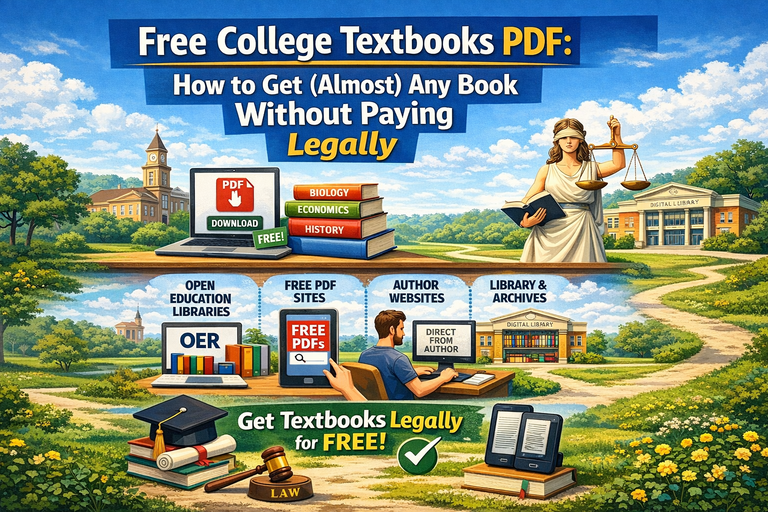
Free College Textbooks PDF: How to Get (Almost) Any Book Without Paying Legally
College textbooks can easily cost hundreds of dollars each semester. It’s no surprise that searches for “free textbook PDF” spike at the start of every term. But here’s the reality: many of those “free” downloads come from unauthorized sources that violate copyright laws and can expose you to malware, scams, or even academic penalties.
The good news? There are completely legal, reliable ways to get textbooks for free or very close to free. With the right strategy, you can often access everything you need without paying full price.
This guide walks you through the smartest, legitimate ways to get college textbooks without breaking the rules.
1) Start with Open Educational Resources (OER): Truly Free, Legal PDFs
Open Educational Resources (OER) are textbooks and learning materials released under open licenses (like Creative Commons). That means you can legally download, share, and use them for free.
Best OER textbook platforms
-
OpenStax
High-quality, peer-reviewed textbooks for subjects like biology, economics, physics, and math. -
Open Textbook Library
A large, searchable catalog organized by subject and course. -
BCcampus OpenEd
Strong collection for undergraduate courses, especially in business and social sciences. -
LibreTexts
Massive library for science and engineering topics, often with export-to-PDF options. -
OER Commons
Broad collection of textbooks, lesson plans, and course materials. -
MERLOT
Curated academic resources including some full textbooks. -
MIT OpenCourseWare
Not always full textbooks, but often provides lecture notes and readings that replace them.
How to use OER effectively
- Search by course title or subject (e.g., “Intro to Microeconomics open textbook”).
- Compare tables of contents, not just titles.
- Confirm the license (Creative Commons = safe to use).
- Download the PDF or use the online version.
2) Use Your College Library (More Powerful Than You Think)
You’re already paying for library access use it fully.
A) Course reserves
Many libraries keep required textbooks on short-term loan.
What to do:
Search by course code or ask at the circulation desk.
B) Library eBooks
Universities subscribe to platforms like:
- ProQuest Ebook Central
- EBSCO eBooks
- JSTOR
You can often:
- Read full books online for free
- Download chapters as PDFs (within limits)
C) Interlibrary Loan (ILL)
If your library doesn’t have the book, they can request it from another institution.
Tip: This works especially well for academic (non-commercial) texts.
3) Check Digital Libraries: Borrow Books Legally
Some platforms offer legal access to books through borrowing systems or public-domain collections.
-
Internet Archive (Open Library)
Offers time-limited borrowing of many textbooks. -
HathiTrust
Excellent for older or public-domain academic works.
Best for:
- Older editions
- Humanities and social science materials
- Supplementary readings
4) Look for Instructor Materials and Author-Sharing
Sometimes the fastest “free” route is through your professor or the author.
A) Instructor-provided materials
Professors may legally share:
- Scanned chapters (fair use)
- Library-linked readings
- Alternative free resources
Ask questions like:
- “Is an older edition acceptable?”
- “Are there free alternatives or library links?”
B) Author websites & repositories
Many authors share:
- Preprints (common in STEM)
- Book chapters
- Full drafts (occasionally)
Where to check:
- University faculty pages
- Institutional repositories
- Subject-specific archives (e.g., arXiv)
5) Use Public Libraries + Apps
Your local public library can be surprisingly helpful especially for general education courses.
Popular library apps
- Libby
- Hoopla
Best for:
- Literature and novels
- Writing and communication textbooks
- Popular nonfiction used in courses
6) Ask for an Older Edition (Huge Savings)
This isn’t a free PDF but it’s one of the smartest cost-cutting strategies.
How to do it
-
Email your professor:
“Is the previous edition acceptable if I follow the same chapters?” - Compare tables of contents.
- Verify using ISBN numbers.
Reality:
Older editions are often 90% identical, with only minor changes.
7) Use Campus Support Programs
Many schools quietly offer textbook support but students rarely take advantage.
Look for:
- Textbook lending libraries
- Department loaner copies
- Emergency grants
- Basic needs centers
- TRIO / first-generation student programs
Action step:
Search your school website for:
- “Textbook assistance”
- “Student emergency fund”
- “Basic needs support”
8) Accessibility Services Can Provide PDFs
If you have a documented need (e.g., visual impairment, dyslexia), your school’s accessibility office can:
- Provide screen-reader-friendly PDFs
- Convert textbooks into accessible formats
- Obtain digital copies through approved channels
This is a fully legitimate and often fast option.
9) A Simple Workflow to Find Free Textbooks (Fast)
Follow this order to maximize your chances:
- Search OER platforms (OpenStax, Open Textbook Library, LibreTexts)
- Check your campus library (reserves + eBooks)
- Ask your professor about alternatives or older editions
- Use Interlibrary Loan
- Try Internet Archive or HathiTrust
- Check public library apps (Libby, Hoopla)
- Use campus financial support if needed
10) Why “Free Textbook PDF” Sites Are Risky
Unauthorized textbook sites often come with serious downsides:
- Copyright infringement risks
- Malware and phishing scams
- Fake download buttons
- Incomplete or incorrect editions
Even if the file looks legitimate, it may be unsafe or illegal.
FAQ
Can I get any textbook for free as a PDF?
Not always. Some books are freely available through OER or libraries, but many commercial textbooks still require purchase or licensed access.
What if my course requires an access code?
Access codes are usually sold separately and rarely free. Ask your instructor if:
- It’s optional
- There’s a no-code alternative
What’s the best place to start?
Start with OpenStax for introductory courses, then check your campus library for everything else.
Final Thoughts
Getting textbooks for free legally isn’t about one magic website it’s about using a smart combination of resources. OER platforms, libraries, instructors, and public tools can cover most (if not all) of your needs.
If you follow the strategies in this guide, you’ll spend less, avoid risks, and still get the same quality education without cutting corners.