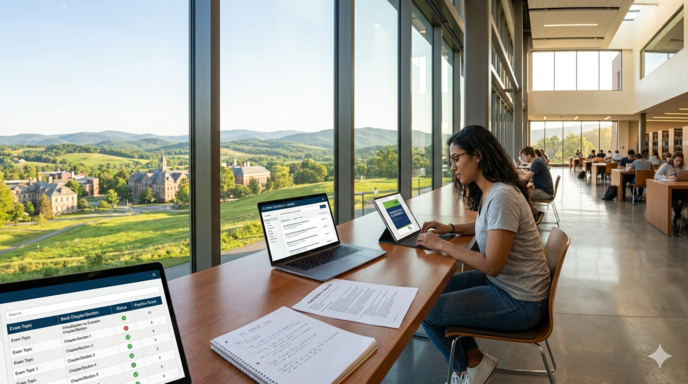
Free Study Materials for University Students (All Courses Covered)
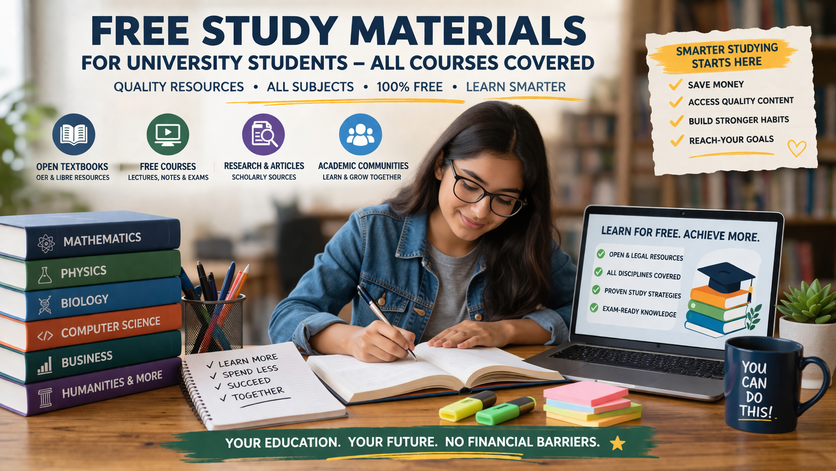
University costs can rise quickly tuition, accommodation, and especially textbooks. But here’s the good news: your learning resources don’t have to drain your budget. With the right strategy, you can access high-quality, legal, and completely free study materials across virtually every discipline.
This guide is your comprehensive master list covering where to find free materials, how to choose the best ones, and how to turn them into real academic success.
1) Start with Your University Library (Your #1 Resource)
Your university library is often the most powerful and most underused tool you already have access to.
What to use first:
- Course reserves (print or digital): Professors often upload required textbooks or key readings.
- E-book collections: Search by title, author, or ISBN.
- Interlibrary loan (ILL): Request books or scans from other institutions usually free.
- Subject databases: Access journals, encyclopedias, and discipline-specific materials.
- Library guides (LibGuides): Curated resources tailored to your department.
Pro Tip:
If your course lists a $200 textbook:
- Check for the exact edition
- Look for an older edition
- Find a similar e-book covering the same topics
2) Best Sites for Free Textbooks (OER)
Open Educational Resources (OER) are legally free textbooks often licensed under Creative Commons.
Top platforms:
- OpenStax – Excellent for introductory STEM, economics, and psychology
- LibreTexts – Massive library across science, math, and engineering
- Open Textbook Library – Peer-reviewed academic texts
- BCcampus OpenEd – High-quality textbooks used in real courses
- OER Commons – Broad multidisciplinary catalog
- DOAB (Directory of Open Access Books) – Academic books across fields
How to choose quickly:
Match your syllabus topics with the textbook’s table of contents.
If 70–80% aligns, it’s good enough to use as your main resource.
3) Free Full Courses (Lectures, Notes, Exams)
Sometimes you need more than a textbook you need a full course structure.
Best platforms:
- MIT OpenCourseWare (OCW) – Complete courses with notes, assignments, and exams
- OpenLearn – Short, structured courses
- Saylor Academy – Free courses in business, tech, and humanities
- NPTEL – Strong engineering and science lectures
- edX / Coursera – Many courses are free to audit
Why this matters:
If your professor moves fast, these platforms can act as your backup instructor.
4) Free Research Articles and Academic Books
For essays, lab reports, and projects, scholarly sources are essential.
General tools:
- Google Scholar – Look for free PDFs
- CORE – Aggregated open-access papers
- Unpaywall – Finds legal free versions of articles
- DOAJ – Fully open-access journals
Preprint servers:
- arXiv – Physics, math, computer science
- bioRxiv / medRxiv – Biology and medicine
- SSRN – Social sciences, law, business
- RePEc – Economics
Field-specific:
- PubMed / PubMed Central – Biomedical research
- ERIC – Education research
5) Subject-by-Subject Free Resources
Here’s a curated list of high-impact resources for each discipline:
A) Mathematics & Statistics
- Open textbooks (OpenStax)
- MIT OCW (problem sets + exams)
- Paul’s Online Math Notes
- Tools: GeoGebra, Desmos, Python, R
B) Physics
- OpenStax University Physics
- MIT OCW
- PhET Simulations
C) Chemistry
- OpenStax Chemistry
- ChemLibreTexts
- PhET Simulations
D) Biology & Health Sciences
- OpenStax Biology, Microbiology
- NCBI Bookshelf
- PubMed Central
E) Engineering
- MIT OCW
- NPTEL lectures
- Tools: Python, GNU Octave, KiCad, FreeCAD, LTspice
F) Computer Science & IT
- CS50 (Harvard)
- MIT OCW
- freeCodeCamp
- MDN Web Docs
- Tools: VS Code, Git, Linux
G) Business, Finance, Economics
- OpenStax Economics
- Saylor Academy
- RePEc
- FRED (economic data)
H) Social Sciences
- Open textbooks
- DOAJ + Google Scholar
- Our World in Data
I) Humanities (History, Philosophy, Literature)
- Project Gutenberg
- Internet Archive
- Stanford Encyclopedia of Philosophy
- Purdue OWL
J) Law
- Government legal portals
- SSRN
- Open-access law reviews
K) Education
- ERIC database
- OER Commons
- University repositories
6) Free Tools That Replace Paid Study Systems
Memorization:
- Anki (spaced repetition)
- Self-quizzing documents
Writing & citations:
- Zotero (reference manager)
- Overleaf (LaTeX editor)
- Purdue OWL (formatting guide)
Data & coding:
- Google Colab
- Jupyter Notebook
- RStudio
7) How to Find Free Materials for Any Course
When resources aren’t obvious, use smart search strategies:
Effective search queries:
"topic" "open textbook"site:libretexts.org topicfiletype:pdf "CC BY" topic- Search by ISBN
Bonus tip:
Many professors upload free versions of their books:
- University pages
- Institutional repositories
- Personal websites
8) Turn Free Materials Into Exam Success
Having resources isn’t enough you need a system.
Use this study method:
- Map your syllabus
→ Match topics to chapters - Active recall
→ Close your book and write what you remember - Practice under pressure
→ Use problem sets and exams - Keep an error log
→ Track mistakes and corrections - Spaced repetition
→ Review after 2–3 days, then weekly
This method is far more effective than passive reading.
9) Avoid Pirated PDFs and Unsafe Sites
It may be tempting, but pirated materials can be:
- Illegal
- Incomplete or inaccurate
- Bundled with malware
Safer alternatives:
- Library access
- OER platforms
- Open-access databases
- Ask your professor for alternatives
10) Your Ready-to-Use “Free Materials Kit”
Start today with this simple plan:
- Review your syllabus and list topics
- Choose one free textbook (OpenStax/LibreTexts)
- Add a practice source (MIT OCW/NPTEL)
- Set up Zotero for citations
- Use Anki for memorization
- Book a librarian consultation if needed
- Final Thoughts
Free study materials are not just a backup they can be just as powerful (or even better) than paid resources when used correctly. The key is knowing where to look and how to study effectively.
With the tools and strategies in this guide, you can build a complete, high-quality learning system without spending a dime.