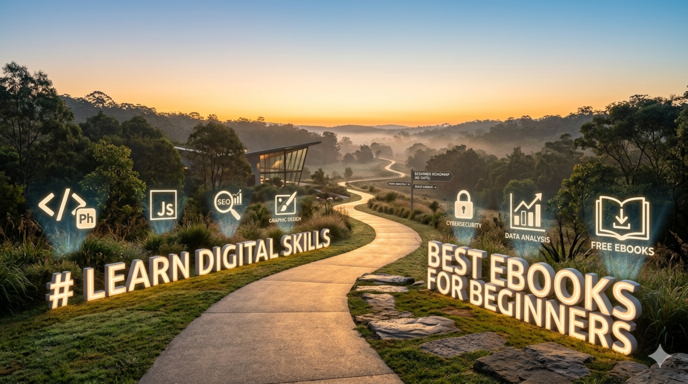
Learn Digital Skills for Free: The Ultimate 2026 Guide to Beginner eBooks
In 2026, the barrier to entry for a high-paying tech or creative career has never been lower. Digital skills are no longer just "nice-to-haves" they are the primary currency of the global economy. Whether you’re looking to escape the 9-to-5, launch a freelance side hustle, or future-proof your resume, the knowledge you need is available for zero dollars.
You don’t need a four-year degree or a $2,000 bootcamp to get started. High-quality, industry-standard eBooks written by experts are available for free online. This guide breaks down the best resources to help you master the digital landscape this year.
🚀 Why Digital Skills Matter in 2026
The digital economy has shifted toward skill-based hiring. Employers and clients care less about where you learned and more about what you can execute. Mastering these skills allows you to:
Work from Anywhere: Join the global remote workforce.
Scale Your Income: Digital roles typically offer higher starting salaries and freelance rates.
Adaptability: Stay relevant as AI and automation reshape traditional industries.
1. Programming & Coding
Coding remains the "superpower" of the digital age. It’s the foundation for everything from apps to automation.
ðŸ Automate the Boring Stuff with Python Al Sweigart
Best For: Complete novices who want immediate results.
Key Learnings: Python syntax, web scraping, and automating Excel/PDF tasks.
The Edge: It skips the heavy computer science theory and moves straight to "how can I make my computer do my work for me?"
🌠Eloquent JavaScript Marijn Haverbeke
Best For: Aspiring web developers.
Key Learnings: Logic, control flow, and DOM manipulation.
The Edge: Often called the "Bible of JavaScript," it includes interactive coding sandboxes in the digital version.
🌿 Pro Git Scott Chacon & Ben Straub
Best For: Anyone wanting to work in a professional dev team.
Key Learnings: Version control, branching, and GitHub.
The Edge: You can't work in tech without Git. This book is the gold standard for learning how to manage code.
2. Web Development (HTML & CSS)
Web development is the most accessible "entry point" into tech.
HTML & CSS Basics (OER): Focuses on the structural bones of the internet. Learn responsive design so your sites look great on smartphones and desktops alike.
You Don’t Know JS (Kyle Simpson): Once you’ve mastered the basics, this series dives into the "why" behind the code, turning you from a coder into a developer.
3. Digital Marketing & Content Strategy
Marketing in 2026 is data-driven and person-centered.
HubSpot Academy eBooks: They offer a massive library on Inbound Marketing and Content Strategy. These are highly practical and updated frequently to reflect current SEO trends.
Google Digital Garage: Their "Fundamentals of Digital Marketing" guide is essential for understanding the ecosystem of search engines and social media advertising.
Scientific Advertising (Claude Hopkins): Though written decades ago, this is the foundation of modern Copywriting. It teaches you how to write words that sell.
4. Data Science & Analytics
Data is the "new oil," and those who can interpret it are highly compensated.
Python Data Science Handbook (Jake VanderPlas): A comprehensive guide to using Python for data manipulation (Pandas) and visualization (Matplotlib).
Think Stats (Allen Downey): Perfect for those who want to understand the probability and logic behind data, rather than just clicking buttons in a program.
5. Graphic Design & Visual Communication
In a visual-first world, design is a critical skill for marketers and creators.
Canva Design School: Their eBooks simplify complex concepts like Color Theory and Typography for non-designers.
UX Design Guides (Various Open Source): Learn the basics of User Experience how to design apps and sites that are intuitive and easy to use.
6. Cybersecurity
As our lives move further online, the need for "digital police" has skyrocketed.
Open Security Training: Provides introductory modules on Cryptography and Network Defense.
NIST Framework Guides: This is the industry standard for risk management. Understanding this makes you an asset to any corporate IT department.
7. Freelancing & The "Solo-preneur" Mindset
Skills are useless if you don't know how to sell them.
The $100 Startup (Chris Guillebeau): Teaches you how to turn a hobby or skill into a business with minimal investment.
Upwork/Fiverr Success Guides: These platforms offer free internal eBooks on how to write winning proposals and build a 5-star reputation.
📂 Where to Download Legally
Don't pirate books; use these legitimate, free sources:
Project Gutenberg: For classic texts on logic and marketing.
Open Library (archive.org): A massive digital lending library.
Author Websites: Many tech authors (like Al Sweigart and Kyle Simpson) offer their books for free online to support the community.
Libby/OverDrive: Use your local library card to borrow the latest digital skills books on your phone.
ðŸ› ï¸ Your 90-Day Execution Strategy
| Timeline | Goal | Focus |
| Month 1 | Foundations | Pick one skill (e.g., Python). Read the beginner eBook and do every exercise. |
| Month 2 | Application | Build 3 "ugly" projects. A basic website, a simple script, or a mock marketing plan. |
| Month 3 | Professionalism | Learn Git, set up a LinkedIn/GitHub portfolio, and start networking in your chosen field. |
Final Thoughts
The difference between where you are now and where you want to be in 2027 is the information you consume and the consistency of your practice. The cost of entry is no longer a barrier only your discipline remains. Pick one book from this list today and read the first chapter. Your future self will thank you.