
Best Free Learning Resources for Secondary School Students
Secondary school is a critical stage where strong academic habits can shape your exam results, confidence, and future opportunities. You’re building foundations in mathematics, science, reading, writing, and problem-solving and the good news is that you don’t need expensive tutoring or paid apps to succeed.
There are powerful, completely free learning resources created by universities, educators, public institutions, and global platforms. This guide breaks down the best ones by subject and purpose and shows you how to use them effectively.
1) The Best All-in-One Free Learning Platforms
If you want a single place to start, these platforms cover multiple subjects and grade levels.
Khan Academy
Best for: Math, science, computing
Why it stands out:
- Step-by-step explanations
- Thousands of practice questions
- Progress tracking and mastery system
How to use it:
Use daily for math practice and to fill gaps after school lessons.
BBC Bitesize
Best for: English, maths, science, humanities
Why it stands out:
- Short, exam-focused lessons
- Quick quizzes and summaries
Tip: Perfect for last-minute revision before tests.
CK-12 Foundation
Best for: Math and science
Why it stands out:
- Free digital textbooks (“FlexBooks”)
- Interactive practice and simulations
Tip: Use it like a structured textbook aligned with your syllabus.
OpenStax
Best for: Advanced secondary students
Why it stands out:
- High-quality, university-level textbooks
- Free and legally accessible
Tip: Ideal for students preparing for advanced exams or bridging to university.
2) Best Free Resources by Subject
Mathematics
Math improves fastest through consistent practice and feedback.
Top tools:
- Khan Academy
- Desmos
- GeoGebra
Smart strategy:
- Practice 20–40 minutes daily
- Keep an error log (track mistakes and why they happened)
Physics
Physics requires both conceptual understanding and problem-solving.
Top tools:
- Khan Academy
- CK-12 Foundation
- PhET Interactive Simulations
- OpenStax
Smart strategy:
Use simulations (like PhET) to visualize concepts, then practice mixed questions.
Chemistry
Chemistry becomes easier when you connect theory with calculations.
Top tools:
- Khan Academy
- CK-12 Foundation
- PhET Interactive Simulations
- LibreTexts
Smart strategy:
Create one-page summaries for each topic (formulas, reactions, definitions).
Biology
Biology combines understanding processes with memorization.
Top tools:
- Khan Academy
- CK-12 Foundation
- Amoeba Sisters
- Crash Course Biology
Smart strategy:
Turn topics into questions and test yourself regularly.
English / Language Arts
Strong literacy improves performance in every subject.
Top tools:
- CommonLit
- Project Gutenberg
- Purdue OWL
- BBC Bitesize
Smart strategy:
Use structured writing methods like PEEL (Point, Evidence, Explain, Link).
History / Geography / Social Studies
These subjects reward structure and clear explanations.
Top tools:
- BBC Bitesize
- Crash Course
- National Geographic
Smart strategy:
Practice writing structured answers:
Claim → Evidence → Explanation → Link
Computer Science / Coding
Coding is best learned through practice and projects.
Top tools:
- CS50
- freeCodeCamp
- Scratch
- MDN Web Docs
Smart strategy:
Build small projects (e.g., quiz app, calculator, simple game).
3) Best Free Resources for Exam Preparation
The most valuable exam prep tools are often free:
- Past exam papers
- Marking schemes
- Examiner reports
- Official syllabus/specifications
How to use them:
- Attempt under timed conditions
- Mark using the official scheme
- Identify mistakes
- Practice similar questions again
This builds real exam confidence and accuracy.
4) Free Study Tools That Boost Learning Speed
Flashcards (Spaced Repetition)
- Anki
- Quizlet
Use for:
- Definitions
- Formulas
- Biology processes
- Vocabulary
Note-Taking & Organization
- Google Docs
- Microsoft Office Online
- Notion
Time Management
Use a simple system:
- 25 minutes study
- 5 minutes break (Pomodoro technique)
Focus on what you complete, not just time spent.
5) How to Use Free Resources Without Getting Overwhelmed
Too many tools can slow you down. Keep it simple.
Use the “3-Layer System”:
-
Core Resource (main learning)
- Example: Khan Academy
-
Practice Resource
- Example: Past papers, CK-12
-
Support Resource
- Example: PhET or YouTube explanations.
Weekly Study Routine
Mon–Thu:
- Learn + short practice (30–60 min)
Fri/Sat:
- Longer practice or timed test (60–120 min)
Sun:
- Review mistakes + flashcards (30–60 min)
6) Quick “Best Picks” (Start Here)
If you only choose a few:
- Khan Academy
- BBC Bitesize
- CK-12 Foundation
- PhET Interactive Simulations
- Anki
- Past papers + marking schemes
7) Safety and Quality Tips
- Use trusted sources (universities, official platforms, known educators)
- Avoid suspicious “free PDF” websites
- Cross-check important information
- Combine videos with practice questions (don’t rely on watching alone)
Final Thought
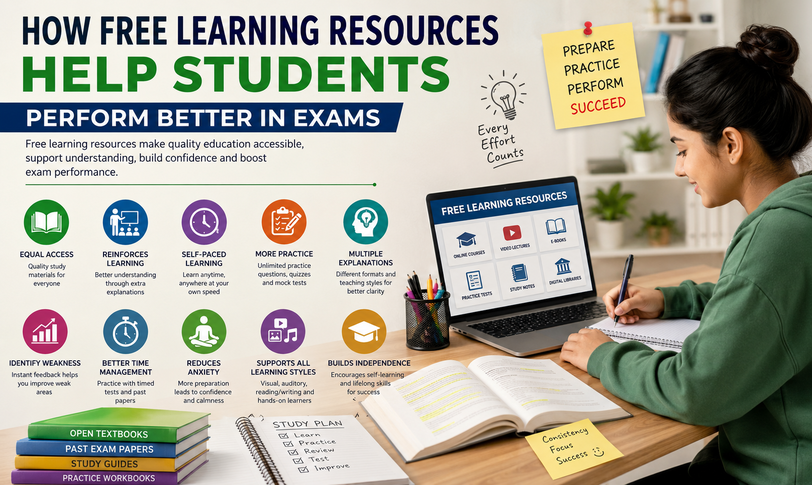
Free learning resources today are powerful enough to replace expensive textbooks and tutoring but results depend on how you use them.
Focus on:
- Active practice
- Consistent review
- Learning from mistakes
With a simple routine and a few reliable tools, any secondary school student can achieve excellent academic results without spending money.