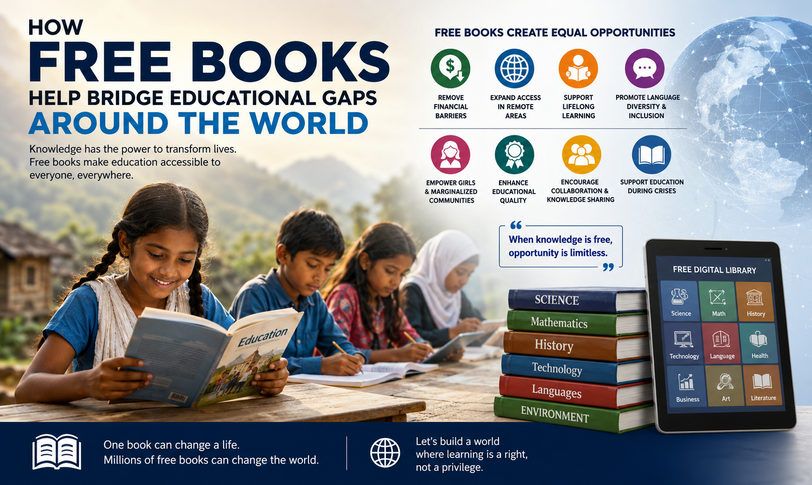
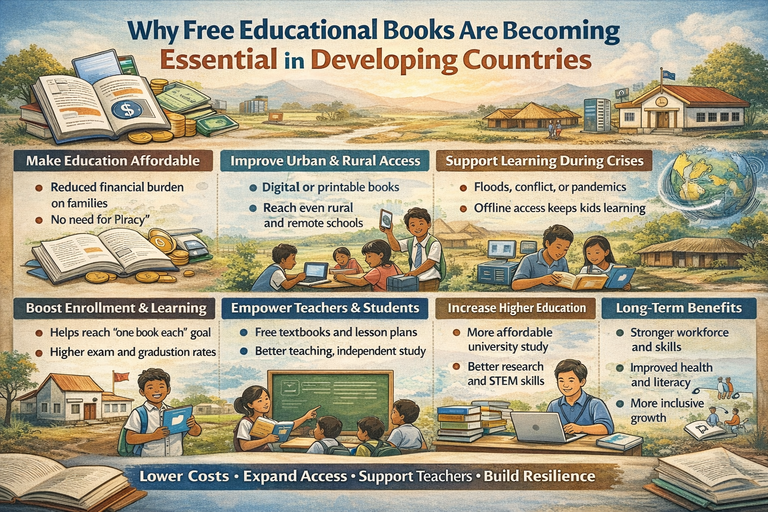
Free educational books especially open textbooks and legally shared learning resources are rapidly shifting from a helpful option to an essential pillar of education systems in developing countries. As demand for education grows and traditional textbook models become increasingly expensive, governments, educators, and students are turning to open and freely available resources to close learning gaps.
These resources include open textbooks, public-domain materials, and legally shared academic content that can be downloaded, shared, printed, and reused without costly licensing restrictions. When implemented effectively, they can dramatically reduce education costs, expand access to learning materials, improve teaching quality, and strengthen educational resilience during crises.
This article explores why free educational books are becoming so important, what benefits they offer in low-resource environments, the challenges involved, and how institutions can successfully adopt them.
1. The Cost Barrier Is Growing and Students Feel It Most
Textbooks Are Often Unaffordable Relative to Income
In many developing countries, educational expenses consume a large share of household income. When textbooks are imported or priced according to wealthier markets, the cost can become prohibitive.
As a result, students often face difficult compromises:
-
Several students share one textbook
-
Teachers rely heavily on handwritten notes
-
Students cannot practice exercises independently
-
Learning becomes more memorization-based instead of analytical
Free educational books remove one of the largest recurring education costs, allowing families to allocate their limited resources toward other necessities like transportation, meals, or internet access.
Hidden Education Costs Make the Problem Worse
Even when tuition is subsidized or free, families often pay additional costs such as:
-
Examination fees
-
School uniforms
-
Transportation to school
-
Stationery and printing
-
Mobile data for online learning
Eliminating textbook costs can significantly reduce the overall financial burden of schooling.
2. Enrollment Is Rising Faster Than Textbook Supply
Over the past two decades, many developing countries have successfully expanded access to education. More students are enrolling in:
-
Primary schools
-
Secondary schools
-
Universities and technical institutions
However, textbook procurement systems often struggle to keep up. Traditional publishing and distribution models involve complex processes such as:
-
Government procurement cycles
-
Printing and shipping logistics
-
Distribution to rural schools
-
Replacement of damaged or lost books
Free digital textbooks solve many of these problems. Once created, they can be copied and distributed instantly at near-zero cost, making it far easier to scale educational access.
3. Free Books Help Close Urban–Rural Learning Gaps
Rural Schools Face Greater Shortages
Students in remote areas often face severe textbook shortages due to:
-
Long distribution delays
-
Limited local bookstores
-
Few libraries or photocopy centers
-
Higher transportation costs
Digital and printable free books allow rural schools to access the same materials available in urban schools.
Offline distribution methods such as USB drives, memory cards, or local school servers—can deliver thousands of books without requiring continuous internet access.
Removing Paywalls Improves Equity
When learning materials are locked behind paywalls, wealthier students gain a clear advantage. Free educational books help move systems closer to the ideal of:
-
One learner, one book
-
Equal access to study materials
-
Fair preparation for national examinations
Education becomes more merit-based rather than income-based.
4. Smartphones Are Becoming the New Library Card
In many developing regions, personal computers remain rare. However, smartphone adoption has grown dramatically.
This shift is transforming how students access information:
-
A free textbook can be downloaded directly to a phone
-
Files can be stored on inexpensive memory cards
-
Reading apps allow highlighting and note-taking
-
Offline reading is possible after download
Even when internet connectivity is limited, a single download can allow thousands of students to access the same book.
While smartphones do not completely eliminate the digital divide, they significantly lower the cost of accessing educational materials.
5. Free Books Support Learning During Crises
Educational disruptions are common in many parts of the world. These disruptions may be caused by:
-
Natural disasters such as floods or earthquakes
-
Political instability or conflict
-
Disease outbreaks
-
Teacher strikes
-
Extreme weather events
The global education crisis during the COVID-19 pandemic demonstrated how fragile traditional classroom systems can be.
When students already have access to free educational books especially digital ones they can continue learning independently even when schools close temporarily.
Governments can also distribute updated materials quickly without waiting for long printing and procurement cycles.
6. Open Educational Books Can Be Localized
Traditional textbooks often fail to reflect the realities of students in developing countries.
Open educational resources allow educators to adapt and localize content, improving relevance and understanding.
Language Accessibility
Many learners study in multilingual environments. Open textbooks can be:
-
Translated into local languages
-
Adapted for bilingual education
-
Simplified for students transitioning between languages
This improves comprehension and classroom participation.
Cultural and Contextual Relevance
Open books can incorporate local examples such as:
-
Regional history and literature
-
Local agriculture and economic systems
-
Community health practices
-
Local geography and environmental issues
Students learn more effectively when content reflects their own environment and experiences.
7. Free Books Improve Teaching Quality
In schools without textbooks, teachers often spend significant time creating their own notes or improvised teaching materials.
Free educational books can provide teachers with:
-
Structured lesson content
-
Exercises and practice questions
-
Visual diagrams and explanations
-
Glossaries and summaries
-
Additional resources for struggling students
These materials act as instructional support, especially in areas where teachers have limited training or access to professional development.
8. Free Resources Strengthen Universities and Research
Higher education institutions in developing countries often face limited budgets for textbooks and academic journals.
Open resources help universities by:
-
Expanding access to foundational textbooks
-
Supporting independent learning
-
Providing up-to-date academic research
-
Strengthening research literacy among students
Open access research platforms such as Directory of Open Access Journals and PubMed Central allow students and researchers to access high-quality studies without subscription fees.
This is particularly important in fields like:
-
Medicine
-
Engineering
-
Teacher education
-
Environmental science
-
Agriculture
These disciplines directly affect national development outcomes.
9. Free Does Not Mean Low Quality
One common misconception is that free educational materials must be inferior. In reality, many open textbooks are developed through rigorous academic processes.
High-quality open educational books often include:
-
Peer review by subject experts
-
Alignment with national curricula
-
Professional editing and formatting
-
Practice exercises and worked examples
-
Periodic updates and revisions
Many open publishing models follow similar workflows to traditional publishers but remove the paywall.
10. The Economics Favor Open Resources
At national scale, free educational books often cost less over time than traditional textbook procurement.
Lower Long-Term Costs
Instead of repeatedly purchasing restricted textbooks, governments can invest in:
-
Content creation and peer review
-
Translation and localization
-
Digital distribution platforms
-
Teacher training programs
-
Print-on-demand copies for schools
Once developed, open books can be reused for years with minor updates.
Greater Transparency
Open licensing allows governments and donors to fund the creation of educational content without becoming dependent on single commercial vendors.
This can help prevent inflated pricing and encourage collaborative improvement of materials.
11. Free Books Reduce the Need for Piracy
When students cannot afford textbooks, piracy often becomes widespread. Pirated copies frequently have serious problems:
-
Missing pages or poor scanning quality
-
Outdated editions
-
Typographical errors
-
Malware from unsafe download sites
Providing legitimate free alternatives helps students access materials safely and legally, reducing the need for unauthorized sharing.
12. Challenges That Must Be Addressed
Despite their benefits, free educational books require thoughtful implementation.
Internet and Device Inequality
Possible solutions include:
-
Offline access and downloads
-
School-based digital libraries
-
Local servers or Wi-Fi hotspots
-
Subsidized printed copies
Teacher Training
Teachers need guidance on:
-
Integrating open books into lessons
-
Aligning materials with curriculum standards
-
Using digital resources effectively
Sustainability
Open textbooks must be maintained through:
-
Editorial oversight
-
Version control
-
Funding for periodic updates
Accessibility
Books should be designed for learners with disabilities through:
-
Screen-reader compatible formats
-
Adjustable fonts
-
High-contrast layouts
-
Image descriptions
13. Practical Steps for Successful Adoption
For Governments
-
Adopt national Open Educational Resource (OER) policies
-
Fund development of open textbooks aligned with curricula
-
Require open licensing for publicly funded materials
-
Improve distribution systems for rural schools
For Schools and Teachers
-
Curate approved lists of free textbooks
-
Combine digital and printed materials
-
Encourage structured reading and study habits
For NGOs and Donors
-
Support translation and localization
-
Invest in offline digital libraries
-
Provide teacher training and technical support
For Universities
-
Encourage faculty to adopt or write open textbooks
-
Host institutional repositories
-
Train students to find and cite open resources
14. Free Books as Educational Infrastructure
Educational materials are more than just classroom tools they are development infrastructure.
Free educational books support:
-
Faster workforce skill development
-
Greater literacy and health awareness
-
Increased research capacity
-
Reduced inequality in education access
In developing countries, removing textbook cost barriers may be one of the most cost-effective ways to expand learning opportunities.
Conclusion
Free educational books are becoming essential in developing countries because they address the most pressing challenges in modern education: affordability, access, equity, and resilience.
When combined with strong quality standards, teacher training, localization, and offline distribution systems, open and free learning resources can dramatically expand educational opportunities.
By lowering costs and removing barriers to knowledge, these resources allow millions of students to pursue education without forcing families to choose between learning and basic survival needs.
In the long term, expanding access to free educational books does more than help individual learners it strengthens entire societies by making knowledge truly accessible to everyone.