Free Educational Resources That Replace Expensive Textbooks
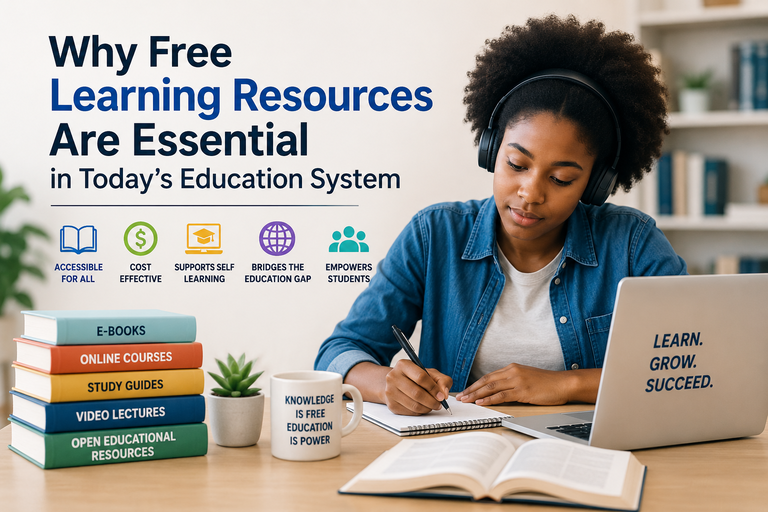
Across more than a decade of research, the academic consensus is clear: free educational resources especially Open Educational Resources (OER) can replace traditional textbooks without harming learning outcomes and often improving access and equity. Multiple large-scale and meta-analytic studies show that students using OER perform as well as or better than peers using commercial textbooks, while saving substantial costs.
Crucially, the biggest advantage is not just cost savings it is universal access from day one, which improves participation, retention, and course completion, particularly among lower-income students. At the same time, research highlights ongoing challenges such as uneven quality, discoverability, and gaps in specialized subjects.
1. Why Textbooks Are So Expensive
The modern textbook market is structurally different from normal book markets. Students rarely choose what they buy instructors do which reduces price competition.
Key drivers of high costs include:
- Constant release of new editions
- Bundled digital access codes
- Limited competition in niche academic fields
- Publisher-controlled ecosystems
- Institutional inertia favoring established brands
Research confirms that these factors create a system where prices rise without proportional improvements in learning outcomes.
2. What Are Free Educational Resources?
Free educational resources include any learning material available at no cost. The most powerful category is:
Open Educational Resources (OER)
OER are materials with open licenses that allow:
- Reuse
- Modification
- Redistribution
This flexibility enables custom, course-specific textbooks, something impossible with traditional publishing models.
Other categories include:
- Open textbooks
- MOOCs (Massive Open Online Courses)
- Lecture notes and courseware
- Educational video platforms
- Open-access journals
- Public-domain libraries
3. The Rise of OER: A Structural Shift in Education
OER is not just a cost-saving trend it is a systemic transformation of knowledge access.
Research shows:
- OER adoption significantly reduces student expenses without lowering performance (Hilton, 2020)
- Students often achieve equivalent or better outcomes compared to traditional textbooks (Clinton, 2019)
- OER improves equity and completion rates, especially for underserved groups (Colvard et al., 2018)
The key innovation is pedagogical flexibility: instructors can remix and adapt content to match their teaching goals.
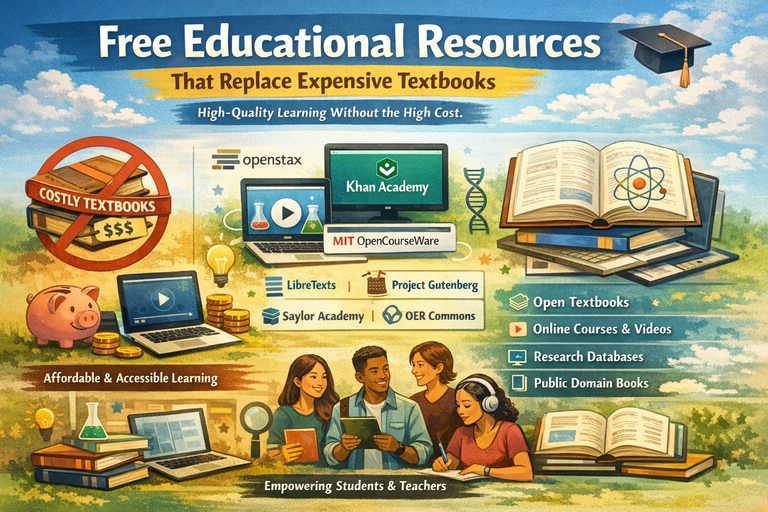
4. Best Free Educational Resources That Replace Textbooks
4.1 OpenStax
One of the most trusted OER providers, offering peer-reviewed, full textbooks aligned with college curricula.
- Subjects: STEM, social sciences, business, humanities
- Features: free PDFs, low-cost print versions, instructor resources
- Strength: direct one-to-one replacement for textbooks
4.2 MIT OpenCourseWare
Provides full course materials from MIT.
- Includes: lecture notes, assignments, exams
- Best for: engineering, math, computer science
- Advantage: goes beyond textbooks into full course design
4.3 Khan Academy
A global leader in free education.
- Strengths: math, science, economics
- Features: videos, exercises, adaptive learning
- Best use: concept mastery and practice
4.4 LibreTexts
A modular OER platform designed for customization.
- Strong in: STEM fields
- Advantage: instructors can build custom textbooks
- Includes interactive and digital-first content
4.5 Project Gutenberg
A massive library of public-domain works.
- Best for: literature, philosophy, history
- Strength: primary sources and classic texts
4.6 Internet Archive
A digital library with millions of resources.
- Includes: textbooks, historical documents, multimedia
- Unique feature: controlled digital lending
4.7 Saylor Academy
Offers structured, free courses.
- Includes: readings, assessments, credentials
- Best for: self-paced learners
4.8 OER Commons
A meta-platform aggregating OER globally.
- Strength: discoverability across disciplines
- Includes: lesson plans, textbooks, modules
4.9 BCcampus Open Education
High-quality Canadian OER initiative.
- Peer-reviewed textbooks
- Strong instructor support
- Widely used in higher education
4.10 Open Research Databases
For advanced learners:
- PubMed (biomedical research)
- DOAJ (open-access journals)
- arXiv (STEM preprints)
- ERIC (education research)
These replace textbooks in upper-level and graduate study.
5. How Free Resources Compare to Traditional Textbooks
Advantages
- Cost: eliminates major financial burden
- Access: immediate, universal availability
- Flexibility: customizable content
- Interactivity: videos, simulations, quizzes
- Updatability: faster revisions
Limitations
- Variable quality
- Gaps in niche subjects
- Less publisher-provided support materials
- Requires digital access
Research consistently shows no significant difference in learning outcomes, despite these trade-offs.
6. Subjects Where Free Resources Excel
Mathematics
- OpenStax, Khan Academy, MIT OCW
- Strongest OER coverage overall
Science
- LibreTexts, PhET simulations
- Highly interactive learning environments
Computer Science
- Harvard CS50, freeCodeCamp
- Industry-aligned and frequently updated
Humanities
- Project Gutenberg, Internet Archive
- Rich access to primary texts
Social Sciences
- OpenStax, OER Commons
- Increasing availability of peer-reviewed materials
7. Benefits for Students
- Immediate access to materials
- Reduced financial stress
- Flexible learning formats
- Lifelong availability
- Improved academic performance through access
Studies show that students who previously could not afford textbooks benefit the most, often improving completion rates.
8. Benefits for Teachers and Institutions
- Higher student preparedness
- Customizable course design
- Lower dropout rates
- Institutional cost savings
OER adoption is increasingly supported by universities and governments worldwide.
9. Challenges and Limitations
- Quality inconsistency across platforms
- Discovery difficulty due to abundance
- Limited coverage in specialized fields
- Digital divide issues
However, systematic reviews show these barriers are gradually decreasing as OER ecosystems mature.
10. How to Use Free Resources Effectively
For Students:
- Check syllabus early
- Combine multiple platforms
- Verify topic alignment
- Download offline copies
For Teachers:
- Start with high-enrollment courses
- Mix OER with existing materials
- Collaborate with librarians
- Gradually transition
11. The Future of Textbook-Free Education
Emerging trends include:
- Government-funded OER initiatives
- AI-powered personalized learning
- Open pedagogy and collaborative content creation
- Integration of adaptive learning systems
The future is likely not one textbook but a curated ecosystem of resources tailored to each learner.
12. Conclusion
Free educational resources have moved from alternatives to credible replacements for traditional textbooks. Platforms like OpenStax, MIT OpenCourseWare, and Khan Academy demonstrate that high-quality education can be delivered at little or no cost.
More importantly, this shift represents a deeper transformation:
- From static to dynamic learning
- From restricted to open access
- From standardized to customizable education
When used strategically, free educational resources do more than reduce costs they expand opportunity, improve equity, and redefine how knowledge is shared