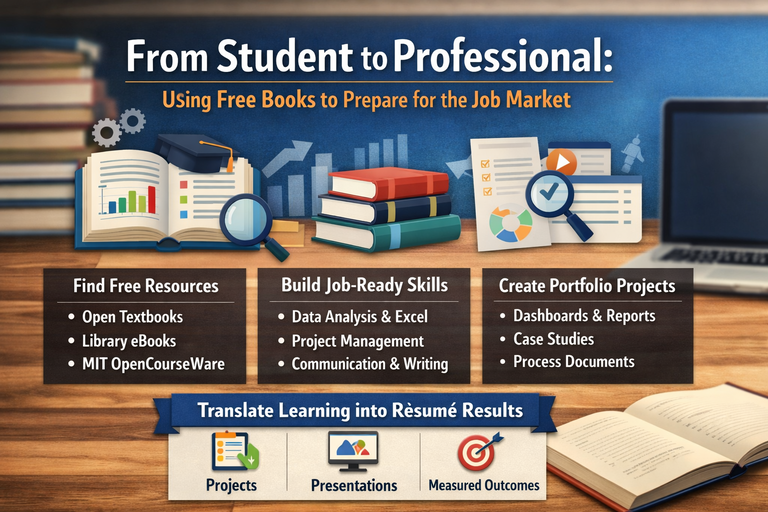
From Student to Professional: Using Free Books to Prepare for the Job Market
A degree opens doors but employers hire for demonstrated skills, sound judgment, and the ability to deliver results. One of the most overlooked ways to build those qualities without spending much money is through free, legal books: open textbooks, public-domain classics, industry handbooks released under open licenses, and library eBooks.
When used strategically, these resources help you move from “I studied this” to “I can do this.” They give you practical frameworks, professional vocabulary, and most importantly real project outputs you can show to employers.
This guide explains how to use free books to build job-ready skills, create a portfolio, and translate your learning into measurable résumé outcomes without getting stuck in endless reading.
Why Free Books Are a Powerful Career Tool
1) They Provide Depth That Short Content Often Misses
Online job advice is often fragmented. Books especially textbooks and professional handbooks offer:
-
Structured progression from fundamentals to application
-
Clear definitions and workplace frameworks
-
Case studies you can turn into portfolio projects
-
Exercises that simulate real-world tasks
Instead of scattered tips, you get systems of thinking.
2) They Give You Professional Language
Hiring managers respond well when you use industry-standard concepts confidently:
-
Stakeholder analysis
-
Regression diagnostics
-
Threat modeling
-
Design constraints
-
Behavioral interviewing
-
Root-cause analysis
Books teach the shared vocabulary professionals use. That credibility matters in interviews.
3) They Allow Cost-Efficient Skill Stacking
Rather than paying for multiple courses, you can stack:
-
One foundational book (core theory)
-
One applied/project-focused book
-
One career-focused book (communication, résumé, interviews)
This layered approach builds competence and presentation skills.
Start With a Job Target Not a Reading List
Free resources are abundant. Direction is scarce.
Step 1: Pick a Role
Examples:
-
Junior Data Analyst
-
Marketing Coordinator
-
IT Support Specialist
-
HR Assistant
-
Mechanical Engineering Intern
-
UX/UI Designer (Junior)
Step 2: Analyze 10 Job Descriptions
Copy postings into a document. Highlight repeated requirements:
Tools: Excel, SQL, Python, Git, Figma, Power BI
Skills: Documentation, customer communication, testing, reporting
Outputs: Dashboards, campaigns, resolved tickets, lesson plans
Patterns reveal what employers actually value.
Step 3: Build a Skills Map
Create three columns:
| Must-Have Skills | Nice-to-Have | Proof You Can Show |
|---|---|---|
| Excel dashboards | SQL basics | Dashboard project |
| Reporting | Data cleaning | Written analysis |
Now use free books strategically to close the gaps.
Where to Find Free, Legal Books
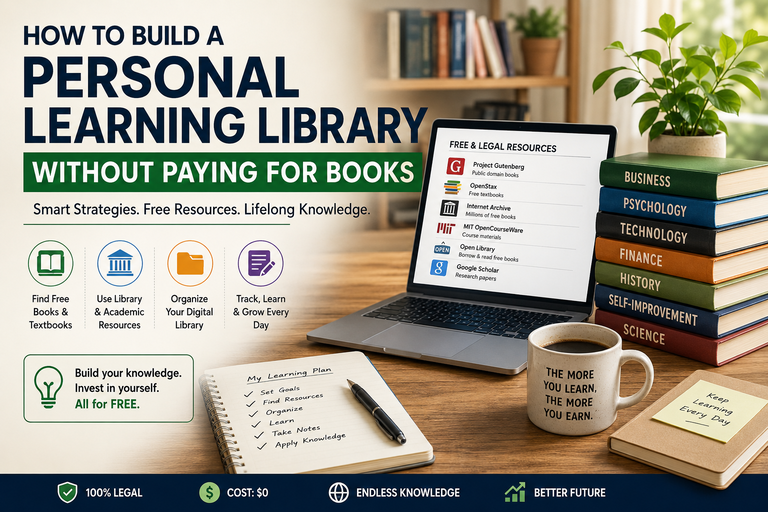
Here are trusted sources:
-
Your public or university library (eBooks via OverDrive/Libby)
-
OpenStax – Free, peer-reviewed textbooks
-
MIT OpenCourseWare – Free course materials and readings
-
Open Textbook Library – Peer-reviewed open textbooks
-
Directory of Open Access Books – Academic open-access books
-
OAPEN – Scholarly open-access content
-
Project Gutenberg – Public-domain classics
-
Internet Archive / Open Library – Borrowable digital books
Always choose legally licensed materials (Creative Commons or library access). Avoid piracy it risks malware and damages professional credibility.
The 5-Minute Book Evaluation Test
Before committing:
-
Publication date: Is it current enough for your field?
-
Author credibility: Academic? Practitioner? Recognized expert?
-
Table of contents: Does it match your job-skill map?
-
Exercises included? You need outputs, not just theory.
-
Reviews/citations: Signs of quality and relevance.
The “Book-to-Job” Learning Plan
Reading alone won’t get you hired. Employers care about results.
The 3-Layer Structure
-
Foundation (Concepts) – 1 book
-
Application (Projects) – 1 book
-
Career Translation (Communication/Interviews) – 1 book
Weekly Schedule (5–7 Hours)
-
2–3 hrs: Reading + structured notes
-
2 hrs: Exercises or project building
-
1 hr: Create a proof-of-work summary
-
30 mins: Update résumé bullets
Consistency beats intensity.
Read Like a Professional (Not a Student)
The “SQ3R + Deliverable” Method
-
Survey
-
Question
-
Read
-
Recite
-
Review
-
Deliverable (critical step)
Every chapter must produce something tangible:
-
Framework cheat sheet
-
Checklist
-
Case study
-
Automation script
-
Diagram
-
Mini-report
No deliverable = incomplete learning.
Build a “Proof-of-Skills” Folder
Organize your work:
/Projects
/Writing
/Templates
/Presentations
/Metrics
This becomes your portfolio foundation.
High-Impact Skill Areas (Across Most Fields)
1) Communication
Deliverables:
-
Project brief template
-
Professional email guide
-
Polished writing sample
2) Critical Thinking
Deliverables:
-
Trade-off analysis
-
Decision log
-
Root-cause analysis report
3) Digital Literacy (Excel + Data Basics)
Deliverables:
-
Cleaned dataset
-
KPI dashboard
-
Recommendation memo
4) Project Management Fundamentals
Deliverables:
-
Project plan
-
Gantt chart or Kanban board
-
Retrospective document
5) Industry Knowledge
Deliverables:
-
Industry landscape summary
-
Competitor comparison
-
Glossary of key terms
Turn Book Learning Into Résumé Results
Never write:
-
“Read marketing textbook”
-
“Learned about statistics”
Instead, use this formula:
Action + Tool/Method + Output + Result
Examples:
-
Built an Excel dashboard tracking 6 KPIs using pivot tables; reduced reporting time from 2 hours to 25 minutes (personal project).
-
Conducted competitor analysis and delivered 5 positioning recommendations in a 2-page strategic memo.
-
Created QA checklist and identified 12 defects in a sample web application.
Even personal projects demonstrate execution.
Interview Preparation Using Books
Build a STAR Story Bank
Every project generates:
-
Situation
-
Task
-
Action
-
Result
Exercises from books can become legitimate interview stories even without formal employment.
Create a “Concept-to-Example” Sheet
For each concept:
-
Definition (1 line)
-
Your example (2–3 lines)
-
Pitfall and lesson learned
This dramatically improves interview clarity.
Sample Free-Book Career Tracks
Track A: Business / Operations
Focus:
-
Management fundamentals
-
Project planning
-
Risk communication
Outputs:
-
Project plan template
-
Process improvement proposal
Track B: Data Analyst
Focus:
-
Intro statistics
-
Spreadsheet modeling
-
SQL fundamentals
Outputs:
-
Cleaned dataset + dashboard
-
Written analytical report
Track C: Marketing
Focus:
-
Consumer behavior
-
Campaign measurement
Outputs:
-
Campaign brief
-
KPI plan
-
Positioning analysis
Track D: Software / IT
Focus:
-
Networks and OS basics
-
Security fundamentals
-
Documentation processes
Outputs:
-
Troubleshooting playbook
-
GitHub repo with small tools
Track E: UX / Design
Focus:
-
Human-centered design
-
Usability testing
Outputs:
-
Case study
-
Wireframes + usability report
Avoid the Infinite Reading Trap
Use the 70/30 Rule:
-
70% Doing
-
30% Reading
Move on when:
-
You can explain it simply
-
You’ve applied it once
-
You’ve documented the result
Make Your Work Visible
Choose a platform:
-
GitHub
-
Notion or Google Drive
-
Personal website
-
LinkedIn Featured section
Visibility ideas:
-
“What I built this week” post
-
Share one insight from your dashboard
-
Publish a one-page case study
Keep it professional. Remove sensitive data. Anonymize datasets.
A 30-Day Plan to Go From Reading to Job-Ready
Week 1
-
Select target role
-
Extract job requirements
-
Start foundational book
-
Create portfolio folder
Week 2
-
Build Project #1
-
Write 1-page summary
Week 3
-
Build Project #2
-
Create slide deck or memo
Week 4
-
Update résumé with measurable bullets
-
Prepare STAR stories
-
Begin tailored applications
Final Thoughts
Free books won’t replace experience but they can help you create it.
The winning strategy is not “read more.” It is:
-
Read with intent
-
Build tangible outputs
-
Translate outputs into measurable results
-
Make your work visible
With a clear job target and disciplined execution, you can transform free reading into a compelling portfolio, stronger interviews, and a confident transition from student to professional.
The difference between a graduate and a professional isn’t access to information it’s evidence of applied skill