How to Build a Personal Study Library Using Free Resources
A personal study library is one of the most powerful systems you can build to accelerate your learning. Whether you are a student, a researcher, or a lifelong learner, having a centralized, organized repository of knowledge saves time and reduces the mental friction of starting a new project.
The best part? You don’t need a massive budget or a physical wing in your home. By leveraging free digital tools and open-access materials, you can construct a professional-grade learning ecosystem from scratch.
1. Defining Your Architecture
Before you download a single PDF, you must define the purpose of your library. A library without a goal is just a digital junk drawer.
Identify Your Domains: Are you focusing on academic research, professional upskilling (like data analysis or coding), or personal enrichment?
Choose Your Format: * Digital: Best for searchability and portability (using cloud storage and PDF managers).
Physical: Best for focus and tactile learning (using binders and printed modules).
Hybrid: The most popular choice storing bulky resources digitally while keeping active summaries and workbooks in physical notebooks.
2. Sourcing High-Quality Free Materials
The internet is full of information, but a library requires curated knowledge. Focus on these reliable pillars:
Open Educational Resources (OER)
Platforms like OpenStax or OER Commons provide peer-reviewed textbooks for free. These are excellent for building a foundational "core" for any subject.
University OpenCourseWare
Institutions like MIT, Harvard, and various regional universities often publish syllabi, lecture notes, and even full video courses online. Use these to structure your learning path so you aren't just "reading at random."
Public Libraries and Digital Archives
Beyond physical books, most modern libraries provide access to apps like Libby or Kanopy, giving you free access to thousands of ebooks, audiobooks, and documentaries. For historical or classic texts, Project Gutenberg is an essential resource.
3. Organizing for Accessibility
A library is only useful if you can find what you need in under 60 seconds. Use a "Nested Folder" strategy to keep things clean.
| Level | Folder Name | Contents |
| Tier 1 | Subject (e.g., Economics) | High-level overview |
| Tier 2 | Resource Type | Books, Video Lectures, Research Papers |
| Tier 3 | Specific Topic | Macroeconomics, Fiscal Policy, Case Studies |
| Tier 4 | Active Work | Your handwritten notes, flashcards, and summaries |
4. The "Curation vs. Hoarding" Rule
One of the biggest mistakes is "digital hoarding" downloading hundreds of papers you will never read. To keep your library functional:
The 1-in-1-out Rule: For every new deep-dive resource you add, archive or delete one that is no longer relevant.
The Quality Check: Before adding a resource, ask: Who is the author? Is this updated? Does it provide exercises or just theory?
5. Building Your "Active" Layer
Your library shouldn't just be a collection of other people's work. It must include your processed thoughts.
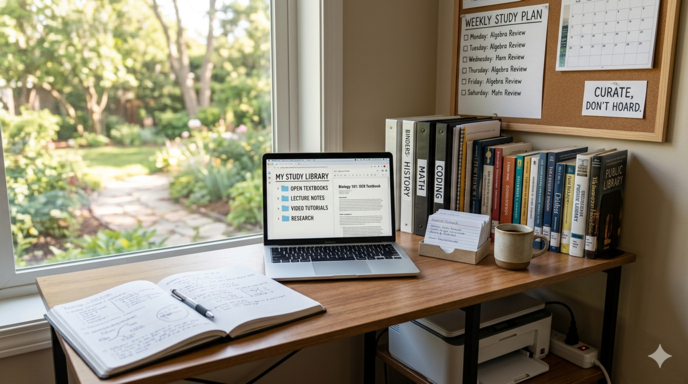
The Resource Index: Keep a simple spreadsheet or a document that lists every major resource you own, its status (Unread, In Progress, Completed), and a 2-sentence takeaway.
Summary Notes: Never store a textbook without a corresponding summary folder. Your "Past Self" should explain the concepts to your "Future Self" in simple language.
Flashcards: Use free tools like Anki to turn the facts in your library into long-term memories.
6. Maintenance: The Weekly Review
A library is a living organism. Without maintenance, links break and folders get messy. Spend 20 minutes every Sunday performing these tasks:
File Naming: Ensure all files follow a standard format (e.g.,
YYYY-MM-Topic-Title).Pruning: Delete resources that felt "too basic" or weren't as helpful as you expected.
Backing Up: Ensure your digital library is synced to a free cloud service (Google Drive, Dropbox, etc.) so you don't lose years of work to a hardware failure.
Conclusion
Building a personal study library is an investment in your future self. By choosing quality over quantity and prioritizing organization, you transform "information" into "knowledge." Start today by picking one subject and finding your first three core resources.