
How to Learn a New Subject Using Only Free Books
In today’s digital world, learning a new subject no longer depends on expensive textbooks, costly university programs, or premium online courses. Thanks to public domain archives, open educational resources, nonprofit initiatives, and digital libraries, anyone with internet access can build deep knowledge using completely free books.
Whether you want to study psychology, programming, economics, philosophy, biology, history, finance, or mathematics, it is now possible to create a structured self-education system using only freely available reading materials.
The challenge is no longer access to information it is knowing how to organize, study, and apply what you read effectively.
This guide explains how to learn a new subject using free books in a practical, organized, and results-driven way.
Why Learning Through Free Books Still Works
Many people underestimate books in the age of short videos and fast content. However, books remain one of the most powerful tools for mastering a subject because they provide:
- Deep explanations
- Structured learning
- Comprehensive coverage
- Logical progression
- Academic-level detail
- Long-term understanding
Unlike scattered internet articles or random social media tips, books guide learners systematically from beginner concepts to advanced understanding.
Benefits of Using Free Books
Free books provide:
- Zero financial barriers
- Access to academic knowledge
- Flexible self-paced learning
- Long-form explanations
- Independent learning opportunities
- Better focus compared to fragmented content
For motivated learners, free books can rival formal educational materials.
Step 1: Define Your Learning Goal Clearly
Before downloading books, identify exactly what you want to achieve.
Many people fail because their goals are vague.
Instead of saying:
“I want to learn science.â€
Be specific:
- “I want to understand basic biology.â€
- “I want to learn Python programming.â€
- “I want to study macroeconomics.â€
- “I want to understand Western philosophy.â€
Questions to Ask Yourself
Clarify:
- Am I a beginner or intermediate learner?
- Do I want practical skills or academic understanding?
- How much time can I study weekly?
- What outcome do I want?
Clear goals help you choose the right books and avoid information overload.
Step 2: Break the Subject Into Core Areas
Every field contains foundational categories.
Instead of trying to learn everything at once, divide the subject into major sections.
Example: Psychology
Main areas include:
- Cognitive psychology
- Social psychology
- Developmental psychology
- Research methods
- Personality theory
Example: Computer Science
Core areas include:
- Programming basics
- Data structures
- Algorithms
- Databases
- Computer systems
Example: Economics
Key areas include:
- Microeconomics
- Macroeconomics
- Economic history
- Behavioral economics
How to Identify Core Topics
Search for:
- “Beginner roadmap for [subject]â€
- “College syllabus for [subject]â€
- “Introduction to [subject] curriculumâ€
This creates a study structure before collecting books.
Step 3: Find High-Quality Free Books
Not all free books are useful. Focus on trusted legal sources with academic or educational credibility.
Best Platforms for Free Educational Books
1. OpenStax
OpenStax provides free peer-reviewed textbooks used by universities worldwide.
Subjects Available
- Biology
- Physics
- Mathematics
- Psychology
- Economics
- Chemistry
- Sociology
Why OpenStax Is Excellent
- Professionally written
- Well-structured
- Beginner-friendly
- Academic quality
- Completely free
These are full textbooks, not summaries.
2. Directory of Open Access Books (DOAB)
DOAB offers free academic books across multiple disciplines.
Subjects Include
- Humanities
- Social sciences
- Technology
- Law
- Education
- STEM fields
Many books are written by researchers and university professors.
3. Project Gutenberg
Project Gutenberg specializes in public domain books.
Excellent for subjects like:
- Philosophy
- Political theory
- Literature
- History
- Classical economics
Authors You Can Study
- Plato
- Adam Smith
- Charles Darwin
- Friedrich Nietzsche
- Sigmund Freud
Project Gutenberg is especially useful for foundational theory and classic intellectual works.
4. Open Library
Open Library offers:
- Borrowable textbooks
- Historical academic works
- Out-of-print books
- Research materials
This is helpful when modern textbooks are unavailable elsewhere.
5. Google Books
Google Books allows users to search millions of scanned books.
Tips for Finding Free Content
Use filters such as:
- “Full Viewâ€
- “Free Google eBooksâ€
You can often find:
- Academic books
- Historical texts
- Public domain works
- Educational references
6. University Open Course Libraries
Many universities publish free educational resources online.
Search terms like:
- “Open courseware [subject]â€
- “University textbook PDFâ€
- “Open educational resources [subject]â€
can uncover excellent study materials.
Step 4: Create a Structured Study Plan
Random reading leads to confusion.
A study plan helps you move from beginner knowledge to deeper understanding.
A Simple 12-Week Study Structure
Weeks 1–2: Introduction
Focus on:
- Basic terminology
- Overview concepts
- Fundamental principles
Read beginner-friendly textbooks first.
Weeks 3–6: Core Concepts
Study the major pillars of the subject.
Take notes on:
- Definitions
- Theories
- Systems
- Frameworks
Weeks 7–9: Intermediate Learning
Begin exploring:
- Case studies
- Applications
- Advanced explanations
- Comparative ideas
Weeks 10–11: Specialized Topics
Choose areas that interest you most.
For example:
- Behavioral economics
- Machine learning
- Clinical psychology
- Political philosophy
Week 12: Review and Consolidation
Use this phase to:
- Summarize chapters
- Review notes
- Create concept maps
- Test your understanding
Reviewing improves long-term memory retention.
Step 5: Read Actively Instead of Passively
Reading alone is not enough.
Learning happens when you process information actively.
Effective Active Reading Techniques
The SQ3R Method
A classic learning strategy:
- Survey
- Question
- Read
- Recite
- Review
This improves comprehension and memory.
Other Effective Techniques
Highlight Key Ideas
Mark:
- Definitions
- Important theories
- Examples
- Core concepts
Write Chapter Summaries
After each chapter, summarize the main points in your own words.
Create Flashcards
Useful for:
- Terminology
- Formulas
- Historical dates
- Concepts
Teach the Material
Explaining ideas aloud helps identify gaps in understanding.
Step 6: Apply What You Learn
Books provide theory. Application creates mastery.
For STEM Subjects
Practice by:
- Solving exercises
- Completing problem sets
- Reviewing examples
For Programming
Build:
- Small projects
- Practice scripts
- Simple applications
Real-world practice accelerates learning.
For Humanities
Apply knowledge through:
- Essays
- Discussions
- Critical analysis
- Comparative thinking
Writing helps deepen understanding.
Step 7: Compare Multiple Books
Different authors explain concepts differently.
If one explanation feels confusing:
- Read another textbook
- Compare interpretations
- Look for alternative examples
This creates stronger understanding and broader perspective.
Step 8: Track Your Progress
Tracking prevents aimless studying.
Useful Progress Methods
Study Journal
Record:
- What you learned
- Questions you still have
- Important insights
Reading Log
Track:
- Books completed
- Chapters studied
- Study hours
Weekly Reviews
Ask yourself:
- Can I explain this clearly?
- Can I connect ideas together?
- Can I apply the knowledge?
If yes, your understanding is improving.
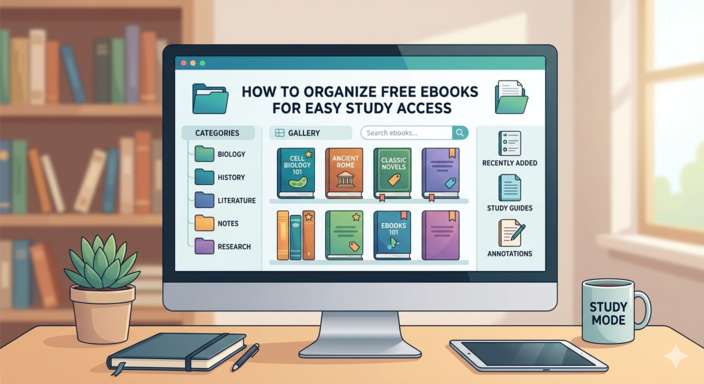
Step 9: Organize Your Digital Library
A messy collection of PDFs quickly becomes overwhelming.
Organize Books By:
- Subject
- Difficulty level
- Learning stage
- Completed vs unread
Useful eBook Management Tools
Calibre
Excellent for:
- Organizing eBooks
- Managing metadata
- Converting file formats
Reading Apps
Popular apps include:
These apps support:
- Highlighting
- Notes
- Syncing across devices
Step 10: Avoid Common Self-Study Mistakes
Many self-learners struggle because of poor study habits.
Common Mistakes
Downloading Too Many Books
Collecting books is not the same as studying them.
Jumping Between Subjects
Too many topics reduce focus and consistency.
Reading Without Practice
Application is essential for understanding.
Ignoring Review Sessions
Review strengthens memory retention.
Studying Without a Schedule
Consistency matters more than intensity.
Even one focused hour daily can produce major progress over time.
Subjects You Can Learn Using Free Books
Today, free books cover almost every major discipline.
Popular Subjects for Self-Study
- Mathematics
- Philosophy
- Psychology
- Economics
- Biology
- History
- Political science
- Sociology
- Programming
- Writing
- Statistics
- Finance
- Physics
While some professional certifications require paid materials, foundational mastery is often achievable entirely for free.
Advantages of Learning This Way
Self-education through free books develops valuable lifelong skills.
Benefits Include
- Independent thinking
- Research ability
- Discipline
- Deep focus
- Self-motivation
- Information literacy
Many highly successful individuals are largely self-taught through reading.
Final Thoughts
Learning a new subject using only free books is absolutely possible in 2026. With the growth of open educational resources, public domain libraries, and digital learning platforms, access to knowledge has never been greater.
The real challenge is no longer finding information it is developing the consistency, organization, and discipline needed to study effectively.
By setting clear goals, choosing high-quality books, following a structured study plan, practicing actively, and applying what you learn, you can build meaningful expertise without spending money.
Knowledge is more accessible than ever before.
All you need to begin is curiosity, commitment, and a willingness to keep learning.