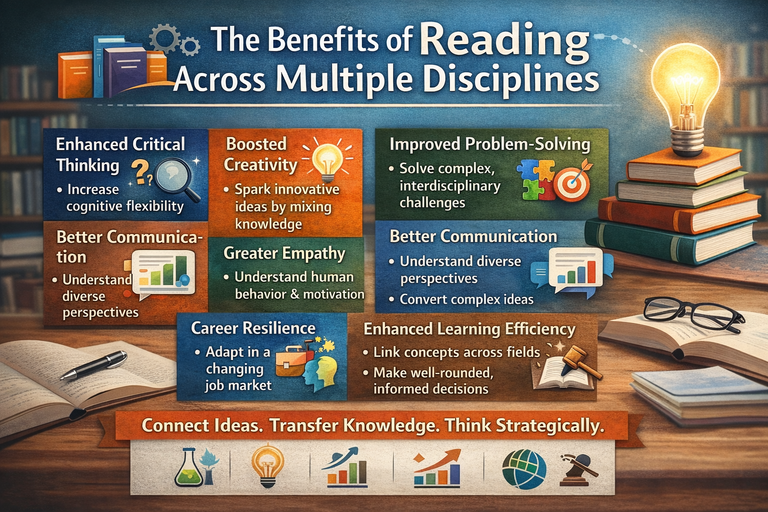
The Benefits of Reading Across Multiple Disciplines
Reading across multiple disciplines often called interdisciplinary reading means regularly exploring ideas outside your primary field. It could be a programmer reading psychology, a nurse exploring economics, a business student studying history, or an artist diving into physics.
This habit is more than intellectual curiosity. It strengthens decision-making, creativity, communication, and long-term career resilience. In a world where most real problems span technology, human behavior, economics, ethics, and policy, interdisciplinary reading builds the kind of flexible thinking modern education and work increasingly demand.
1) What Reading Across Disciplines Does to Your Thinking
Most people are trained for depth: master one subject, learn its vocabulary, and apply its rules. Depth is essential but depth alone can create blind spots.
Interdisciplinary reading builds cognitive range. It improves your ability to:
-
Recognize patterns across contexts
-
Transfer knowledge between fields
-
Question assumptions inside your specialty
-
Develop mental models compact frameworks for understanding complex systems
Example: One Concept, Many Fields
Consider the idea of feedback loops:
-
In biology: homeostasis and regulation
-
In engineering: control systems
-
In economics: market corrections
-
In habit formation: reinforcement and behavior change
Once you see feedback loops across disciplines, you begin analyzing causes and effects more accurately, predicting outcomes more effectively, and designing better solutions.
2) Better Problem-Solving: Real Problems Are Interdisciplinary
High-impact challenges rarely fit into one textbook. Healthcare, climate change, education reform, cybersecurity, AI, and business innovation all combine technical, social, economic, and ethical dimensions.
The Risk of Staying in One Field
When you read only within your discipline, you may overuse familiar tools:
-
A technical expert might default to building software for a human problem.
-
A policy specialist might propose regulations without understanding operational constraints.
-
A business professional might optimize short-term metrics without considering long-term social effects.
What Interdisciplinary Reading Adds
It expands your solution space. You begin asking broader questions:
-
What incentives shape behavior? (economics)
-
What biases affect decision-making? (psychology)
-
How do systems fail over time? (engineering, safety science)
-
What are the ethical trade-offs? (philosophy)
-
What does history suggest? (history, sociology)
This reduces costly oversights and improves strategic thinking.
3) More Creativity Through Conceptual Cross-Pollination
Creativity is often recombination. The more frameworks you know, the more raw material your mind has to recombine.
How Cross-Pollination Works
Exposure to diverse ideas increases the likelihood of useful “collisions”:
-
A designer borrows constraint-based thinking from engineering.
-
A manager uses storytelling techniques from literature to guide change.
-
A data analyst applies scientific hypothesis testing to marketing experiments.
-
A teacher uses game design principles to increase engagement.
Original ideas rarely come from nowhere they come from everywhere.
4) Stronger Critical Thinking and Resistance to Misinformation
Each discipline has:
-
Its own methods
-
Standards of evidence
-
Common errors
-
Ways of validating claims
Reading widely helps you compare how different fields determine truth.
Over time, you learn:
-
Science emphasizes measurement, replication, and uncertainty.
-
History emphasizes context, sources, and bias evaluation.
-
Philosophy tests logic, clarity, and assumptions.
-
Statistics warns against correlation traps and misleading averages.
The combination makes you harder to mislead by faulty data, persuasive rhetoric, or oversimplified narratives.
5) Improved Communication Across Audiences
Professionals rarely work with people identical to themselves. Engineers collaborate with marketing. Doctors coordinate with administrators. Researchers explain findings to the public.
Interdisciplinary reading strengthens:
-
Vocabulary flexibility
-
Audience awareness
-
Clarity of writing
-
Tone and persuasion
Literature, essays, and narrative writing improve structure and flow—skills valuable in every profession.
Those who translate complex ideas clearly often become:
-
Team leadersProject coordinators
-
Client-facing specialists
-
Effective teachers and mentors
6) Greater Empathy and Understanding of Human Behavior
Many challenges are not purely technical they are human. Reading psychology, sociology, anthropology, and literature deepens your understanding of:
-
Why people resist change
-
How culture shapes decisions
-
How narratives influence belief
-
What different lived experiences feel like
Empathy improves leadership, collaboration, and service quality in almost every field.
7) Career Resilience in a Changing Economy
Job markets evolve quickly. Multidisciplinary readers adapt more easily because they:
-
Learn new domains faster
-
Collaborate across departments
-
Pivot into adjacent roles
-
Identify emerging opportunities earlier
Durable Skills Gained Through Broad Reading
-
Data literacy
-
Systems thinking
-
Behavioral insight
-
Clear writing
-
Ethical reasoning
-
Project-based thinking
These skills remain valuable even when tools and job titles change.
8) Improved Learning Efficiency
Surprisingly, reading across disciplines can make learning easier.
When knowledge connects across contexts, it forms networks rather than isolated facts. Instead of memorizing separate ideas, you build integrated understanding.
This improves:
-
Long-term retention
-
Recall under pressure
-
Exam and interview performance
-
Real-time decision-making
Connections strengthen memory.
9) Ethical and Civic Benefits
Public debates on healthcare, climate, AI, privacy, economics, or education—are rarely simple. Interdisciplinary reading strengthens civic reasoning by helping you:
-
Evaluate trade-offs
-
Recognize unintended consequences
-
Understand multiple viewpoints
-
Engage with disagreement constructively
You become less vulnerable to “one-cause, one-fix” thinking and more capable of nuanced judgment.
10) Common Obstacles and Practical Solutions
Obstacle 1: “I Don’t Have Time”
Solution: Start small.
15–20 minutes daily builds range over months.
Obstacle 2: “I Don’t Know Where to Start”
Use the Core + Adjacent + Wild Card method:
-
Core: Your primary field
-
Adjacent: Frequently intersecting field (statistics, communication, ethics)
-
Wild Card: Something stretching (history, art, ecology, philosophy)
Obstacle 3: “Some Fields Feel Too Technical”
Start with:
-
Introductory texts
-
Short essays
-
Credible popular science
-
Then move toward deeper materials
Obstacle 4: “I Forget What I Read”
Read for output:
-
Write a short summary
-
Teach someone the concept
-
Apply it to your work
-
Keep a commonplace book of insights
11) Practical Frameworks for Effective Interdisciplinary Reading
A. The Transfer Question
After reading, ask:
-
Where else does this idea apply?
-
How does it change how I approach my work?
B. The “Compare Methods” Lens
Ask:
-
How does this field decide what’s true?
-
What counts as valid evidence?
-
What are its common mistakes?
C. Build a Personal Library of Mental Models
Collect repeatable frameworks such as:
-
Opportunity cost (economics)
-
Incentive design (behavioral science)
-
Second-order effects (systems thinking)
-
Base rates (statistics)
-
Falsifiability (philosophy of science)
-
Narrative framing (literature and media studies)
These mental tools travel across domains.
12) High-Value Discipline Pairings
If you want immediate practical payoff, consider:
-
Technology + Psychology (UX, product design, behavior change)
-
Business + Statistics (forecasting, experiments, analytics)
-
Health + Sociology (public health, equity, patient behavior)
-
Engineering + Ethics (risk, safety, responsible innovation)
-
Education + Neuroscience/Psychology (learning science, motivation)
-
History + Political Science (policy and civic reasoning)
-
Writing/Literature + Any Field (communication and persuasion)
These combinations strengthen both competence and adaptability.
Conclusion
Reading across multiple disciplines builds flexible, systems-level thinking. It strengthens creativity by mixing ideas, improves critical thinking by exposing you to different standards of evidence, and enhances communication by expanding your vocabulary and empathy.
You don’t need to read everything. The goal is intentional variety: a steady blend of your core field, adjacent subjects, and unfamiliar areas always asking how ideas connect and how they apply.
In a complex world, the most valuable thinkers are not those who know one thing deeply, but those who can connect many things intelligently.