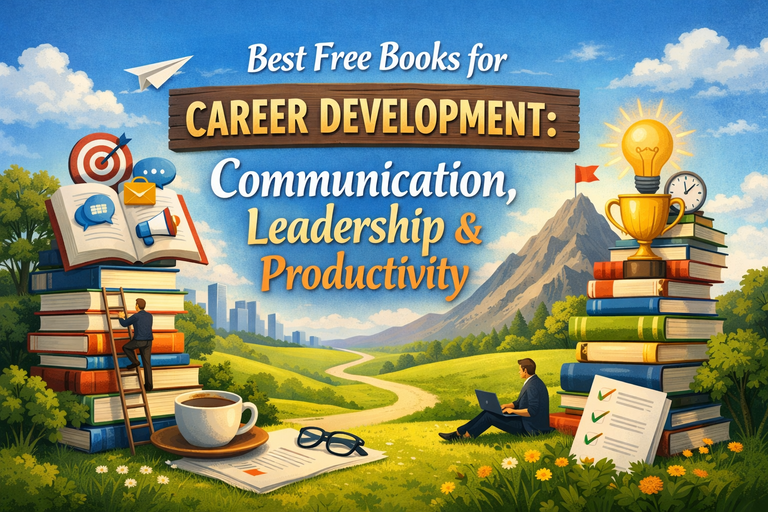
Best Free Books for Career Development: Communication, Leadership & Productivity
Career growth isn’t just about qualifications, degrees, or certifications it’s about skills. And not abstract skills you list on LinkedIn, but the practical ones you use every day: writing emails, running meetings, managing priorities, solving messy problems, and working with people who don’t think like you.
The fastest and most affordable way to build these skills isn’t through expensive courses or exclusive memberships. It’s through strategic reading paired with real-world application. When you read the right books and apply their ideas immediately, your daily work emails, meetings, projects, deadlines, and team dynamics becomes a live training ground.
Below is a practical, no-fluff guide to the best free (and legal) books for career development, with a focus on:
-
Communication
-
Leadership and teamwork
-
Time management
-
Productivity systems
-
Problem-solving and critical thinking
You’ll also find a simple system to turn reading into real career progress so your learning translates into better performance, visibility, and opportunities.
Essential Career Skills Everyone Needs
1) Effective communication
Communication is the ultimate multiplier skill. When it improves, almost every other skill improves with it.
Strong communication shows up as:
-
Clear, concise writing (emails, reports, proposals)
-
Confident speaking (meetings, presentations, interviews)
-
Active listening and better questioning
-
Giving and receiving feedback without defensiveness
-
Navigating difficult or high-stakes conversations
Poor communication creates friction, rework, and misunderstandings. Strong communication builds trust, credibility, and influence.
Career impact: Fewer mistakes, stronger professional reputation, better stakeholder relationships, and faster promotions because people trust you to represent ideas clearly.
2) Leadership and teamwork
Leadership is not a job title it’s a capability. Even individual contributors lead through how they communicate, decide, and collaborate.
Key leadership behaviors include:
-
Setting clear direction and expectations
-
Making decisions with incomplete information
-
Handling disagreement and conflict productively
-
Influencing without formal authority
-
Building accountability and team culture
Employers promote people who reduce chaos and create momentum.
Career impact: You become “the person who can run things,” which is often the fastest path to bigger roles, ownership, and autonomy.
3) Time management
Time management isn’t about squeezing more into your day—it’s about choosing what matters most and protecting it.
Real time management means:
-
Identifying high-impact work
-
Saying no, or negotiating scope intelligently
-
Planning your week instead of reacting to it
-
Protecting deep-focus time
-
Reducing constant “firefighting” behavior
Career impact: More meaningful output, less burnout, and a reputation for reliability and consistency.
4) Productivity systems
Motivation is unreliable. Memory is fragile. Productivity systems exist to solve both problems.
A good system helps you:
-
Capture tasks and commitments outside your head
-
Organize work by projects and outcomes
-
Review priorities regularly
-
Execute the next clear action
-
Build consistency without relying on willpower
Career impact: You stop dropping balls, meet deadlines predictably, and become someone managers trust with complex work.
5) Problem-solving
When employers say they want “good judgment” or “critical thinking,” they usually mean problem-solving.
Strong problem-solvers:
-
Define the real problem (not just symptoms)
-
Break complexity into manageable pieces
-
Test assumptions instead of defending them
-
Use data, logic, and evidence
-
Learn quickly from results and feedback
Career impact: You become valuable in any role operations, marketing, engineering, HR, sales, finance because problems exist everywhere.
Why Free Career Books Matter
Free books aren’t just a budget option they’re a strategic advantage.
-
They remove financial barriers: Not everyone can afford premium courses, subscriptions, or business bestsellers.
-
They enable self-paced learning: You can study in focused 20–30 minute sessions without pressure.
-
They support continuous upskilling: Read during commutes, breaks, or weekends and apply ideas immediately at work.
Many students and professionals use platforms like JunkyBooks to discover free ebooks on communication skills, leadership mindset, and productivity strategies building career confidence without enrolling in costly programs.
Important note: Always ensure ebooks are legally free public domain, open-license, or shared with author or publisher permission. If a site offers copyrighted books for free without authorization, use legitimate alternatives.
Where to Find Free, Legal Career Books
To keep your learning sustainable and ethical, rely on trusted sources:
-
Project Gutenberg – Public domain classics
-
Internet Archive / Open Library – Borrowable scans (availability varies by region)
-
OpenStax – Free, peer-reviewed textbooks
-
Saylor Academy – Free courses and open textbooks
-
Open Textbook Library
-
University repositories – Open-access lecture notes and texts
-
Local library apps – Libby, OverDrive, Hoopla (location-dependent)
If you use JunkyBooks, treat it as a discovery tool, then cross-check titles on the sources above to confirm licensing.
Best Free Books for Communication Skills
1) Business Communication for Success : Scott McLean (Open Textbook)
Why it’s great: Covers modern workplace communication emails, messaging, persuasion, professionalism, and audience awareness.
Best for: Students, early-career professionals, and anyone whose job involves writing.
2) The Art of Public Speaking : J. Berg Esenwein & Dale Carnegie (Public domain)
Why it’s great: A structured foundation for speaking clearly, confidently, and persuasively.
Best for: Presentations, interviews, and high-visibility meetings.
3) The Elements of Style : William Strunk Jr. (1918 public domain edition)
Why it’s great: Short, direct rules that immediately improve clarity.
Best for: Anyone who wants better writing fast.
4) Rhetoric : Aristotle (Public domain)
Why it’s great: Introduces ethos, pathos, and logos the backbone of persuasion.
Best for: Pitching ideas, influencing decisions, leadership communication.
5) How to Speak and Write Correctly : Joseph Devlin (Public domain)
Why it’s great: Practical guidance on grammar, usage, and expression.
Best for: Building confidence in professional English.
Best Free Books for Leadership and Teamwork
1) Principles of Management : OpenStax (Open license)
Why it’s great: A modern, comprehensive foundation leadership styles, motivation, teams, culture, and decision-making.
Best for: Transitioning from individual contributor to manager.
2) The Art of War : Sun Tzu (Public domain)
Why it’s great: Teaches strategy, preparation, and positioning under uncertainty.
Best for: Strategic thinking and negotiation (read ethically and thoughtfully).
3) The Prince : Niccolò Machiavelli (Public domain)
Why it’s great: A realistic look at power, incentives, and human behavior.
Best for: Understanding organizational politics (read critically, not literally).
4) The Autobiography of Benjamin Franklin : Benjamin Franklin (Public domain)
Why it’s great: Lessons on habits, influence, self-discipline, and personal growth.
Best for: Long-term leadership development.
5) Acres of Diamonds Russell H. Conwell (Public domain)
Why it’s great: A short motivational classic about initiative and opportunity.
Best for: Momentum and proactive career behavior.
Best Free Books for Time Management and Productivity
1) How to Live on 24 Hours a Day : Arnold Bennett (Public domain)
Why it’s great: A timeless reminder that small, intentional changes matter.
Best for: Busy professionals who feel constantly behind.
2) The Principles of Scientific Management Frederick Winslow Taylor (Public domain)
Why it’s great: The foundation of efficiency thinking useful when read with a modern, people-first lens.
Best for: Operations, process improvement, productivity analysis.
3) Personal Productivity (Open course materials)
Why it’s great: Structured frameworks for goal setting, prioritization, and habits.
Best for: Building a repeatable system.
4) Open-licensed project management texts
Why they’re great: Productivity scales with planning scope, timelines, risks, execution.
Best for: Anyone coordinating work across teams or deadlines.
Best Free Books for Problem-Solving and Critical Thinking
1) How We Think : John Dewey (Public domain)
Why it’s great: A clear framework for reflective thinking and inquiry.
Best for: Stronger judgment and reasoning.
2) forall x: An Introduction to Formal Logic : P.D. Magnus (Open license)
Why it’s great: Trains precision and helps avoid logical fallacies.
Best for: Analysts, engineers, decision-makers.
3) OpenIntro Statistics (Open license)
Why it’s great: Practical statistics for real-world decision-making.
Best for: Data-informed roles.
4) An Introduction to Statistical Learning (ISLR) : James et al. (Free author-provided PDF)
Why it’s great: Shows how models support predictions and decisions.
Best for: Analytics, marketing, product, data roles.
How to Turn Free Reading Into Real Career Growth
Reading alone doesn’t change outcomes application does.
The 3-2-1 Action Loop (per chapter)
-
3 takeaways
-
2 situations at work to apply them this week
-
1 behavior change to practice for 7 days
Examples:
-
Communication: Rewrite one recurring email template.
-
Leadership: Run the next meeting with a written agenda and decision summary.
-
Productivity: Add a weekly review.
-
Problem-solving: Write a one-page problem definition before proposing solutions.
A Practical 30-Day Reading Plan (Career Skills Starter Track)
Week 1: Communication basics
Read: Business Communication for Success
Apply: Improve one email or document; ask for feedback.
Week 2: Speaking & influence
Read: The Art of Public Speaking
Apply: Deliver a 3–5 minute structured update.
Week 3: Productivity
Read: How to Live on 24 Hours a Day
Apply: Time-block three focus sessions; track distractions.
Week 4: Leadership & decision-making
Read: Principles of Management
Apply: Clarify expectations for one project (owner, deadline, definition of done).
Final Thoughts
The smartest career investment is the one you can sustain.
Free, legal books especially public domain and open-license texts make skill-building accessible at any stage of your career. When paired with deliberate practice, they create a powerful compounding effect.
If you’re using JunkyBooks to discover free ebooks on communication, leadership, and productivity, combine that discovery with open-access sources and a simple application system. That mix consistent reading plus real-world execution builds the competence, confidence, and credibility that lead to promotions, better offers, and stronger performance over time