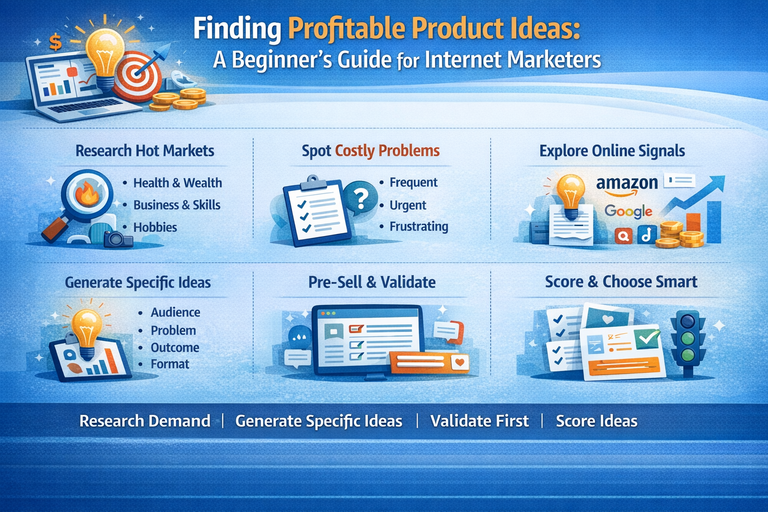
Finding Profitable Product Ideas: A Beginner’s Guide for Internet Marketers
Profitable product ideas rarely appear through random inspiration. In reality, they come from market evidence signals showing that people already want solutions and are willing to pay for them.
Successful internet marketers don’t try to invent entirely new markets. Instead, they observe what people are already searching for, complaining about, and buying. Then they create a better, clearer, or faster solution to the same problem.
This guide walks you through a practical process for discovering, validating, and selecting profitable product ideas you can confidently build and sell online.
1. Understand What “Profitable” Really Means
A profitable product idea sits at the intersection of several important factors.
Demand
People are actively searching for solutions to a problem. They discuss it online, buy products related to it, and look for better ways to solve it.
Ability to Pay
The audience must have the financial ability or strong motivation to spend money.
Distribution
You must be able to reach potential buyers through channels like:
-
Search engines
-
Social media
-
Email marketing
-
Paid advertising
-
Affiliate networks
Deliverability
You need the ability to create and deliver the product reliably, whether it’s digital or physical.
Margin
The selling price should leave enough room for profit after expenses like tools, advertising, platform fees, and support.
Beginner Tip:
Start with ideas that already show strong demand and are easy to deliver even if they’re not completely unique.
2. Start With Markets That Already Spend Money
Many beginners waste time trying to invent new markets. A smarter approach is to enter existing markets where people already spend money.
These are often called “money markets.”
Popular Online Money Markets
Health and Fitness
-
Weight loss
-
Strength training
-
Mobility and flexibility
-
Sleep improvement
Wealth and Career
-
Freelancing
-
Investing
-
Job hunting
-
Salary negotiation
Relationships and Social Life
-
Dating
-
Marriage improvement
-
Communication skills
Business Growth
-
Lead generation
-
Sales systems
-
Productivity tools
-
Hiring processes
Education and Skills
-
Language learning
-
Professional certifications
-
Technical skills
Hobbies With Budgets
-
Photography
-
Music production
-
Gaming
-
Crafting
Entering a market where spending already happens significantly increases your chances of success.
3. Use the Problem-First Method
Instead of asking:
“What product should I create?”
Ask:
“What problem is expensive, urgent, and recurring?”
This method is one of the most reliable ways to discover profitable product ideas.
Signs of a Valuable Problem
Expensive
The problem costs time, money, or missed opportunities.
Urgent
People want solutions quickly.
Recurring
The problem happens regularly.
Emotional
It causes frustration, stress, embarrassment, or confusion.
Measurable Outcome
The solution produces clear, visible results.
Example Problems
-
“I struggle to get consistent leads.”
-
“My advertising costs keep rising.”
-
“I don’t know how to plan healthy meals.”
-
“Editing videos takes too long.”
Once a strong problem is identified, the product format becomes easier to choose.
4. Where to Find Product Ideas With Real Market Signals
Successful internet marketers rely on data sources where demand is visible.
Amazon
Amazon books reveal problems people pay to solve.
Look for:
-
Best-selling books in your niche
-
High review counts
-
Repeated themes in titles
Negative reviews are particularly valuable because they reveal gaps in existing solutions.
Online Learning Platforms
Platforms like:
-
Udemy
-
Coursera
-
Skillshare
These sites show what people want to learn.
Look for:
-
Courses with high enrollment
-
Repeated lecture topics
-
Student questions in reviews
Opportunity: Create a simpler, more practical product that helps users implement what courses teach.
Affiliate Marketplaces
Platforms such as:
-
ClickBank
-
JVZoo
-
WarriorPlus
These marketplaces reveal what sells in direct-response marketing environments.
Study:
-
The promises used in sales pages
-
The unique mechanisms claimed
-
The audience targeted
Use these insights for idea inspiration and positioning.
Digital Product Marketplaces
Sites like:
-
Etsy
-
Creative Market
-
Gumroad
Search for:
-
Products with “bestseller” tags
-
Large bundles
-
Niche-specific variations
Opportunity: Create a better-targeted product for a specific audience.
Communities and Forums
Online communities reveal raw customer language and frustrations.
Examples include:
-
Reddit
-
Quora
-
Facebook groups
-
Discord communities
-
YouTube comments
Look for phrases like:
-
“How do I…”
-
“What’s the best…”
-
“I’m stuck with…”
-
“Is this tool worth it?”
These phrases often become great product headlines or sales copy.
Google Search Trends
Search engines reveal measurable demand.
Use tools such as:
-
Google autocomplete
-
“People Also Ask”
-
Keyword research tools
-
Google Trends
Look for keywords with purchase intent:
-
“Best software”
-
“Template”
-
“Checklist”
-
“Course”
-
“Review”
Even small search volumes can be profitable if the audience is specific and motivated.
5. Turn Demand Into Specific Product Ideas
Use this formula to turn raw demand into a clear product concept.
Audience + Pain + Outcome + Format
Examples
New Shopify store owners
-
Low product page conversion
-
Improve sales pages
-
Product page copywriting template kit
Busy parents
-
Meal planning stress
-
Simplify weekly dinners
-
Meal planner and grocery template
Junior accountants
-
Excel reporting errors
-
Faster monthly reports
-
Spreadsheet template with tutorial
Specific ideas convert far better than broad ones.
6. Product Types That Work Consistently Online
Certain product formats consistently succeed in digital markets.
Templates and Swipe Files
Provide immediate value and quick implementation.
Checklists and SOPs
Ideal for recurring processes.
Toolkits and Bundles
Increase perceived value and pricing potential.
Mini-Courses
Teach one specific skill quickly.
Challenges
Short programs lasting 7–30 days that encourage action.
Done-for-You Assets
Examples include:
-
Canva design packs
-
Prompt libraries
-
Email marketing templates
Productized Services
Fixed-scope services that can later evolve into digital products.
7. Validate Product Ideas Before Building
Validation means proving that people want the solution.
The “Three Proof Rule”
Before creating a product, confirm at least three signals:
-
Competitors selling similar products
-
People asking questions about the problem
-
Search demand for related keywords
-
Email signups for your idea
-
Pre-sales or early buyers
Quick Validation Methods
Problem Interviews
Talk to potential customers and ask:
-
What solutions have you tried?
-
What did it cost you?
-
What would the ideal solution look like?
Landing Page Tests
Create a simple page describing your product.
Drive small traffic from posts or ads and track email signups.
Pre-Selling
Offer the product at a founding price and build it afterward.
Even 10–20 sales can strongly validate an idea.
8. Evaluate Ideas With a Simple Scoring System
Rate each product idea from 1–5 on these factors:
-
Pain intensity
-
Ability to pay
-
Ease of reaching customers
-
Speed to create
-
Market competition clarity
Focus on ideas that score high overall and can be built quickly.
9. Common Beginner Mistakes
Choosing Interests Instead of Problems
Always prioritize market evidence.
Starting Too Broad
Niche down to a specific audience and situation.
Building Before Validating
Always test demand first.
Competing Only on Price
Focus on clarity, speed, and ease of use.
Choosing Complex Formats
Start with templates or toolkits before courses or software.
10. Practical Product Idea Angles
Here are common frameworks that generate profitable ideas:
-
“For [audience] who want [result] without [pain]”
-
Beginner starter kits
-
Audit checklists
-
Sales or outreach scripts
-
Email marketing sequences
-
Content planning systems
-
Financial calculators or planning spreadsheets
11. From Idea to Your First Offer
A simple roadmap for beginners:
-
Choose a proven market
-
Identify recurring problems
-
Define the specific outcome
-
Select a simple product format
-
Create a landing page
-
Collect email signups
-
Pre-sell the product
-
Build and deliver the MVP
-
Collect testimonials
-
Improve and raise the price
This process turns product creation into a repeatable system instead of guessing.
12. Example: Finding a Profitable Idea Quickly
Suppose you explore email marketing for e-commerce businesses.
Research shows:
-
Many store owners struggle with email revenue.
-
Email template products already sell well.
-
Reviews complain about generic templates.
Opportunity:
“Email Flow Templates for Natural Skincare Brands.”
Product includes:
-
Seven automated email flows
-
Copywriting blocks
-
Setup checklist
-
Real examples
After validating demand with pre-sales, you build the product and launch it.
Final Checklist for a Profitable Product Idea
Before building your product, ask:
-
Can I describe the customer and outcome in one sentence?
-
Are people already buying solutions for this problem?
-
Can I reach buyers through specific channels?
-
Can I create a minimum viable version quickly?
-
Does the product have a clear differentiator?
If the answer is yes, you are not guessing you are making a calculated, evidence-based business decision