
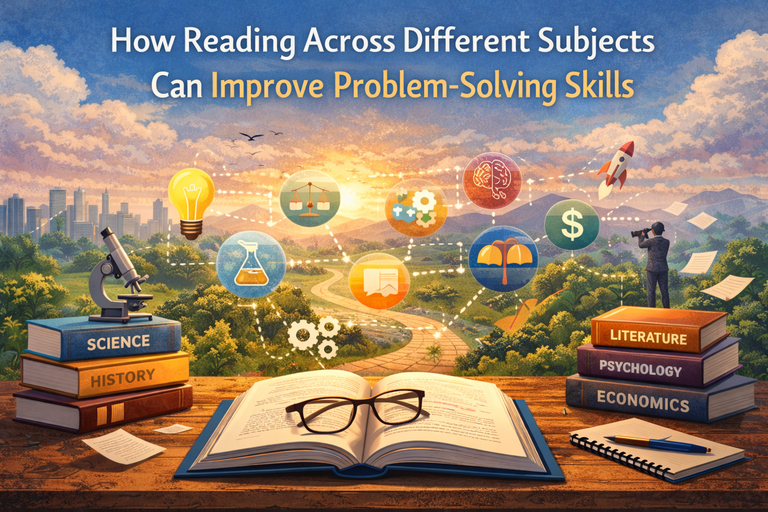
How Reading Across Different Subjects Can Improve Problem-Solving Skills
Problem-solving is one of the most valuable abilities a person can develop. It shapes how we make decisions, respond to challenges, adapt to change, and create solutions in school, work, and everyday life. While many people attempt to improve their problem-solving ability through direct practice or specialized training, one of the most powerful and often overlooked methods is reading across different subjects.
Reading widely beyond a single field exposes the mind to diverse ways of thinking. When you read history, science, psychology, economics, philosophy, literature, technology, and other disciplines, you encounter different perspectives, frameworks, and analytical tools. These perspectives help you recognize patterns, evaluate ideas from multiple angles, and connect concepts that might otherwise remain isolated.
These habits are the foundation of strong problem-solving.
This article explores how reading across different subjects enhances problem-solving ability, why interdisciplinary thinking matters, and how readers can intentionally develop broader thinking skills through diverse reading.
Understanding Problem-Solving
Problem-solving refers to the ability to identify a challenge, understand its causes, evaluate possible responses, and develop effective solutions. This ability is not limited to academic or technical environments it plays a role in almost every aspect of life.
People use problem-solving when they:
-
Manage time and priorities
-
Resolve interpersonal conflicts
-
Make financial decisions
-
Address work-related issues
-
Develop business strategies
-
Complete school assignments
-
Navigate uncertainty
-
Improve systems and processes
-
Respond to unexpected setbacks
Strong problem-solving involves a combination of mental abilities, including:
-
Observation
-
Analysis
-
Logical reasoning
-
Creativity
-
Decision-making
-
Judgment
-
Adaptability
-
Reflection
These abilities rarely develop in isolation. They grow stronger when the mind engages with a variety of ideas, perspectives, and frameworks—which is exactly what cross-subject reading provides.
What Does It Mean to Read Across Different Subjects?
Reading across different subjects means exploring books, articles, and educational materials from multiple disciplines instead of focusing exclusively on one field.
For example:
-
A business professional might read psychology, communication, and history.
-
A science student might explore philosophy, ethics, and economics.
-
A writer might study sociology, biology, and politics.
-
An entrepreneur might read marketing, behavioral science, and design.
This approach is often called interdisciplinary learning or broad-based learning. The goal is not to become an expert in every field but to expose the mind to different ways of understanding the world.
Each discipline trains the brain differently:
-
Mathematics develops logic and precision.
-
History builds contextual thinking and pattern recognition.
-
Science strengthens evidence-based reasoning.
-
Literature encourages empathy and interpretation.
-
Philosophy sharpens questioning and argument analysis.
-
Psychology reveals human behavior and motivation.
-
Economics explains incentives and trade-offs.
-
Technology and engineering promote systems thinking.
-
Art and design encourage creativity and perception.
When these ways of thinking combine, problem-solving becomes more powerful and sophisticated.
Narrow Reading Can Limit Thinking
Specialization has many advantages. Deep knowledge in one subject is valuable and often necessary for expertise. However, reading exclusively within one field can limit how people approach problems.
Real-world challenges rarely belong to a single discipline.
For example:
-
A workplace conflict involves psychology, leadership, communication, and organizational systems.
-
A public health issue involves medicine, sociology, economics, and policy.
-
A business problem involves customer behavior, data analysis, design, and competition.
-
Environmental challenges involve science, politics, economics, and engineering.
If a person thinks from only one perspective, their solutions may be incomplete. Reading across subjects expands the mental toolkit, allowing individuals to approach problems from multiple directions.
How Reading Across Different Subjects Strengthens Problem-Solving
1. It Expands Your Mental Models
A mental model is a framework used to understand how something works. Different fields offer different mental models.
Examples include:
-
Economics teaches incentives and scarcity.
-
Psychology explains habits and cognitive biases.
-
Biology demonstrates adaptation and interconnected systems.
-
History reveals cause-and-effect patterns over time.
-
Engineering emphasizes efficiency and design logic.
When people read across disciplines, they accumulate more mental models. This helps them analyze problems more effectively.
For instance, if a company experiences low employee productivity, a narrow explanation might blame laziness. But someone familiar with multiple disciplines might ask:
-
Are incentives misaligned? (economics)
-
Is morale affected by leadership? (psychology)
-
Is the system poorly designed? (engineering)
-
Has this problem occurred historically in similar organizations? (history)
The more models you have, the more ways you can analyze a challenge.
2. It Strengthens Critical Thinking
Critical thinking involves evaluating information carefully rather than accepting it at face value.
Different disciplines teach different forms of evaluation:
-
Science emphasizes experimentation and evidence.
-
Philosophy tests logical consistency.
-
History examines sources and context.
-
Political studies analyze power and bias.
-
Literature explores interpretation and nuance.
Moving between disciplines teaches readers to ask deeper questions such as:
-
What evidence supports this idea?
-
What assumptions are being made?
-
What alternative explanations exist?
-
What perspectives might be missing?
-
What long-term effects could occur?
These questions improve problem analysis and reduce impulsive decision-making.
3. It Develops Cognitive Flexibility
Cognitive flexibility refers to the ability to shift perspectives and adapt thinking when new information appears.
Strong problem-solvers rarely rely on a single rigid approach. They adjust strategies as circumstances change.
Reading across subjects trains this flexibility because each field requires different thinking habits. A reader might move from historical analysis to scientific reasoning, then to philosophical debate, then to economic evaluation.
This constant mental switching makes it easier to adapt when facing complex challenges.
4. It Improves Pattern Recognition
Many problems can be solved by recognizing patterns. People who see patterns clearly can:
-
Identify root causes
-
Predict possible outcomes
-
Compare situations
-
Transfer lessons across contexts
Reading across subjects exposes readers to recurring ideas such as:
-
Feedback loops
-
Adaptation
-
Competition
-
Balance
-
Cause and effect
-
Unintended consequences
These patterns appear in biology, economics, sociology, engineering, and other disciplines. Once readers begin recognizing them, they can apply similar insights to new problems.
5. It Encourages Creative Thinking
Creativity is essential for problem-solving because many solutions come from combining ideas in new ways.
People who read only in one field often repeat familiar solutions. Those who read broadly have more ideas available to combine.
Examples include:
-
A business leader using design thinking to improve team communication.
-
A software developer applying storytelling principles to user experience.
-
An entrepreneur using behavioral psychology to improve marketing strategies.
-
A teacher applying game design principles to education.
Innovation frequently occurs when ideas from one discipline are applied to another.
6. It Improves Understanding of Human Behavior
Many problems involve people rather than purely technical issues.
Understanding human behavior is crucial for:
-
Leadership
-
Negotiation
-
Customer relations
-
Conflict resolution
-
Education
-
Team collaboration
Reading literature, psychology, sociology, and history helps readers understand emotions, motivations, social dynamics, and cultural influences.
This knowledge allows solutions to be more realistic and human-centered.
7. It Builds Comfort With Complexity
Some problems have no simple answers. They involve trade-offs, uncertainty, and competing priorities.
Reading across subjects helps people tolerate complexity.
For example:
-
Philosophy teaches careful reasoning about difficult questions.
-
Economics highlights trade-offs and unintended consequences.
-
History shows that decisions can produce mixed outcomes.
-
Science demonstrates that knowledge evolves as new evidence emerges.
Understanding complexity prevents oversimplified solutions
.
8. It Improves Decision-Making
Problem-solving often ends with a decision.
Broad reading improves decisions by encouraging consideration of:
-
Evidence and facts
-
Ethical implications
-
Social consequences
-
Economic costs
-
Long-term impacts
For example, a business decision may require insights from economics, psychology, ethics, and history to be fully evaluated.
9. It Strengthens Communication Skills
A solution is only useful if it can be communicated clearly.
Reading across subjects exposes readers to different writing styles, argument structures, and storytelling techniques. This improves the ability to:
-
Explain complex ideas
-
Present logical arguments
-
Persuade others
-
Adapt communication for different audiences
Effective communication often determines whether a solution is accepted or ignored.
Real-World Examples of Cross-Subject Thinking
Business Leadership
A manager addressing declining productivity might combine ideas from psychology, communication studies, and management theory to improve both workflow and morale.
Academic Success
A student struggling with exams might draw insights from cognitive science, time management, and health studies to improve study habits.
Entrepreneurship
An entrepreneur launching a product may combine insights from economics, behavioral psychology, design, and marketing to create a more successful strategy.
Civic Engagement
Understanding complex social issues often requires reading across economics, history, sociology, and public policy.
Subjects That Strengthen Problem-Solving
Some disciplines are especially valuable when combined:
-
History: teaches causation and long-term patterns.
-
Science: develops evidence-based reasoning.
-
Mathematics: strengthens logic and precision.
-
Philosophy: sharpens argument and ethical reasoning.
-
Psychology: explains behavior and motivation.
-
Economics: focuses on incentives and trade-offs.
-
Literature: builds empathy and interpretation.
-
Sociology: explains systems and group dynamics.
-
Engineering: emphasizes design and practical solutions.
-
Art and design: encourage creative thinking.
The strongest thinkers often integrate ideas from several of these fields.
How to Read Across Subjects Intentionally
1. Mix Familiar and Unfamiliar Topics
If you usually read business books, try psychology or history. If you prefer science, explore philosophy or literature.
New disciplines stretch your thinking.
2. Read With Questions
Ask while reading:
-
How does this field define problems?
-
What methods does it use to solve them?
-
What assumptions does it challenge?
3. Compare Different Perspectives
Notice how different fields address similar topics like motivation, systems, ethics, or change.
This comparison reveals deeper connections.
4. Take Notes on Transferable Ideas
Write down concepts that apply across fields, such as:
-
feedback loops
-
incentives
-
resilience
-
bias
-
trade-offs
-
adaptation
These become powerful thinking tools.
5. Apply Ideas to Real Problems
After reading, ask how the ideas relate to real challenges in your work or life.
Application turns reading into practical skill.
6. Maintain a Balanced Reading Habit
A useful pattern might include:
-
one book for professional depth
-
one book for perspective (history, psychology)
-
one book for creativity (literature or philosophy)
This balance keeps thinking both focused and flexible.
Challenges of Reading Across Subjects
Despite its benefits, interdisciplinary reading has some challenges:
Information overload: Too many topics can feel overwhelming.
Superficial knowledge: Exposure should still include depth.
Difficulty connecting ideas: Cross-disciplinary connections develop gradually.
With consistent reading and reflection, these challenges diminish over time.
Long-Term Benefits Beyond Problem-Solving
Reading across subjects also helps people:
-
Think more independently
-
Communicate more effectively
-
Avoid narrow perspectives
-
Become more innovative
-
Develop empathy
-
Adapt to change
-
Continue learning throughout life
In many ways, better problem-solving emerges because the person becomes a broader thinker.
Conclusion
Reading across different subjects is one of the most powerful ways to strengthen problem-solving ability. It expands mental models, improves critical thinking, encourages flexibility, deepens pattern recognition, and sparks creativity. It also improves understanding of human behavior, decision-making, and communication.
In a world where many challenges are complex and interconnected, narrow thinking is often not enough. The best problem-solvers are those who can draw from multiple sources of knowledge and see relationships others might miss.
The goal of broad reading is not to know everything it is to think better.
By exploring history, science, psychology, economics, philosophy, literature, and other disciplines, readers develop the intellectual versatility needed to approach problems wisely, creatively, and effectively.
Over time, reading across subjects becomes more than a learning habit. It becomes a lifelong advantage in navigating complexity and finding better solutions.