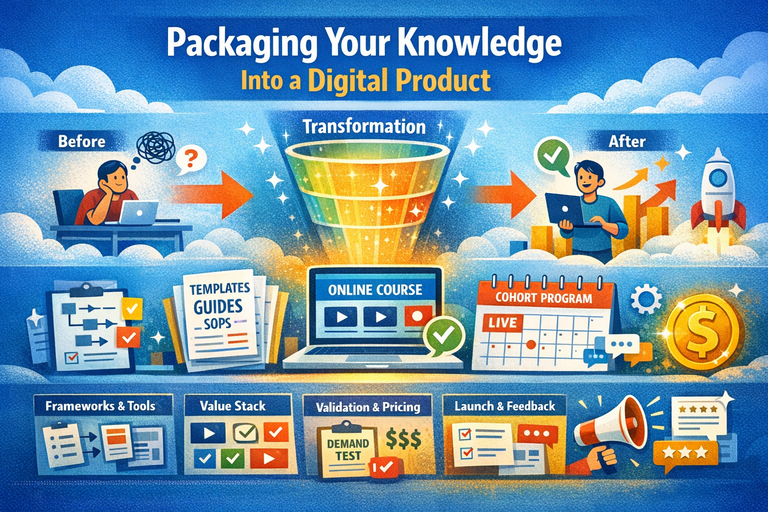
Packaging Your Knowledge Into a Valuable Digital Product
You can be highly skilled and still struggle to monetize your expertise because knowledge alone isn’t a product. A product is a repeatable, structured transformation that takes someone from a frustrating “before” state to a desirable “after” state with clarity, speed, and confidence.
Packaging your knowledge into a digital product means turning what you know into a deliverable solution that people can buy, use, and benefit from without needing you live on every call.
Instead of selling scattered advice, you create a structured system that consistently produces results. This article explains how to define the outcome, choose the right format, structure your content, price your offer, and launch successfully so your knowledge becomes a scalable asset. 🚀
1. Start With the Transformation, Not the Topic
Many digital products fail because they are topic-based instead of outcome-based.
Weak topic-based ideas
-
“A course about marketing”
-
“A productivity guide”
-
“Business templates”
These sound useful but don’t promise a specific result.
Strong outcome-based products
-
“Get your first 10 B2B leads in 14 days”
-
“Build a freelance portfolio that attracts clients”
-
“Set up a weekly CEO dashboard in Notion in 60 minutes”
Customers buy results, not information.
Create a transformation statement
Use this formula:
I help [specific person] achieve [specific result] in [timeframe] without [major obstacle].
Examples:
-
“I help first-time course creators validate and pre-sell their course in 21 days without needing a large audience.”
-
“I help small agencies standardize client onboarding in one weekend without hiring operations staff.”
This transformation becomes the foundation for your product, marketing, and pricing.
2. Choose a Real Buyer (Not “Everyone”)
The value of your product increases dramatically when it’s designed for a specific audience.
You can narrow your audience by:
-
Role: designer, marketer, HR manager, founder
-
Experience stage: beginner, intermediate, scaling
-
Industry: ecommerce, fitness, consulting
-
Constraints: no budget, small team, limited time
Weak audience definition
“Beginners who want to learn marketing.”
Strong audience definition
-
Freelance designers transitioning from referrals to outbound sales
-
Shopify store owners earning $10k–$50k per month who need retention systems
-
First-time managers leading former coworkers
Specific audiences make it easier to:
-
Write targeted content
-
Create relevant examples
-
Charge premium pricing
3. Validate Demand Before You Build
Many creators waste months building products that no one actually wants.
Instead, validate demand before investing time in production.
Quick validation methods
1. Problem interviews
Talk to 10–15 people in your target audience and ask about their biggest challenges.
2. Competitor research
Study existing products on platforms like:
-
Gumroad
-
Teachable
-
Podia
-
course marketplaces
Look at reviews and complaints to find gaps.
3. Smoke tests
Create a landing page describing your product and invite people to join a waitlist.
4. Pre-selling
Offer early access before building the full product.
If people buy, you know demand exists.
Powerful validation questions
Ask potential customers:
-
What’s the hardest part of achieving this result?
-
What have you already tried?
-
Where do you get stuck?
-
What would success look like in the next 30 days?
Your goal is to identify the moment when someone is motivated enough to pay.
4. Choose the Right Digital Product Format
Your knowledge can be packaged in many forms. The best format depends on complexity and customer needs.
1. Templates and toolkits
Examples:
-
Notion dashboards
-
Canva design templates
-
Google Sheets financial trackers
Best for:
-
workflows
-
systems
-
planning
Value: saves time and eliminates blank-page problems
2. Mini-courses
Short courses lasting 1–3 hours.
Best for:
-
solving one specific problem
-
teaching a focused skill
Value: quick clarity and fast results
3. Flagship courses
Comprehensive programs covering multiple stages of a transformation.
Best for:
-
complex outcomes
-
multi-step learning
Value: complete roadmap and depth
4. Cohort-based programs
Time-limited live programs with groups.
Best for:
-
accountability
-
feedback
-
implementation support
Value: motivation and guidance
5. Membership communities
Ongoing access to training and community.
Best for:
-
evolving topics
-
continuous learning
Value: long-term support and updates
6. Playbooks and SOP packs
Common in B2B environments.
Best for:
-
team operations
-
repeatable workflows
Value: consistency and efficiency
7. Productized services
Hybrid between product and service.
Examples:
-
done-with-you consulting
-
setup services
Best for:
-
complex outcomes
-
high-stakes implementations
Simple rule of thumb
-
If buyers need speed → sell templates
-
If they need skills → sell courses
-
If they need accountability → sell cohorts
-
If the field changes constantly → sell memberships
5. Extract Your Knowledge Into a Framework
People don’t pay for information. They pay for organized thinking and decision-making.
You need to convert your expertise into a repeatable framework.
Method 1: Process replay
Think about your last five successful results.
Write down the steps you followed each time.
The repeating steps become your framework.
Method 2: Decision maps
Write “if/then” rules such as:
-
If conversion rates are low → improve landing page clarity
-
If traffic is low → focus on distribution channels
Decision frameworks are incredibly valuable.
Method 3: Common mistakes
List the top 10 errors beginners make.
Then build tools that prevent them:
-
checklists
-
templates
-
examples
Create a signature method
Naming your system increases perceived value.
Examples:
-
The 5-Step Client Onboarding System
-
The 3-Layer Retention Framework
-
Validate → Pre-sell → Build Method
A named process makes your product easier to remember and market.
6. Design the Product Around Implementation
Customers don’t want to consume content.
They want to finish the process.
Design your product to maximize completion.
Effective learning structure
-
Setup and orientation
-
Core workflow
-
Optimization strategies
-
Troubleshooting guidance
-
Next steps for scaling
Improve implementation with:
-
worksheets
-
templates
-
checklists
-
milestone goals
-
real examples
These tools turn knowledge into action.
7. Build a Powerful Value Stack
Great digital products include multiple supporting assets.
Example value stack
-
Core training videos or written guide
-
Templates and toolkits
-
SOP checklists
-
Case studies
-
Implementation roadmap
-
Troubleshooting guide
-
Community or office hours
Bonuses should remove friction, not add noise.
Good bonuses solve real obstacles customers face.
8. Price Based on Outcome, Not Effort
Creators often price based on how long they worked.
Customers price based on how valuable the result is.
Typical pricing ranges
Templates / toolkits
$19 – $149
Mini-courses
$29 – $199
Flagship courses
$199 – $2,000+
Cohort programs
$500 – $5,000+
Memberships
$15 – $500+ per month depending on niche
Questions that help set pricing
-
What is this outcome worth?
-
What problem cost does it remove?
-
How quickly can the buyer recover the cost?
If your product helps someone increase revenue, save time, or reduce risk, pricing can be significantly higher.
9. Create Packaging That Communicates Value Instantly
Packaging is not just the files.
It is how you present the offer.
Your sales page should clearly explain:
-
Who the product is for
-
What result it delivers
-
How the system works
-
What is included
-
Proof and testimonials
-
Risk reduction (guarantees)
-
A clear call to action
Messaging that sells
Use:
-
customer language from interviews
-
specific promises
-
real examples and screenshots
Specific results always outperform vague claims.
10. Launch a First Version Without Overbuilding
Your first version does not need perfect production.
Many successful digital products started as:
-
Google Docs playbooks
-
Notion templates
-
Recorded workshops
-
Live cohort sessions
Focus on delivering the core outcome first.
Then improve based on feedback.
11. Launch With Simple Strategies
Strategy 1: Pre-sell to early users
Offer limited seats to early customers.
Benefits:
-
validate demand
-
earn revenue while building
-
gather testimonials
Strategy 2: Audience launch
If you already have followers:
-
email campaigns
-
webinars
-
limited-time bonuses
Strategy 3: Evergreen funnel
After proof of success:
-
SEO content
-
YouTube content
-
paid ads
-
low-ticket entry products
Start simple and scale later.
12. Improve the Product With Feedback
Your best version emerges after customers start using it.
Collect feedback using:
-
post-purchase surveys
-
completion surveys
-
support questions
-
analytics
Then improve by:
-
adding examples
-
simplifying lessons
-
improving onboarding
-
adding templates
Continuous iteration is how digital products become category leaders.
Common Mistakes to Avoid
Packaging too broadly
Solution: narrow your audience and outcome.
Teaching everything you know
Solution: include only what helps achieve the result.
Lack of implementation tools
Solution: provide templates, checklists, and examples.
Vague positioning
Solution: use specific before/after results.
Overbuilding before selling
Solution: pre-sell or launch a beta version.
Quick Worksheet: Package Your Knowledge in 30 Minutes
Fill this in to create your product blueprint:
Target customer:
Current situation (before):
Pain points:
Desired outcome:
Timeframe:
Your method (3–7 steps):
Deliverables (templates, examples, tools):
Support level:
Price hypothesis:
Validation plan:
Completing this exercise often reveals a sellable product idea immediately.
Final Thoughts
The most successful digital products do more than teach.
They provide:
-
a clear roadmap
-
a repeatable system
-
tools that reduce effort
-
guidance that removes uncertainty
-
a defined finish line
When your knowledge is packaged around real results, it becomes more than advice it becomes a valuable, scalable asset.
Turn expertise into a structured transformation, validate it with real buyers, and deliver it in a format that helps people succeed quickly.
That’s how knowledge becomes a profitable digital product.