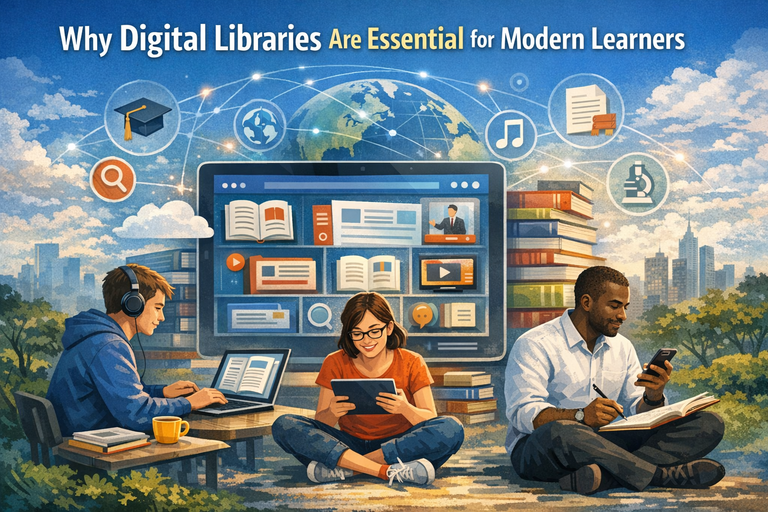
Why Digital Libraries Are Becoming Essential for Modern Learners
The way people learn has changed dramatically in the digital age. Education is no longer limited to classrooms, printed textbooks, and physical library visits. Modern learners students, professionals, researchers, and lifelong readers now expect knowledge to be available instantly, flexibly, and from almost anywhere.
In this changing environment, digital libraries have become one of the most important tools in education.
Digital libraries are more than online collections of books. They are organized, searchable, and often curated platforms that provide access to e-books, academic journals, research papers, audiobooks, archives, multimedia resources, and educational databases. They bring together knowledge in a format that matches the needs of today’s learners: mobile, fast, interconnected, and increasingly self-directed.
As learning becomes more personalized and technology-driven, digital libraries are no longer optional extras. They are becoming essential infrastructure for modern education. This article explores why digital libraries matter so much today, how they support different kinds of learners, what benefits they offer, and why their role will continue to grow in the future.
What Are Digital Libraries?
A digital library is a collection of educational, academic, or informational resources that are stored and accessed electronically. Unlike a traditional library, which relies on physical shelves and printed materials, digital libraries make their content available through computers, tablets, smartphones, and other internet-enabled devices.
Digital libraries may include:
-
E-books
-
Scholarly articles
-
Textbooks
-
Academic journals
-
Dissertations and theses
-
Historical documents and archives
-
Audio and video lectures
-
Interactive learning materials
-
Public domain works
-
Open educational resources
Some digital libraries are operated by universities, schools, governments, and public library systems. Others are created by research institutions, publishers, nonprofit organizations, and open-access communities.
What makes digital libraries especially powerful is not just the format, but the functionality they provide. Users can often:
-
Search by keyword or topic
-
Filter by subject or publication date
-
Highlight and annotate text
-
Bookmark important sections
-
Download materials for offline reading
-
Access content anytime
These features transform a simple digital collection into a dynamic learning environment.
The Changing Nature of Learning
To understand why digital libraries are becoming essential, it is important to understand how learning itself has evolved.
In the past, education depended heavily on fixed schedules, local institutions, and printed resources. Students often had to visit a physical library, wait for a book to become available, or rely only on assigned textbooks.
Today, learning has become far more flexible, continuous, and personalized.
Modern learners often:
-
Study from multiple locations
-
Combine formal and informal education
-
Learn outside traditional school hours
-
Use both text and multimedia resources
-
Pursue self-directed learning goals
-
Balance education with work and family responsibilities
-
Seek updated information quickly
This shift has created demand for learning resources that are accessible, portable, affordable, and efficient. Digital libraries meet these needs in ways traditional systems alone cannot.
1. Instant Access to Knowledge
One of the biggest advantages of digital libraries is immediate access to information.
Instead of traveling to a library building, checking opening hours, or waiting for a book to be returned, learners can access materials within seconds.
This is particularly valuable for:
-
Students completing assignments
-
Researchers gathering sources
-
Professionals needing quick reference materials
-
Independent learners exploring new subjects
A learner can search for a topic, open relevant books or articles, and begin studying immediately.
For modern learners especially those accustomed to digital tools this type of instant access is not just convenient; it is expected.
2. Making Education More Affordable
The cost of education remains a major challenge worldwide. Textbooks, research materials, journal subscriptions, and academic publications can be expensive.
Digital libraries help reduce these financial barriers by providing free or low-cost access to educational resources.
This is particularly important for:
-
Students with limited budgets
-
Adult learners returning to education
-
Job seekers developing new skills
-
Learners in underserved regions
-
Families supporting multiple students
Public digital libraries, university repositories, and open-access platforms allow learners to access materials that might otherwise be financially inaccessible.
By lowering the cost of educational resources, digital libraries make learning more inclusive and equitable.
3. Learning Anytime, Anywhere
Modern life is often busy and unpredictable. Many learners cannot organize their lives around library hours or campus schedules.
They may be:
-
Working full-time jobs
-
Caring for families
-
Commuting long distances
-
Living in areas with limited educational infrastructure
Digital libraries solve this problem by offering 24/7 access to learning materials.
Learners can:
-
Study early in the morning before work
-
Read during lunch breaks
-
Access research articles late at night
-
Learn while traveling
-
Review materials on mobile devices
This flexibility allows education to fit into everyday life, rather than forcing life to adjust around education.
4. Expanding Access Beyond Geography
Physical libraries are often limited by location. What learners can access frequently depends on where they live or study.
In many regions especially rural or underserved areas local libraries may have limited collections or outdated materials.
Digital libraries dramatically reduce this inequality.
With an internet connection, a learner in a remote area can access:
-
University archives
-
Public digital libraries
-
International research databases
-
Global open-access resources
This connectivity helps level the educational playing field by making knowledge accessible beyond geographic boundaries.
5. Faster and More Efficient Research
Traditional libraries offer immense value, but finding specific information in printed books can be time-consuming.
Digital libraries improve efficiency through advanced search features.
Users can:
-
Search entire collections instantly
-
Locate exact phrases within documents
-
Filter by subject, author, or publication date
-
Access related works quickly
-
Jump directly between references
For students writing essays or researchers compiling sources, this efficiency can save hours of work.
In an academic environment where time is often limited, digital libraries become indispensable research tools.
6. Supporting Different Types of Learners
Digital libraries serve a wide variety of users with different needs and goals.
Students
Students use digital libraries to access course readings, textbooks, academic journals, and additional learning materials.
Researchers
Researchers benefit from specialized databases, academic publications, and citation tools.
Professionals
Professionals rely on digital resources to stay updated with industry developments and learn new skills.
Lifelong Learners
Curious individuals explore topics for personal growth, hobbies, or career changes.
Learners With Disabilities
Digital libraries often provide accessibility features such as:
-
Screen-reader compatibility
-
Adjustable font sizes
-
Audiobooks
-
Searchable text
These features make learning more inclusive and adaptable.
7. Encouraging Self-Directed Learning
Modern education increasingly emphasizes independent learning. Learners are often expected to identify their own knowledge gaps and seek resources to fill them.
Digital libraries support this approach by providing organized knowledge without requiring formal classroom structures.
Learners can:
-
Explore new subjects independently
-
Compare different authors and viewpoints
-
Build personal study plans
-
Supplement classroom learning
-
Deepen understanding beyond assigned readings
This access encourages curiosity, initiative, and intellectual independence.
8. Supporting Interdisciplinary Learning
Many modern challenges—such as climate change, public health, and artificial intelligence—require knowledge from multiple disciplines.
Digital libraries make interdisciplinary research easier by bringing different fields together in a single searchable environment.
For example, a learner studying environmental policy might need to explore:
-
Environmental science
-
Economics
-
Law
-
Ethics
-
Political science
Digital libraries allow this type of cross-disciplinary exploration without the limitations of separate physical collections.
This promotes broader thinking and deeper understanding.
9. Keeping Information Current
In many fields, knowledge evolves rapidly. This is especially true in:
-
Technology
-
Medicine
-
Business
-
Science
-
Law
-
Digital media
Printed materials are valuable but can quickly become outdated.
Digital libraries allow faster distribution of:
-
Newly published research
-
Updated textbooks
-
Revised academic articles
-
Current statistical data
This ensures that learners are working with relevant and up-to-date information.
10. Strengthening Research Skills
Using digital libraries effectively helps learners develop important academic and professional skills.
These include:
-
Evaluating credible sources
-
Comparing different viewpoints
-
Tracking citations
-
Organizing research materials
-
Distinguishing scholarly work from unreliable information
In a digital world filled with mixed-quality content, digital libraries provide a structured and reliable research environment.
11. Preserving Rare and Historical Knowledge
Digital libraries also play a crucial role in preserving valuable cultural and historical materials.
Many historical documents, manuscripts, and archives are fragile or geographically restricted. Digitization allows these resources to be protected while making them widely accessible.
This benefits:
-
Historians and researchers
-
Students studying cultural heritage
-
The general public exploring historical knowledge
Digitization ensures that important knowledge is not lost over time.
12. Integrating With Modern Study Habits
Modern learners frequently combine multiple digital tools during study sessions.
They may read a text, highlight passages, take notes, search related topics, and save citations simultaneously.
Digital libraries support these workflows by allowing users to:
-
Bookmark pages
-
Add annotations
-
Export citations
-
Download PDFs
-
Sync reading progress across devices
-
Connect with research management software
These features make studying more efficient and organized.
13. Supporting Education During Disruption
The importance of digital libraries becomes especially clear during periods of disruption.
Events such as:
-
Public health crises
-
Natural disasters
-
Political instability
-
Economic challenges
-
School closures
can limit access to physical educational spaces.
Digital libraries allow learning to continue even when physical institutions are temporarily unavailable.
They provide educational resilience and continuity.
14. Promoting Lifelong Learning
Education no longer ends with a degree.
Modern careers and personal development require continuous learning.
People frequently need to:
-
Learn new technologies
-
Develop professional skills
-
Explore emerging industries
-
Change career paths
-
Pursue intellectual interests
Digital libraries support lifelong learning by providing ongoing access to knowledge throughout adulthood.
This transforms education from a limited phase of life into a continuous process.
Challenges Digital Libraries Still Face
Despite their advantages, digital libraries also face several challenges.
Digital Divide
Not everyone has reliable internet access or modern devices.
Screen Fatigue
Long reading sessions on screens can be tiring.
Licensing Restrictions
Some digital resources require subscriptions or institutional access.
Information Overload
The vast amount of available content can overwhelm learners.
Quality Control
Not all digital materials are equally credible.
Technical Barriers
Some users may struggle with interfaces, logins, or file compatibility.
Improving digital literacy, infrastructure, and platform design will help address these issues.
Using Digital Libraries Effectively
To gain the most value from digital libraries, learners should adopt effective strategies.
Define your learning goal
Know whether you are researching, reviewing, or exploring a topic.
Use advanced search tools
Filters and keywords improve accuracy.
Evaluate sources carefully
Check the author, publication date, and credibility.
Organize resources
Use digital folders, citation managers, or note-taking apps.
Focus on quality over quantity
Choose relevant materials instead of downloading everything.
Apply what you learn
Use knowledge in assignments, projects, or discussions.
Balance screen time
Take breaks or use printable formats when possible.
The Future of Digital Libraries
Digital libraries will likely become even more important as education continues to evolve.
Key trends shaping their future include:
-
Growth of open-access publishing
-
Improved accessibility technologies
-
AI-powered search and recommendation tools
-
Integration with online learning platforms
-
Global knowledge collaboration
In the future, digital libraries may evolve from simple repositories into interactive learning ecosystems that guide learners toward deeper understanding.
Conclusion
Digital libraries are becoming essential because they align perfectly with the realities of modern education. They provide instant, affordable, and flexible access to knowledge, supporting learners across different locations, lifestyles, and learning goals.
They strengthen independent learning, improve research efficiency, encourage interdisciplinary thinking, and ensure that information remains accessible and current.
Traditional libraries will always remain valuable centers of learning and community. However, digital libraries have become a critical extension of educational opportunity in a fast-changing world.
For modern learners, access to a digital library is no longer simply a convenience.
It is increasingly a foundation for educational success, lifelong learning, and global knowledge access