From Beginner to Expert: How Consistent Reading Builds Expertise Over Time
Expertise often appears effortless from the outside. A skilled teacher simplifies complex ideas, a programmer solves problems with precision, and a historian connects events across centuries with clarity. It can seem like talent alone explains this level of ability but in reality, expertise is rarely sudden. It is built gradually through repetition, reflection, application, and one of the most powerful habits of all: consistent reading.
Reading is not just about gathering information. Over time, it reshapes how a person thinks, analyzes, and understands the world. When practiced consistently, it becomes a foundation for long-term intellectual growth and a critical driver in the journey from beginner to expert.
Expertise Is Built, Not Given
One of the most common myths about expertise is that it comes from natural talent alone. While talent may provide an advantage, most expertise is the result of sustained effort over time.
Experts develop:
-
Deep knowledge of their field
-
Strong judgment and decision-making ability
-
Pattern recognition skills
-
The ability to connect ideas across contexts
Reading contributes to all of these. It allows learners to absorb years of knowledge in a relatively short time by learning from the insights, mistakes, and discoveries of others. Instead of relying only on personal experience, readers benefit from the collective experience of many minds.
Why Reading Plays a Central Role in Expertise
Consistent reading supports several essential components of mastery.
1. It Builds Foundational Knowledge
Every field has core principles, concepts, and terminology. Reading introduces these in a structured way, helping beginners develop a clear understanding of the basics.
Without this foundation, learning remains scattered. With it, new knowledge becomes easier to absorb and connect.
2. It Expands Vocabulary and Precision
Experts think more clearly because they use language more precisely. Reading helps learners acquire the specific vocabulary of a field, enabling them to:
-
Identify subtle differences
-
Describe problems accurately
-
Understand complex ideas more easily
As vocabulary improves, so does thinking.
3. It Develops Pattern Recognition
A defining feature of expertise is the ability to recognize patterns quickly.
Through repeated exposure to examples, case studies, and explanations, readers begin to see similarities across situations. What once seemed like isolated information becomes part of a larger structure.
Over time, this ability allows experts to make faster and more accurate decisions.
4. It Builds Mental Models
Experts organize knowledge into frameworks or “mental models” that help them interpret new situations.
Books often teach these models by showing:
-
How systems work
-
How causes lead to outcomes
-
How principles apply across contexts
With consistent reading, learners internalize these frameworks and begin using them automatically.
5. It Deepens Judgment and Nuance
Beginners often look for simple answers. Experts understand complexity.
Reading exposes learners to multiple perspectives, exceptions, and real-world complications. This helps them develop:
-
Critical thinking
-
Balanced judgment
-
The ability to handle uncertainty
This intellectual maturity is a key part of expertise.
Why Consistency Matters More Than Intensity
Reading occasionally can be helpful, but consistent reading is what builds expertise.
Knowledge Compounds Over Time
Each book or article builds on previous knowledge. Over time, ideas connect, reinforce each other, and create a deeper understanding.
Repetition Strengthens Memory
Encountering ideas repeatedly in different contexts improves retention and familiarity.
Continuity Maintains Momentum
Regular reading keeps a subject active in the mind, making it easier to build depth without losing context.
Even 20–30 minutes of daily reading can lead to significant growth over months and years.
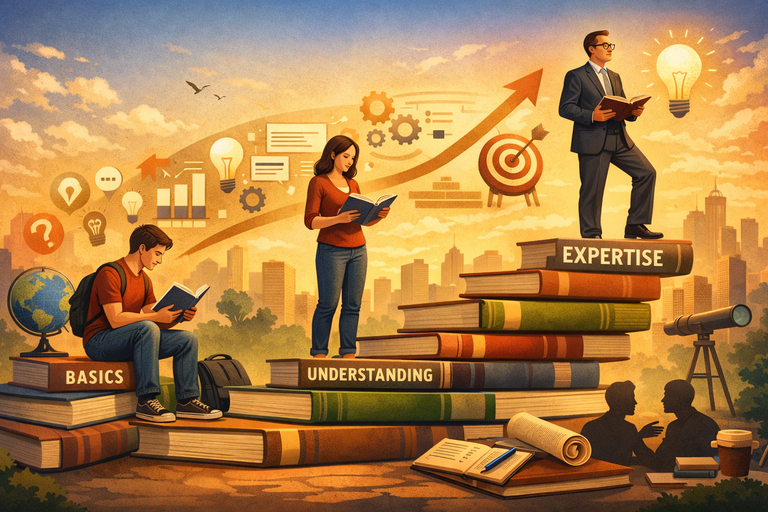
The Stages of Growth: From Beginner to Expert
Reading plays a different role at each stage of development.
1. Beginner Stage: Building a Map
At the start, learners need orientation.
Focus on:
-
Introductory books
-
Basic explanations
-
Core terminology
Goal: Understand what the field is about and how it is structured.
2. Developing Stage: Building Understanding
Learners begin to:
-
Recognize patterns
-
Compare ideas
-
Ask better questions
Reading becomes deeper and more analytical.
3. Competent Stage: Connecting Knowledge to Use
At this stage:
-
Reading supports real-world application
-
Case studies and advanced explanations become valuable
-
Learners begin making independent decisions
4. Advanced Stage: Refining Judgment
Reading becomes more critical and selective.
Learners:
-
Evaluate different viewpoints
-
Identify assumptions
-
Seek nuance and depth
5. Expert Stage: Sustaining Mastery
Experts continue reading to:
-
Stay updated
-
Refine their thinking
-
Explore new ideas
-
Teach others effectively
Expertise is not a final destination it is a continuous process.
How Reading Transforms Thinking
Consistent reading changes the mind in powerful ways.
Improves Concentration
Deep reading strengthens focus, an essential skill for mastering complex subjects.
Enhances Analytical Thinking
Readers learn to evaluate arguments, question assumptions, and follow logical reasoning.
Encourages Intellectual Humility
The more one reads, the more one realizes how much there is to learn leading to curiosity and openness.
Supports Synthesis
Experts connect ideas across disciplines. Reading widely makes this possible.
Reading Alone Is Not Enough
While reading is essential, it must be combined with action.
True expertise requires:
-
Practice
-
Feedback
-
Real-world application
-
Reflection
-
Discussion
Reading provides knowledge. Application turns that knowledge into skill.
How to Read Deliberately for Expertise
To maximize the benefits of reading:
1. Read Consistently
Even small daily sessions build long-term progress.
2. Follow a Progression
Move from beginner to advanced materials gradually.
3. Take Notes
Summarize ideas in your own words to improve understanding.
4. Revisit Important Books
Rereading reveals deeper insights as your knowledge grows.
5. Read Multiple Perspectives
This strengthens critical thinking and prevents narrow views.
6. Connect Reading to Action
Ask:
-
How can I apply this?
-
Where does this fit in real life?
7. Teach What You Learn
Explaining ideas helps clarify understanding and reveal gaps.
Common Mistakes to Avoid
-
Reading without a clear purpose
-
Mistaking familiarity for mastery
-
Avoiding challenging material
-
Consuming information without reflection
-
Failing to apply what is learned
Avoiding these mistakes ensures that reading leads to real growth.
The Power of Compounding Knowledge
The effects of consistent reading are often invisible at first. Progress may feel slow, and results may not be immediate.
But over time:
-
Complex ideas become easier to understand
-
Patterns become clearer
-
Confidence increases
-
Problem-solving improves
This is the compounding effect of knowledge. Small daily efforts accumulate into significant expertise.
Conclusion
The journey from beginner to expert is built over time through consistent effort, and reading plays a central role in that process. It builds foundational knowledge, sharpens thinking, expands perspective, and connects learners to the insights of others.
At first, reading helps you understand a field. Over time, it helps you think within it. Eventually, it enables you to contribute to it.
Expertise is not created overnight. It is developed page by page, idea by idea, and year by year. For those who read consistently with purpose and apply what they learn, the path from beginner to expert is not only possible it is inevitable.