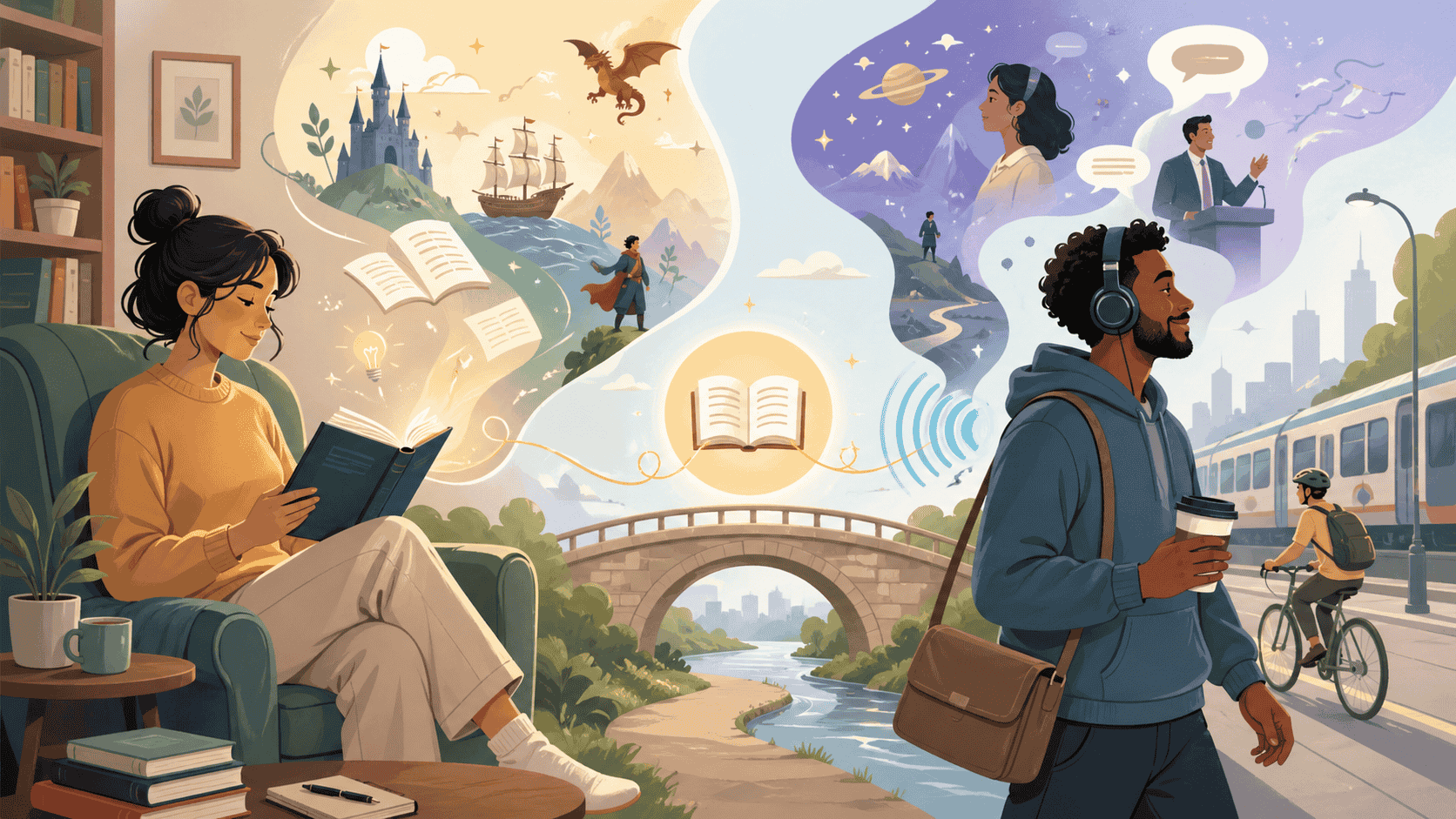
Listening to Books Is Not the Same as Reading And That’s Exactly Why It Still Matters
For years, people have debated whether listening to a book is the same as reading it.
The honest answer is: not really.
But that doesn’t mean one is better than the other. It simply means they are different ways of learning, and each serves a different purpose.
Two different ways of absorbing ideas
Reading gives you full control. You can slow down, reread a paragraph, take notes, or pause to think. That makes it ideal for books that require deep understanding like psychology, business strategy, or history.
Listening, on the other hand, is more linear. Even if you pause or rewind, the experience keeps moving forward. It’s smoother and often easier to consume, but also easier to forget especially when you’re listening during a commute or while multitasking.
That’s the tradeoff:
👉 You can finish more books by listening
👉 But you may remember less from each one
Why audiobooks feel easier but lighter
Many people finish an audiobook and feel like they understood everything, only to realize later they can’t explain the main ideas.
That’s because listening often creates a sense of familiarity, not necessarily deep understanding.
When you read, you build mental anchors page structure, notes, highlighted ideas. When you listen, those anchors are weaker, especially if your attention is divided.
So if your goal is deep retention, reading usually works better.
But audiobooks are still incredibly useful
Saying audiobooks are not ideal for deep study doesn’t mean they’re not valuable.
In fact, they’re one of the best tools for quick exposure to ideas.
Let’s be honest many modern nonfiction books don’t need to be read cover to cover. A lot of them revolve around one core concept, repeated with different stories and examples.
In these cases, what you really need is:
the main idea
the key framework
a few actionable insights
That’s where audiobooks shine.
They help you:
explore new books quickly
learn during otherwise “dead” time
decide whether a book is worth deeper reading
For readers who want to capture key ideas efficiently, platforms focused on audiobook summaries can be especially helpful, allowing you to understand the core message of a book before deciding whether it deserves deeper attention.
A better way to learn from books
If you actually want to understand and remember what you learn, listening alone isn’t enough.
A simple three-step approach works much better:
1. Listen once
Start with the audiobook. Focus on getting the overall structure and main idea not perfection.
2. Review with a structured summary
Go through the book again using a mind map or structured summary. This helps turn a flowing audio experience into something your brain can organize.
For example, if you’re learning about communication and influence, books like The Art of Persuasion can be much easier to grasp when broken down into key frameworks rather than consumed passively from start to finish.
3. Explain what you learned
This is the most important step. Try explaining the book to a friend or even to AI.
If you can’t explain it, you probably didn’t fully understand it.
Similarly, for modern leadership topics, The AI-Driven Leader highlights how AI is reshaping decision-making and strategy making it a great example of content that benefits from structured review and explanation rather than passive listening.
Why this method works
This approach combines three key processes:
Listening → exposure
Structure → clarity
Explaining → retention
Together, they lead to much deeper understanding than passive listening alone.
In practice, this kind of three-step learning approach becomes much easier when supported by the right tools. Platforms like AudiobookHub integrate listening, structured summaries, and idea review into a single experience whether accessed through a website or a mobile app.
Instead of switching between formats, readers can move seamlessly from listening to understanding, and then to applying what they’ve learned.
It’s not about finishing more books
Today, many people focus on how many books they finish. But finishing a book doesn’t mean you’ve learned from it.
A better goal is simple:
👉 Keep more from what you read or listen to
Some books deserve deep reading.
Some are perfect for listening.
And some are best treated as ideas to extract quickly.
Listening to books is not the same as reading but that’s exactly why it’s useful.
The key is knowing how to use both.