How to Use Free eBooks for Self-Study Without a Teacher
Self-study has become one of the most powerful ways to learn in the digital age. With thousands of free eBooks available online, anyone with a smartphone, tablet, or computer can access quality educational content from anywhere in the world without enrolling in formal classes or paying expensive tuition fees.
Whether you want to learn programming, mathematics, writing, science, business, or a new language, free eBooks make knowledge widely accessible. But simply downloading books is not enough.
Without a teacher, you become responsible for your own learning process. You must set goals, stay disciplined, understand difficult topics, review your progress, and stay motivated.
The good news is that with the right strategy, self-study using free eBooks can be just as effective as traditional classroom learning and sometimes even more effective because it gives you control over your pace, schedule, and focus.
This guide explains how to use free eBooks effectively for self-study without a teacher, so you can turn digital books into a complete learning system.
Why Self-Study with Free eBooks Works
Free eBooks are valuable because they remove one of the biggest barriers to learning: cost.
Instead of paying for classes or printed textbooks, you can access educational materials for free and study on your own schedule.
Benefits of Learning with Free eBooks
📚 Unlimited Access to Knowledge
Thousands of books are available on subjects ranging from academic courses to practical skills.
💸 Zero Cost
You can learn without paying tuition fees or buying expensive books.
🌠Learn from Experts Worldwide
Many free eBooks are written by educators, institutions, and professionals.
â° Flexible Schedule
Study whenever it suits you morning, evening, or weekends.
📱 Portable Learning
Your study materials can be stored on your phone, tablet, or laptop.
These advantages make self-study affordable and convenient.
However, self-study also comes with challenges:
- No teacher to guide you
- No fixed schedule
- No direct feedback
- No classroom accountability
That’s why building a clear learning strategy is essential.
Step 1: Choose the Right eBooks
The first step in successful self-study is selecting the right learning materials.
Not every free eBook is suitable for serious learning. Some books are outdated, poorly structured, or too advanced for beginners.
To avoid frustration, choose books that are well-organized and aligned with your goals.
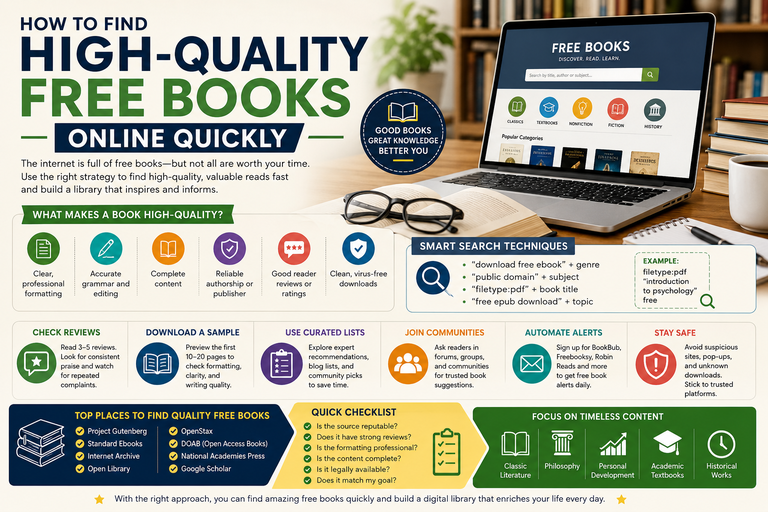
Look for eBooks with:
- Clear chapter structure
- Defined learning objectives
- Practice exercises
- Review questions
- Updated information
- Reliable authors or publishers
A structured textbook is usually better for self-study than an informal guide.
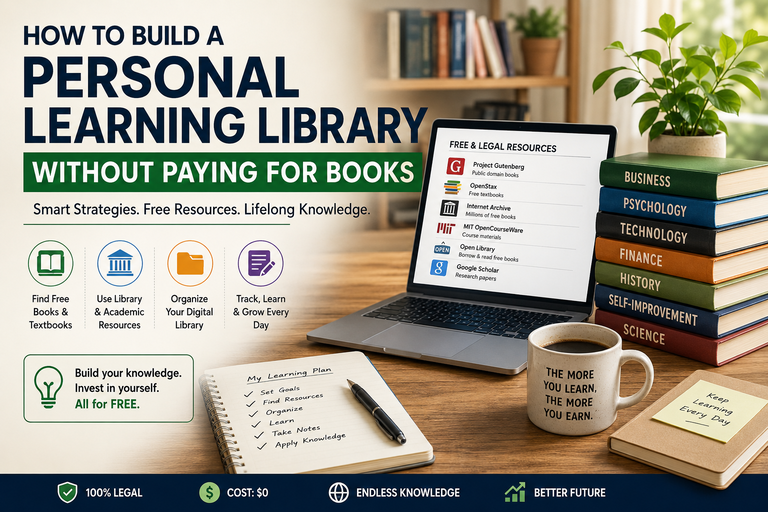
Best Sources for Free Educational eBooks
OpenStax
Provides free, peer-reviewed textbooks for academic subjects.
MIT OpenCourseWare
Offers course materials from MIT.
Project Gutenberg
Great for literature and public domain classics.
Internet Archive
Offers books, educational materials, and archived texts.
Directory of Open Access Books
Useful for academic and scholarly texts.
Google Books
Includes previews and free books.
University Websites
Many universities publish free educational resources.
These platforms provide reliable learning materials at no cost.
Step 2: Define a Clear Learning Goal
One of the biggest mistakes self-learners make is studying without a specific goal.
Without direction, it’s easy to read randomly without making real progress.
Before starting your eBook, define:
- What you want to learn
- How well you want to learn it
- How long you want to take
Examples of Strong Learning Goals
Instead of saying:
“I want to learn programming”
Say:
“I want to learn enough Python in 3 months to build beginner projects.”
Instead of:
“I want to improve in math”
Say:
“I want to master algebra fundamentals in 8 weeks.”
Clear goals create focus and motivation.
Step 3: Build a Study Plan
A teacher normally creates the syllabus and schedule. Without one, you need to create your own roadmap.
Breaking the eBook into manageable study units prevents overwhelm.
Example Study Plan
If your book has 20 chapters and you want to finish in 10 weeks, your plan becomes:
- 2 chapters per week
- 1 chapter every 3–4 days
This gives structure to your study.
Simple Weekly Schedule
Day 1:
Read the chapter
Day 2:
Take notes
Day 3:
Complete exercises
Day 4:
Review difficult concepts
Day 5:
Apply the lesson
Weekend:
Revise all content
A consistent study routine matters more than studying for long hours occasionally.
Step 4: Use Active Reading Strategies
Reading without engagement leads to weak retention.
To learn effectively, you need to read actively.
Preview Before Reading
Before starting a chapter:
- Read the headings
- Scan summaries
- Look at diagrams
- Identify key topics
This creates mental context before deep reading.
Take Structured Notes
Instead of copying everything, summarize important ideas in your own words.
Useful note-taking methods include:
Cornell Method
Divide notes into:
- Main notes
- Questions
- Summary
Mind Maps
Useful for:
- Biology
- Literature
- History
- Philosophy
Structured notes improve understanding and revision.
Highlight Key Ideas Only
Highlight:
- Definitions
- Formulas
- Key arguments
- Important examples
Avoid highlighting entire pages. Over-highlighting reduces usefulness.
Step 5: Practice Without a Teacher
Reading creates familiarity, but practice creates mastery.
That means applying what you read.
Complete All Exercises
If your eBook includes:
- Questions
- Worksheets
- Case studies
- Practice problems
Do them.
These exercises replace classroom assignments.
Ask Yourself Questions
After each chapter, ask:
- Can I explain this concept simply?
- What problem does this solve?
- How would I apply this?
This helps reinforce understanding.
Step 6: Use Free Supporting Resources
When a concept is unclear, don’t stop.
Supplement your eBook with:
- YouTube tutorials
- Khan Academy
- Coursera
- Reddit discussions
- Stack Overflow
- Educational blogs
Different explanations often make difficult ideas easier to understand.
For example:
If your eBook explanation of calculus is confusing, watch a beginner-friendly video explanation.
Combining books with videos improves learning.
Step 7: Build a Revision System
Without review, most information is forgotten quickly.
Revision helps transfer information into long-term memory.
Use Spaced Repetition
Review content:
- After 1 day
- After 1 week
- After 1 month
This strengthens memory over time.
Apps like:
- Anki
- Quizlet
- Notion
make this easier.
Create Summary Sheets
After each chapter, create a one-page summary with:
- Main ideas
- Key terms
- Formulas
- Important examples
These summaries become valuable review materials later.
Step 8: Test Yourself Regularly
In a classroom, teachers test your progress. In self-study, you must test yourself.
Testing reveals what you truly understand.
Ways to Test Yourself
- Practice quizzes
- Past exam questions
- Writing summaries from memory
- Timed exercises
- Online worksheets
Self-testing improves recall and identifies weak areas.
Step 9: Apply What You Learn
The best way to master a subject is to use it.
Application turns theory into skill.
For Technical Subjects
- Write code
- Solve real problems
- Build projects
For Writing Subjects
- Write essays
- Publish summaries
- Analyze examples
For Language Learning
- Practice speaking
- Write journal entries
- Join conversation groups
Applying knowledge replaces classroom assignments.
Step 10: Stay Motivated Without a Teacher
Self-study success depends on discipline.
Without accountability, motivation can fade quickly.
Build a Study Routine
Study at the same time daily.
Consistency builds habit.
Track Your Progress
Use:
- Habit trackers
- Study logs
- Checklists
- Digital planners
Tracking visible progress improves motivation.
Celebrate Milestones
Examples:
- Finish 5 chapters
- Complete first project
- Score well on practice tests
Celebrating progress reinforces momentum.
Step 11: Avoid Common Self-Study Mistakes
Many learners fail because of poor habits.
Avoid:
⌠Downloading too many books
Choose one main resource.
⌠Reading without practice
Practice is essential.
⌠Skipping hard chapters
Difficult topics often matter most.
⌠No revision system
Without review, learning fades.
⌠Changing goals constantly
Stay focused until completion.
Completing one resource is better than collecting many.
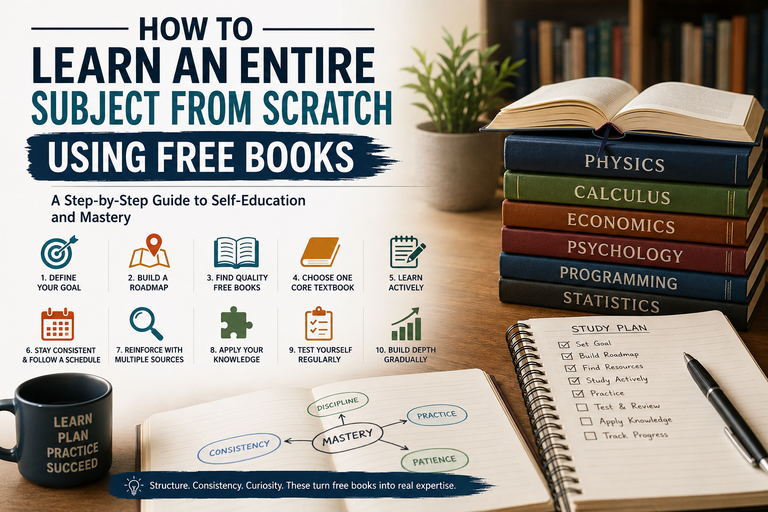
Step 12: Build a Complete Self-Study System
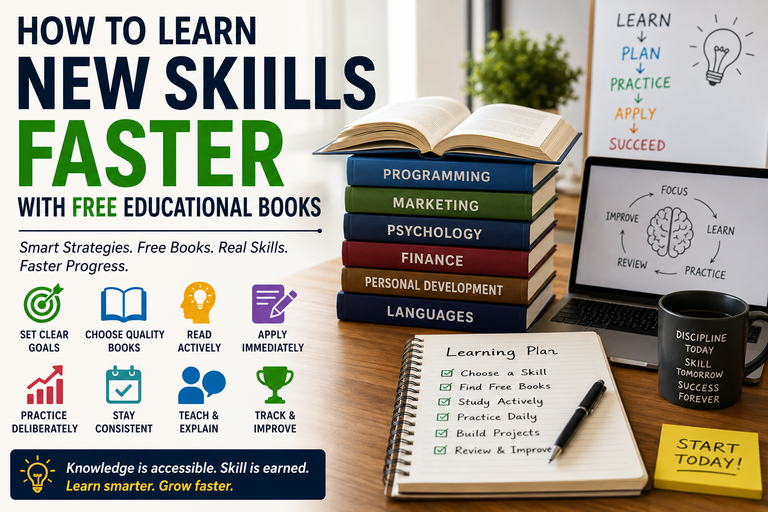
A simple self-study framework:
- Choose one eBook
- Set a clear goal
- Make a schedule
- Read actively
- Take notes
- Complete exercises
- Review regularly
- Test yourself
- Apply what you learn
- Track progress
This transforms free eBooks into a complete learning system.
Example: Learning Python with a Free eBook
Here’s what self-study might look like:
- Download a beginner Python textbook
- Study one chapter weekly
- Write code examples daily
- Solve exercises
- Watch tutorials for difficult topics
- Build small projects
- Review your progress monthly
This creates a structured path to real skills.
Final Thoughts
Free eBooks make self-education more accessible than ever before.
But success in self-study depends on structure, consistency, and active engagement.
When used properly, free eBooks can help you build:
- Knowledge
- Discipline
- Problem-solving skills
- Independence
- Real-world competence
The most successful self-learners are not those with the most resources—they are the ones with the best systems.
Start simple:
- Choose one book
- Set one goal
- Follow one plan
Study actively, review often, and apply what you learn.
With the right strategy, free eBooks can become your personal classroom and your discipline becomes your teacher. 📚