How Free Books Help First-Generation Students Succeed Academically
First-generation college students those who are the first in their families to attend college often arrive on campus with extraordinary motivation, resilience, and determination. For many, earning a degree represents not only personal achievement but also family progress, economic mobility, and the fulfillment of long-held dreams.
Yet despite this drive, first-generation students frequently encounter obstacles that have little to do with intelligence or effort. Many of these challenges are invisible, systemic, and deeply intertwined with access to information and resources. One of the most underestimated and most solvable barriers is access to required course materials.
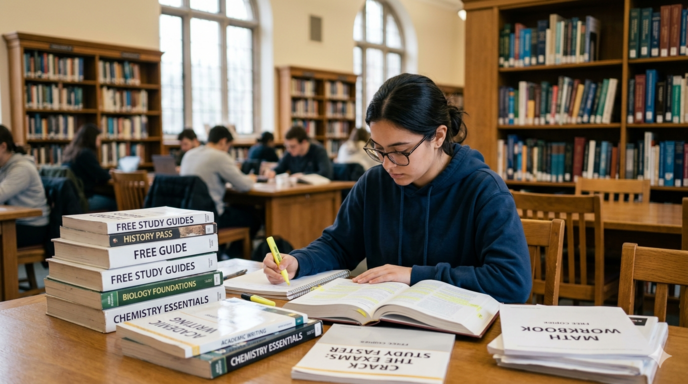
When textbooks and learning resources are expensive or delayed, first-generation students can fall behind before classes even meaningfully begin. Free digital books including open textbooks, library-provided ebooks, and legally available academic platforms are increasingly reshaping this reality.
This article explores how free books support first-generation students academically, why their impact is so powerful, and how institutions, educators, and communities can make “day-one access” the norm rather than the exception.
1) The Challenges First-Generation Students Face (Beyond the Classroom)
First-generation students are not a single, uniform group. Their backgrounds, cultures, ages, and life experiences vary widely. However, many share overlapping challenges that directly influence academic performance and persistence.
Navigating an unfamiliar academic system
College is not just an educational environment it is a complex system with its own language, expectations, and unwritten rules. For students whose parents or guardians attended college, much of this knowledge is passed down informally. For first-generation students, it often must be learned through trial and error.
Common areas of confusion include:
-
How office hours work and why attending them matters
-
What terms like syllabus, rubric, credit hours, and prerequisites actually mean in practice
-
How to communicate with professors professionally and confidently
-
How to study for exams that prioritize critical thinking and problem-solving rather than memorization
-
How to select courses strategically without delaying graduation
Without early guidance, first-generation students may misinterpret expectations, miss opportunities for support, or assume that confusion reflects personal inadequacy rather than a learning curve built into the system.
Time constraints and competing responsibilities
Many first-generation students carry significant responsibilities outside the classroom, including:
-
Part-time or full-time employment
-
Commuting long distances rather than living on campus
-
Caring for siblings, children, or elderly family members
-
Assisting with household management or translation tasks
These responsibilities reduce the time and flexibility available for studying. As a result, immediate and reliable access to learning materials becomes critical. When students must spend extra time searching for, borrowing, or waiting for textbooks, the cost is not just financial—it is measured in lost study hours.
Imposter syndrome and uncertainty about belonging
First-generation students are more likely to experience imposter syndrome the feeling that they do not truly belong in academic spaces or that they are “not college material.” This mindset can discourage students from:
-
Asking questions in class
-
Seeking tutoring or academic support
-
Attending office hours
-
Advocating for themselves when resources are inaccessible
Small obstacles, such as not having the textbook during the first week, can reinforce these doubts. What appears to be a minor logistical issue can quickly become a psychological barrier.
Limited financial margin for unexpected costs
Tuition and housing are visible expenses. Course materials often are not.
For first-generation students operating on tight budgets, a sudden requirement to purchase an expensive textbook or access code can force painful tradeoffs:
-
Buying fewer groceries
-
Delaying utility or transportation payments
-
Sharing books or skipping materials entirely
-
Waiting weeks for the next paycheck
These decisions have immediate academic consequences and long-term emotional stress.
2) Cost Barriers in Education: Why Books Hit First-Generation Students Hardest
Textbook prices affect nearly all students but the burden is not evenly distributed. The key difference is financial cushion.
The hidden cost of “required” materials
Beyond tuition, students may be required to pay for:
-
Textbooks and lab manuals
-
Online homework platforms and access codes
-
Specialized software or calculators
-
Printing, supplies, and lab equipment
For first-generation students, these costs can determine whether they are able to fully participate in a course from the first week.
The “day-one disadvantage”
When students cannot afford required materials immediately:
-
They fall behind on readings and assignments
-
They struggle to participate meaningfully in discussions
-
They perform poorly on early quizzes that often shape final grades
-
Catching up becomes increasingly difficult as the term progresses
This disadvantage is not about motivation it is about timing. Starting two weeks late academically is often enough to derail confidence and performance for the entire semester.
Course avoidance and altered academic paths
High material costs also influence enrollment decisions. Students may:
-
Avoid courses with expensive textbooks
-
Choose sections based on cost rather than teaching style
-
Drop classes after seeing the materials list
-
Reduce course loads to manage expenses
These choices can extend time-to-degree, increase overall costs, and raise the risk of stopping out altogether.
3) The Role of Free Digital Books: What They Provide That Money Can’t
Free books do more than save money they remove friction. For first-generation students, friction often determines whether momentum builds or breaks.
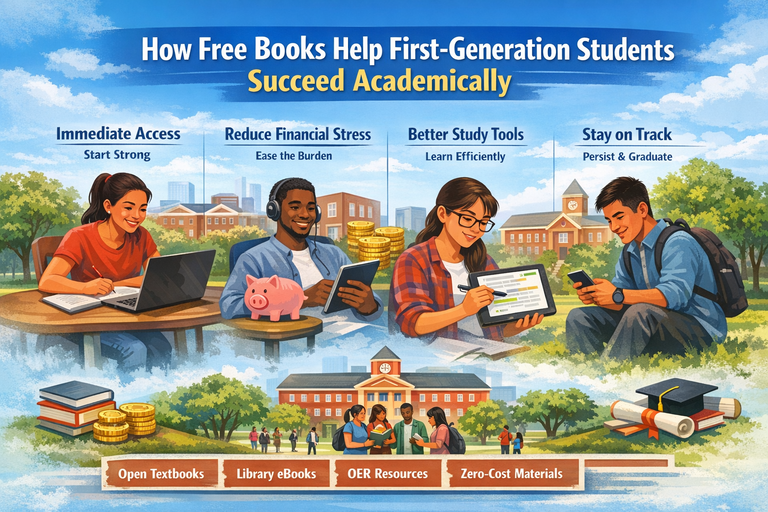
A) Immediate access and strong starts
Free digital books allow students to access course materials on day one. This early access matters because:
-
Study habits form in the first two weeks
-
Early assignments set academic tone and confidence
-
Students can prepare for lectures in advance
Starting strong academically often leads to sustained engagement throughout the term.
B) Reduced stress and mental load
Financial anxiety consumes cognitive energy. When students are worried about how to afford materials, they have less mental space to focus on learning.
Free books shift attention from logistics to comprehension:
-
“How do I pay for this?” becomes “How do I master this concept?”
C) More time spent learning, not improvising
Students without access to textbooks often rely on inefficient workarounds:
-
Borrowing books for short periods
-
Photographing pages
-
Waiting for limited library reserves
-
Piecing together content from multiple sources
Free digital access eliminates these obstacles and allows study time to be used more effectively.
D) Built-in advantages of digital formats
Digital books offer features that actively support learning:
-
Searchable text for quick reference
-
Easy highlighting and annotation
-
Adjustable fonts and screen readers for accessibility
-
Copyable definitions for notes and flashcards
-
Seamless cross-referencing between chapters
For students still developing academic reading and study strategies, these tools can significantly improve comprehension and retention.
E) The power of Open Educational Resources (OER)
OER are not only free they are adaptable. Instructors can:
-
Customize content to match course objectives
-
Remove unnecessary chapters
-
Add culturally relevant examples
-
Translate or localize material
For first-generation students, a clearer, better-aligned textbook can be as valuable as a lower-cost one.
4) What “Free Books” Really Means and Where They Come From
Not all free resources are equal. Legitimacy and stability matter.
Common legal sources of free digital books
-
Open textbooks (OER): Freely available and openly licensed (e.g., OpenStax)
-
Library ebooks: Accessible through academic or public libraries
-
Institution-created materials: Faculty-developed notes and reading packets
-
Public domain texts: Classic works commonly used in humanities courses
Why legal access matters
First-generation students often face higher risk when academic requirements are unclear. Legal, stable resources protect them from:
-
Broken links mid-semester
-
Incorrect or incomplete editions
-
Ethical or disciplinary issues
Reliable access is essential for consistent learning.
5) Real-World Impact: What Change Looks Like in Practice
The following scenarios reflect common first-generation experiences.
Marisol, a commuter student working evenings, previously waited weeks to buy biology textbooks. When her course adopted an open textbook, she accessed materials immediately, performed well on early quizzes, and finished the term with her first A in science.
Darius considered dropping a required statistics course due to high material costs. A zero-cost section using open resources allowed him to stay enrolled and graduate on time.
Amina struggled with academic reading until digital textbooks allowed her to search terms, build glossaries, and review examples efficiently.
Carlos, balancing work and family responsibilities, benefited from mobile-friendly digital books that allowed him to study anytime, anywhere.
6) Why Free Books Work: The Academic Mechanisms Behind the Impact
Free books improve outcomes because they directly support:
-
Access: Materials are available immediately
-
Consistency: Learning isn’t interrupted by financial gaps
-
Engagement: Students participate fully from the start
-
Confidence: Early success reduces imposter syndrome
-
Persistence: Fewer cost-related drops and delays
In many cases, academic struggle is not about ability it is about sustained access to practice and explanation.
7) Expanding Access: What Institutions and Communities Can Do
Institutional actions
-
Fund OER adoption and faculty training
-
Create zero-cost degree pathways
-
Expand library ebook licensing
-
Display textbook costs during course registration
Instructor-level actions
-
Adopt open textbooks when available
-
Place physical copies on reserve when paid texts are unavoidable
-
Avoid mandatory single-use access codes
-
Offer free alternatives for graded assignments
Student support initiatives
-
Curate legal free-book resource lists
-
Host workshops on accessing library ebooks
-
Help students communicate access concerns early
Platform-level impact (mission-driven initiatives)
Platforms like JunkyBooks can:
-
Curate high-quality educational ebooks
-
Create first-year academic skill collections
-
Highlight legal OER clearly
-
Provide guidance on finding course books for free
Conclusion: Free Books Don’t Just Save Money They Protect Momentum
First-generation students succeed when effort meets opportunity. Too often, high textbook costs and delayed access undermine momentum at the most critical point: the start of the semester.
Free digital books especially open educational resources and library-based ebooks remove a powerful structural barrier. They help students begin on equal footing, stay engaged, and progress toward graduation without unnecessary detours.
Because they are scalable, sustainable, and immediately impactful, free books represent one of the most practical equity tools available in modern education and one of the simplest ways to turn access into achievement