How to Learn Any New Skill From Scratch Using Free Online Books
Self-learning rarely fails because people are lazy or unmotivated. It fails because most people don’t have structure.
Paid courses quietly solve this problem by giving you a syllabus, a learning sequence, deadlines, and exercises. When that structure disappears, learners drift, over-consume resources, or give up halfway through.
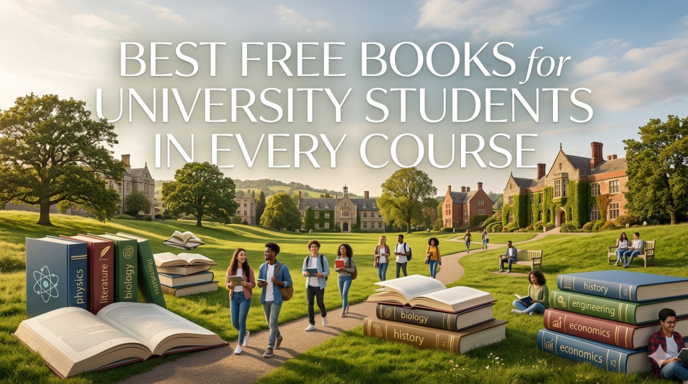
The good news is that you can build the same system yourself without paying for courses by using free, legal online books such as open textbooks, author-published ebooks, and books made available to read freely on the web.
This article shows you how to:
-
choose the right skill so your effort actually pays off,
-
build a book-based curriculum from scratch,
-
progress from beginner to capable using a clear ebook sequence,
-
stay consistent without paid courses or certificates,
-
and understand why this approach works especially well for self-learners and career switchers.
If you’ve ever said, “I learn better from books, but I don’t know where to start,” this is your roadmap.
1) Choosing a Skill: Pick Something You Can Realistically Learn “Book-First”
Not every skill is equally suited to book-only learning. Some thrive in fast-moving environments where tools change weekly. Others rest on stable fundamentals that books explain exceptionally well.
A good book-first skill usually has three key traits.
1. Clear fundamentals that don’t change every month
Books shine at teaching principles, frameworks, and mental models.
Good examples:
-
Programming fundamentals
-
Accounting and finance
-
Statistics and data analysis
-
Writing and editing
-
Project management
-
Design principles and theory
More difficult (but not impossible) with books alone:
-
Rapidly changing ad platforms
-
Highly niche tools with poor documentation
-
Trend-driven tactics that rely on insider updates
2. A practice loop you can run independently
You must be able to do the skill without needing a classroom, instructor, or paid platform.
Examples:
-
Coding: write scripts, build small projects
-
Writing: draft, revise, publish
-
Data analysis: analyze public datasets
-
Graphic design: redesign existing materials
-
Finance: solve problems, analyze statements
If you can’t practice regularly with free tools, momentum will break.
3. Enough free books to support real progression
Before committing, check that you can find at least:
-
one solid beginner-friendly text,
-
one practice-heavy or project-oriented book,
-
and one deeper reference or intermediate resource.
If those don’t exist, building a sustainable learning path becomes much harder.
A 15-Minute Skill Filter (Use This Before You Commit)
Ask yourself:
-
Why this skill?
Career switch, promotion, freelancing, research, curiosity? -
What does “good enough” look like in 8–12 weeks?
Examples:-
“Build a small portfolio website”
-
“Analyze a dataset and write a report”
-
“Write five publishable blog posts”
-
-
Do job listings mention it (if career-driven)?
Scan 20 listings and note repeating keywords. These become your subskills. -
Can I practice it 4–6 days per week using free tools?
If practice requires paid software, the “free books only” plan may stall.
Decompose the Skill (This Prevents Overwhelm)
Once you choose a skill, break it into 6–10 subskills. This becomes your syllabus.
Example: Data Analysis
-
Spreadsheet fundamentals
-
Python or R basics
-
Data cleaning
-
Descriptive statistics
-
Visualization
-
Communicating insights
-
Reproducible workflows
This step turns a vague goal into a manageable system.
2) Build Your “Free Online Book Stack” (Legally)
You’re not collecting random PDFs you’re designing a curriculum. A small, intentional library beats a hard drive full of unread files.
Reliable Sources for Free, Legal Online Books
-
OpenStax – outstanding for math, statistics, economics, science
-
MIT OpenCourseWare – lecture notes and reading lists (sometimes full texts)
-
DOAB (Directory of Open Access Books) – broad academic coverage
-
Open Library / Internet Archive – borrow books digitally (availability varies)
-
Wikibooks – mixed quality, but useful for some technical topics
-
University open-access presses
-
Authors who publish books free online (very common in programming)
If you’re career switching, check your public library’s ebook access (Libby/OverDrive). It’s still free and massively expands your options.
Avoid piracy. Besides legal issues, pirated books are often outdated, incomplete, or poorly scanned. Bad inputs lead to shallow learning.
Choose Books by Role (Not Popularity)
A strong book stack usually includes:
-
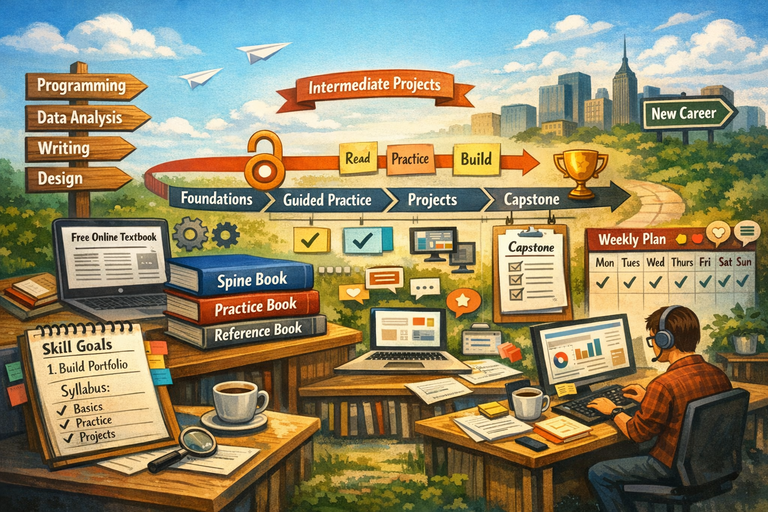
The Spine (Primary Textbook)
Your main start-to-finish guide with coherent progression. -
The Practice Book
Exercises, labs, prompts, or projects. Some spine books already include this. -
The Second Perspective
A different author for clarity when concepts don’t click. -
The Reference
Not read cover-to-cover used for definitions, syntax, formulas. -
The Capstone or Project Guide (Optional)
Helps you build something real and portfolio-ready.
The 10-Minute Book Evaluation Test
Before committing, quickly check:
-
Table of contents → does it match your subskills?
-
A middle chapter → is it readable?
-
End-of-chapter exercises → are there enough?
-
Publication date → is it too outdated?
If a book fails the readability test, don’t push through. Replace it.
3) Creating a Self-Study Plan That Doesn’t Collapse After Week Two
A self-study plan works only if it’s specific, time-boxed, and practice-heavy.
Step A: Define One Concrete Outcome
Bad goal: “Learn graphic design.”
Better goal: “Redesign six real-world posters and document design decisions in a mini portfolio.”
Choose one outcome for the next 8–12 weeks:
-
a portfolio,
-
a capstone project,
-
a public write-up series,
-
or a recognized exam.
Step B: Set a Sustainable Weekly Time Budget
Consistency beats intensity.
Two realistic options:
-
45–60 minutes per day, 5–6 days/week
-
2 hours per day, 4 days/week
Write it down like an appointment.
Step C: Turn Subskills Into a Syllabus
Map your subskills into 6–10 learning modules.
Example: Web Development Foundations
-
HTML structure
-
CSS layout
-
Responsive design
-
Accessibility basics
-
JavaScript fundamentals
-
DOM manipulation
-
Mini projects
-
Capstone
Step D: Map Chapters to Weeks (The Core Move)
Assign chapters from your spine book to each week. Don’t overpack.
A useful ratio:
-
40% reading
-
60% doing
If your plan is mostly reading, progress will feel real until you try to apply it.
Step E: Build Feedback Into the Plan
Books give structure, but feedback turns effort into skill.
Use:
-
scheduled end-of-chapter exercises,
-
self-made quizzes from headings,
-
weekly tangible outputs.
Simple Weekly Template
-
Week Objective
-
Reading
-
Exercises
-
Output
-
Review: what you still can’t explain clearly
4) Learning Progression Using Ebooks: A Proven Sequence
Free books work best when used in stages, not all at once.
Stage 1: Orientation (1–2 Days)
Understand the landscape and vocabulary.
-
Skim the table of contents
-
Read the introduction
-
Write down what “good” looks like
Stage 2: Foundations (Weeks 1–3)
Build functional basics.
-
Read in small chunks
-
Do exercises immediately
-
Keep notes on mistakes and confusion
No chapter is “done” until you’ve produced something.
Stage 3: Guided Practice (Weeks 3–6)
Turn knowledge into automatic skill.
-
Increase exercise volume
-
Re-solve problems from memory
-
Build tiny projects
Feeling slow here is normal. This is where real learning happens.
Stage 4: Integration Projects (Weeks 6–9)
Create realistic outputs.
-
Build 2–3 projects
-
Use books as reference
-
Keep a decision log
Stage 5: Second Perspective + Specialization (Weeks 9–12)
Patch gaps and align with your goal.
-
Use a second book strategically
-
Specialize based on job or project needs
-
Build a capstone and explain it clearly
How to Read Actively (So Books Become Skill)
Use this loop:
-
Preview
-
Read one section
-
Recall without looking
-
Apply immediately
-
Review 24 hours later
This turns books into a self-designed course.
5) Staying Consistent Without Paid Courses
Paid courses buy momentum, accountability, and deadlines. You can recreate all three for free.
Make Consistency Easier Than Motivation
-
Keep books and notes open and ready
-
Use a fixed daily trigger
-
Track streaks lightly
Use “Minimum Viable Progress”
On bad days:
-
read 3 pages and summarize,
-
do 2 problems,
-
improve one small part of a project.
This prevents quitting spirals.
Don’t Over-Collect Resources
Constraint works:
-
One spine book
-
One practice book
-
Second perspective only when stuck
Create Free Accountability
-
Post weekly progress publicly
-
Study with a partner
-
Join free communities and answer questions
Build a “Stuck Protocol”
When blocked:
-
Re-read the section
-
Redo the simplest example
-
Check definitions
-
Use a second book
-
Reduce scope
Stay in motion.
6) Why This Works (Especially for Career Switchers)
Books are already structured curricula.
Books train depth, not just familiarity.
Free books encourage repetition and iteration.
A book-based path naturally creates portfolio-ready work.
This is exactly what career switchers need: proof of competence, not just certificates.
Example: A 10-Week “Books-Only” Learning Plan
Week 1: Orientation + basics
Weeks 2–3: Core foundations
Weeks 4–5: Practice ramp
Weeks 6–8: Projects
Weeks 9–10: Second perspective + capstone
A Quick Checklist to Start Today
-
Choose one skill and define “good enough in 10 weeks”
-
Decompose it into 6–10 subskills
-
Pick:
-
1 free spine book
-
1 practice-heavy book
-
1 reference
-
-
Put chapters on a calendar
-
Commit to a weekly output you can show
If you want, I can:
-
tailor this for a specific skill (data analysis, writing, programming, finance),
-
turn it into a Medium/Substack-optimized version,
-
or create a downloadable checklist or PDF guide.