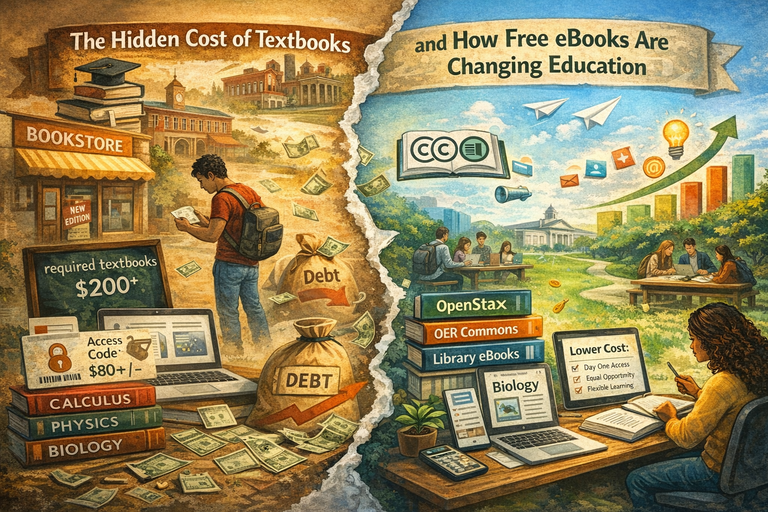
The Hidden Cost of Textbooks (and How Free eBooks Are Changing Education)
Textbooks are often treated as a routine line item on a course syllabus: buy the book, do the readings, pass the class. But for millions of students around the world, the cost of required learning materials quietly shapes academic decisions long before grades are earned.
The “hidden cost” of textbooks isn’t just the price printed on the cover. It includes delayed access to learning, increased stress, unequal participation, extended time to graduation, and in many cases students abandoning courses or entire degree paths. These effects compound existing inequalities and disproportionately affect low-income, first-generation, and working students.
At the same time, a significant shift is underway. Free and low-cost digital textbooks, open educational resources (OER), and library-based ebook platforms are changing how educational content is created, distributed, and used. What was once a niche movement is now influencing institutional policy, teaching practice, and student expectations.
This article explores why textbooks cost so much, how those costs affect students academically and financially, and how free ebooks and OER are reshaping education often in ways that go far beyond saving money.
1) Rising Textbook Prices: Why Required Books Cost So Much
Textbook prices have outpaced inflation for decades
Many students are shocked to learn that a single required textbook can cost as much as a month of groceries or a utility bill. While inflation affects nearly all consumer goods, textbook prices have historically risen faster than inflation and faster than many other educational expenses.
This isn’t accidental. The textbook market operates under conditions that differ sharply from typical consumer markets, limiting price competition and insulating publishers from normal cost pressures.
Why the textbook market is uniquely expensive
Several structural factors keep prices high:
Captive demand
Students rarely choose textbooks based on preference or price. Instructors select the materials, and students must obtain them to succeed. This removes consumer choice from the equation.
Frequent new editions
Publishers release new editions every few years sometimes with minimal content changes. New editions often render older versions incompatible due to revised problem numbers, altered chapters, or updated online components, reducing resale value.
Bundling and access codes
Many textbooks are packaged with mandatory online homework platforms and single-use access codes. These codes usually cannot be resold or transferred, eliminating the used-book market and forcing new purchases.
Opaque pricing and limited competition
Campus bookstores may have exclusive supply agreements, and pricing transparency varies widely. Comparison shopping is difficult when ISBNs change frequently or when access codes are required.
Niche publishing economics
Upper-level and specialized textbooks serve smaller audiences. Publishers often charge higher prices to recover editorial, peer review, and production costs across fewer buyers.
The “real price” includes time, stress, and logistics
The hidden cost of textbooks extends beyond the sticker price:
-
delayed access due to shipping or limited inventory,
-
confusion over which edition is acceptable,
-
digital platforms that expire after a term,
-
inability to resell due to one-time access codes.
These factors disrupt learning especially in the critical early weeks of a course.
2) Student Debt and Access Issues: The Academic Impact of High Costs
Textbook costs create unequal starting lines
When two students enroll in the same class but only one can afford the materials on day one, the course is no longer equal.
Students without immediate access may:
-
fall behind in the first weeks (often the hardest period to recover from),
-
avoid participation because they can’t follow readings,
-
rely on incomplete notes or summaries,
-
share books, limiting study time,
-
use outdated or mismatched editions.
Access delays translate directly into academic disadvantage.
Students change behavior often in harmful ways
High textbook costs don’t just inconvenience students; they actively change decision-making:
-
Delaying purchases: Students wait to see if a book is “really required,” losing weeks of instruction.
-
Taking fewer credits: Higher costs per term push students to enroll part-time, extending graduation timelines.
-
Avoiding certain courses or majors: Fields known for expensive materials become less accessible.
-
Working longer hours: Increased employment reduces study time, raises fatigue, and increases burnout.
These behaviors are rational responses to financial pressure but they undermine academic success.
The link between textbook costs, debt, and persistence
While textbooks may not be the single largest contributor to student debt, they are a recurring, unavoidable expense. Their impact shows up in:
-
increased reliance on credit cards or short-term loans,
-
lower course completion rates,
-
reduced retention and higher dropout risk,
-
widening outcome gaps between income groups.
In this way, textbook pricing becomes a structural barrier to education rather than a simple budgeting issue.
3) Open Educational Resources (OER): What They Are and Why They Matter
What are Open Educational Resources?
Open Educational Resources are teaching and learning materials that are free to access and openly licensed usually under Creative Commons licenses. These licenses allow users to legally:
-
use materials at no cost,
-
share them with others,
-
adapt or edit content,
-
remix materials for specific contexts.
OER can include:
-
full textbooks,
-
lecture notes and slides,
-
assignments and test banks,
-
labs, simulations, and entire course modules.
Why OER matters for students
OER directly addresses access and affordability issues:
-
Day-one access: Students can begin learning immediately.
-
Lower total cost of attendance: Fewer hidden expenses beyond tuition.
-
Flexible study: Digital access across devices, with optional printing.
-
Permanent availability: Materials don’t disappear after the semester ends.
These benefits are especially significant for students balancing work, family, and study.
Why instructors are adopting OER
OER is not just a cost-saving measure it enables better course design:
-
Customization: Materials can be aligned precisely with learning outcomes.
-
Up-to-date content: OER can be revised more frequently than commercial textbooks.
-
Inclusive pedagogy: Content can be adapted for accessibility and diverse cultural contexts.
-
Academic autonomy: Reduced dependence on proprietary platforms and bundled systems.
Challenges OER still faces
Despite its promise, OER adoption is not without obstacles:
-
Discovery: Finding high-quality resources can be time-consuming.
-
Quality variation: Not all OER is equally polished or maintained.
-
Ancillary materials: Commercial publishers often offer robust instructor tools that some OER lacks (though this gap is narrowing).
-
Faculty workload: Adoption and adaptation require time, training, and institutional support.
4) Free eBook Platforms as Alternatives: What’s Available Today
Not all free ebooks are OER. The ecosystem includes open textbooks, library lending, public domain works, and author-published materials. Together, they form a growing alternative to traditional textbook models.
A) Open textbook publishers and repositories (OER-first)
-
OpenStax – Peer-reviewed textbooks in core subjects.
-
Open Textbook Library – A curated catalog used by colleges.
-
OER Commons – A broad repository across disciplines.
-
BCcampus Open Education – Strong for course-ready materials.
Best for: Introductory and general education courses.
B) Institutional and library-based access
Many students already have free ebook access through libraries but don’t realize it.
-
University library ebook collections
-
Public libraries via Libby or OverDrive
-
Course reserves and interlibrary loan
Best for: Supplemental reading, research methods, and non-textbook monographs.
C) Digital libraries and controlled lending
-
Internet Archive / Open Library – Borrowable ebooks and older editions.
Best for: Edition-flexible courses and historical materials.
D) Public domain and classic texts
-
Project Gutenberg
-
Standard Ebooks
Best for: Humanities, philosophy, classic literature, and foundational works.
E) Author-hosted and technical textbooks
Common in programming, data science, and mathematics, where authors publish full books online.
Best for: Rapidly evolving technical fields when materials are reputable and maintained.
5) How Free eBooks Are Changing Education (Beyond Saving Money)
1) First-day readiness becomes realistic
Free access allows instructors to assign readings immediately, improving early engagement and reducing dropout risk.
2) Courses become modular and adaptable
Instead of one expensive textbook, instructors can assemble tailored reading collections that better reflect current practice.
3) Equity improves across institutions
Community colleges and under-resourced institutions benefit disproportionately from free, high-quality materials.
4) Learning becomes more searchable and portable
Ebooks enable:
-
full-text search,
-
accessibility tools,
-
easier annotation and revision.
5) Publishing models are being pressured to evolve
Publishers are experimenting with:
-
subscription access,
-
inclusive access programs,
-
expanded digital platforms.
These models reduce upfront costs but raise new questions about privacy, choice, and long-term affordability.
6) What Students, Educators, and Institutions Can Do Now
For students
-
Search for OER alternatives first.
-
Ask if older editions are acceptable.
-
Use library course reserves and ebooks.
-
Confirm whether access codes are mandatory.
-
Advocate respectfully for open materials.
For instructors
-
Pilot open textbooks for high-enrollment courses.
-
Build modular reading lists from OER.
-
Coordinate materials across course sections.
-
Seek institutional support for adoption.
For institutions
-
Fund OER development and adaptation.
-
Provide librarian and instructional design support.
-
Track cost savings and learning outcomes.
7) Why This Topic Resonates (and Performs Well in Search)
Textbook costs affect students, parents, educators, and policymakers. It’s an evergreen issue driven by constant demand for alternatives and solutions.
High-intent search themes include:
-
“why are textbooks so expensive”
-
“free textbooks legally”
-
“OER textbook”
-
“OpenStax alternatives”
-
“library ebook textbooks”
Articles that explain both the problem and the solution perform well because they meet real, recurring needs.
Conclusion: The Cost of Textbooks Is More Than Money
The hidden cost of textbooks appears in delayed access, unequal outcomes, academic stress, and decisions that reshape students’ futures. Free ebooks and open educational resources are not merely cheaper substitutes they represent a structural shift in how educational content is produced and shared.
As quality improves and adoption grows, the key question is no longer “Can students afford the materials?” but rather “Are we designing courses where every student can start learning on day one?”