How to Write a Strong Term Paper: Step-by-Step Guide from Topic to Final Draft
A term paper is more than a long assignment it’s a test of your ability to think critically, research effectively, and communicate ideas clearly over an extended piece of writing. Strong term papers don’t happen by accident. They are built through a clear, repeatable process: choosing a workable topic, researching strategically, organizing ideas, drafting carefully, revising thoughtfully, and polishing to meet academic standards.
This comprehensive guide walks you through every stage of writing a strong term paper, from the first idea to the final submission, with practical tips and proven strategies you can apply to any course or discipline.
What Makes a Term Paper “Strong”?
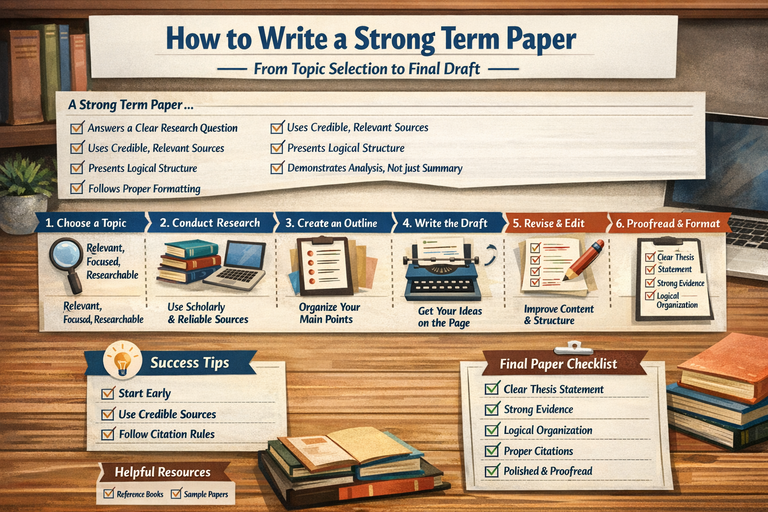
A high-quality term paper typically:
-
Answers a clear, focused research question
-
Uses credible and relevant academic evidence
-
Presents ideas in a logical, easy-to-follow structure
-
Demonstrates analysis and critical thinking, not just summary
-
Follows required formatting and citation rules
-
Is polished, clear, and readable, with good grammar and style
Instructors are not only grading what you know, but how well you argue, support, and present your ideas.
Step-by-Step Guide to Writing a Strong Term Paper
Step 1: Choose a Relevant, Manageable Topic
Your topic sets the foundation for the entire paper. A weak topic makes the rest of the process harder, while a strong one makes research and writing smoother.
A good term paper topic should be:
-
Relevant to the course objectives
-
Interesting enough to keep you motivated
-
Narrow enough to cover within the page limit
-
Researchable, with sufficient credible sources available
How to Narrow a Broad Topic
Start broad, then add focus and specificity:
-
Broad: Social media
-
Narrower: Social media and mental health
-
Focused: How Instagram use affects body image among teenage girls
-
More academic:
The relationship between image-based social media exposure and body dissatisfaction in adolescents (2015–2025)
Quick Topic Checks
Before finalizing your topic, ask yourself:
-
Can I express this topic as a clear research question?
-
Can I imagine a defensible thesis (an argument, not a fact)?
-
Are there enough quality sources available (often 8–15, depending on the assignment)?
If a topic is too broad, your paper becomes a surface-level list. If it’s too narrow, you may struggle to find evidence.
Step 2: Conduct In-Depth Research
Strong research is selective and purposeful, not endless. The goal is to build an evidence base that supports analysis and argument.
Use Credible Sources
Prioritize:
-
Peer-reviewed journal articles
-
Academic books or book chapters
-
Reputable academic databases (via your library)
-
Government or institutional reports (for data and statistics)
-
Primary sources when required (historical texts, interviews, documents)
Use caution with:
-
Random websites or personal blogs
-
Anonymous or uncited sources
-
Outdated materials (unless historically necessary)
-
Sources that repeat claims without evidence
A Time-Saving Research Strategy
-
Start with overviews
Use textbooks, review articles, or academic encyclopedias to understand key concepts. -
Collect core scholarly sources
Focus on recent peer-reviewed studies and foundational authors. -
Follow citations
Use reference lists and “cited by” features to find influential and related studies. -
Take structured notes
Record:-
Key findings
-
Page numbers
-
How each source relates to your argument
-
Track Sources Early
Don’t wait until the end to build your reference list. Record full citation details as you research to avoid last-minute stress and citation errors.
Step 3: Create a Detailed Outline
An outline transforms research into a coherent argument. Many weak term papers fail not because of poor research, but because ideas are poorly organized.
Basic Term Paper Structure
Introduction
-
Background and context
-
Research problem or question
-
Thesis statement
-
Brief roadmap (optional but helpful)
Body
-
Organized sections that support the thesis
-
Evidence combined with analysis
-
Counterarguments or limitations (when appropriate)
Conclusion
-
Restated thesis (in fresh wording)
-
Synthesis of key findings
-
Implications or recommendations
-
Suggestions for future research (optional)
Paragraph-Level Structure
Every strong paragraph should include:
-
Topic sentence – main idea
-
Evidence – data, example, or quotation
-
Analysis – explanation of why it matters
-
Link – transition to the next idea
Make Your Outline Truly Useful
Instead of listing only headings, include:
-
Key claims for each section
-
Which sources support each claim
-
Brief notes on how you will interpret the evidence
A detailed outline makes drafting faster and more focused.
Step 4: Write the First Draft
The first draft is about getting ideas onto the page, not perfection.
Drafting Strategies That Work
-
Write out of order start with the easiest section
-
Use placeholders like “(ADD SOURCE)” or “(EXPLAIN MORE)”
-
Focus on clarity first, polish later
Build Analysis, Not Just Summary
Avoid simply describing what sources say. Instead:
-
Compare studies: Do they agree or disagree?
-
Explain differences: methods, context, definitions
-
Identify patterns across multiple sources
-
Show how evidence supports your thesis
Strong term papers synthesize sources rather than listing them one by one.
Step 5: Revise Content and Structure
Revision is where good papers become excellent ones. Focus on ideas and organization before grammar.
Content Revision Checklist
-
Is the thesis specific and defensible?
-
Does every section support the thesis?
-
Is the evidence sufficient and appropriate?
-
Are claims properly supported with citations?
-
Have counterarguments or limitations been addressed?
Structure Revision Checklist
-
Does the introduction match the actual argument?
-
Are transitions smooth and logical?
-
Does each paragraph focus on one main idea?
-
Are any sections repetitive or off-topic?
Helpful technique:
Write a one- or two-sentence summary of each paragraph. If two summaries are the same, revise or combine.
Step 6: Proofread and Format
Proofreading is the final polish that improves readability and ensures you meet submission requirements.
Proofreading Tips
-
Read the paper out loud
-
Proofread in stages:
-
Sentence clarity and flow
-
Grammar and punctuation
-
Formatting and citations
-
-
Watch for:
-
Run-on sentences
-
Inconsistent verb tense
-
Vague words (“things,” “very,” “a lot”)
-
Unsupported claims
-
Formatting Essentials
Always follow your instructor’s guidelines for:
-
Font, spacing, and margins
-
Title page and headings
-
Page numbers
-
Citation style (APA, MLA, Chicago, etc.)
Double-check that:
-
Every in-text citation appears in the reference list
-
All references are cited in the text
-
Quotes and paraphrases are properly formatted
Success Tips for Writing an Excellent Term Paper
Start Early
Term papers reward planning. A realistic timeline:
-
Week 1: Topic selection and preliminary sources
-
Week 2: Research and note-taking
-
Week 3: Outline and first draft
-
Week 4: Revision, proofreading, and final formatting
Even with limited time, breaking the work into stages improves quality and reduces stress.
Use High-Quality Sources
Stronger sources lead to stronger arguments. Instructors can quickly tell when a paper relies on weak or unreliable references.
Follow Citation Rules Carefully
Citation:
-
Demonstrates academic integrity
-
Strengthens credibility
-
Allows readers to verify claims
-
Protects you from plagiarism
When in doubt, cite the source.
Helpful Support Tools: Reference Books and Sample Term Papers
Free reference books and sample term papers can be useful when used responsibly.
How They Help
-
Clarify structure and formatting expectations
-
Demonstrate strong thesis statements and argument flow
-
Show effective integration of evidence
-
Highlight the difference between summary and analysis
How to Use Them Ethically
-
Use samples as models, not templates
-
Never copy wording, structure, or unique ideas
-
Compare multiple examples to identify patterns
-
Rely on libraries, writing centers, and open educational resources
Final Term Paper Checklist (Before Submission)
-
✔ Topic is focused, relevant, and researchable
-
✔ Thesis is clear and consistently supported
-
✔ Outline structure is reflected in the final draft
-
✔ Evidence is credible, sufficient, and well-integrated
-
✔ Paragraphs emphasize analysis, not just summary
-
✔ Transitions and headings guide the reader
-
✔ Citations are accurate and properly formatted
-
✔ Formatting meets all assignment requirements
-
✔ Grammar and clarity have been carefully proofread
Final Thought
Writing a strong term paper is not about talent it’s about process. When you follow a clear, step-by-step approach and give yourself time to think, revise, and refine, your paper becomes more than an assignment. It becomes a well-argued piece of academic writing that clearly demonstrates your understanding and effort