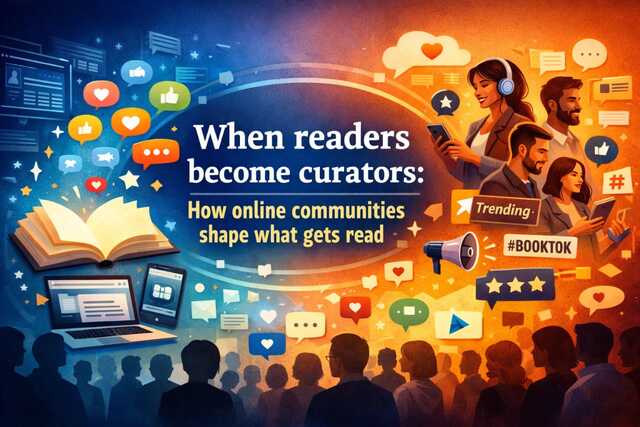
When Readers Become Curators: How Online Communities Shape What Gets Read
For most of modern publishing history, the question “What gets read?” was answered far upstream. Editors acquired manuscripts. Publishers decided which titles to print and promote. Reviewers in newspapers and trade journals signaled what mattered. Bookstores controlled shelf space. Readers chose from what was placed in front of them.
That system still exists but it no longer holds a monopoly on attention.
Today, online communities routinely determine which books break out, which backlist titles resurface, and even what kinds of stories get written next. This shift has little to do with platforms being inherently better at recommendation, and everything to do with a structural change in who holds cultural influence. Millions of readers now act as curators: signaling demand, amplifying enthusiasm, organizing taste, and turning what was once a private activity into a public, networked force.
This is a real transfer of power. Increasingly, popularity is shaped less by institutional push and more by collective pull. The strongest forces behind what rises now tend to be:
-
Requests — what readers ask for, rally around, and repeat
-
Reviews — how communities publicly validate, frame, and interpret books
-
Downloads and reads — behavioral proof that something is worth time
-
Sustained community interest — conversation that keeps a book alive
Publishers can still promote. But online communities can mobilize. And mobilization especially when it feels organic and social is often more persuasive than traditional marketing.
1) From Gatekeepers to Networks: How Curation Changed
Traditional book discovery relied on centralized filters: publishing houses, trade reviews, newspaper critics, and retail placement. Digital culture reorganized that model into something far more distributed and dynamic.
Today, readers gather across:
-
Forums and discussion boards (Reddit)
-
Social feeds (BookTok, Bookstagram, X)
-
Cataloging and tracking platforms (Goodreads, StoryGraph)
-
Fandom spaces (Discord, Tumblr)
-
Serial and subscription ecosystems (Wattpad, AO3, Kindle Unlimited)
In these spaces, taste becomes social. People don’t just read; they post reactions, annotate passages, argue interpretations, recommend titles, remix scenes into memes, and track their reading publicly.
Crucially, signals that were once invisible are now observable in real time: rating spikes, “currently reading” surges, library waitlists, fan art explosions, trending hashtags. In this environment, the book itself is only part of what’s being consumed. Readers also consume the conversation around the book and that conversation often determines whether someone picks it up at all.
2) Requests: Readers Don’t Just Choose They Shape the Shelf
One of the most underestimated forms of reader power is request culture. When communities collectively ask for something explicitly, repeatedly, and publicly they generate a kind of market clarity that authors, publishers, and platforms pay close attention to.
What requests look like online
-
“Looking for…” threads built around tropes, identities, or moods
-
Highly specific prompts (“cozy fantasy with low stakes,” “sapphic space opera with found family”)
-
Direct appeals to authors for sequels, spin-offs, or expansions
-
Library and bookstore request campaigns coordinated through social media
-
Preorder drives and crowdfunding pushes with shared goals
Why requests matter
Requests do two things simultaneously:
-
They reduce perceived risk. When thousands of readers ask for the same thing, that thing stops looking niche.
-
They define the product. Requests often specify tone, pacing, representation, content boundaries, and even aesthetic expectations.
Readers aren’t just selecting from what exists. They’re collectively drafting a brief for what should exist.
3) Reviews: Communities Don’t Just Rate Books They Assign Meaning
Reviews used to function as top-down verdicts. Today, they operate as an ongoing, many-to-many conversation.
What reviews do now
A) Create social proof
High review volume signals legitimacy. Even negative reviews can help by clarifying fit: “too slow and atmospheric” repels some readers while attracting others.
B) Enable taste-matching
Readers increasingly follow individual reviewers rather than institutions. These micro-curators function as trusted filters whose preferences feel more predictive than any professional endorsement.
C) Provide shared language
Communities invent shorthand that travels faster than plot summaries:
-
“slow burn”
-
“morally gray”
-
“closed-door romance”
-
“five-star heartbreak”
-
“rage read”
-
“comfort reread”
These labels help books spread because they make them instantly legible.
D) Apply post-publication pressure
Community reviews can surface harmful stereotypes, factual errors, or misleading marketing. Sometimes this curtails a book’s reach; sometimes it forces institutional response. Either way, readers are exercising editorial influence after release.
When reviews become campaigns
Because reviews are powerful signals, they can be weaponized: coordinated review-bombing, outrage cycles, harassment of authors or reviewers. This is the shadow side of reader curation when collective judgment turns punitive rather than interpretive.
4) Downloads and Reading Stats: Behavior Is the Loudest Recommendation
In digital ecosystems, what people do often matters more than what they say.
Key behavioral signals include:
-
Downloads and borrows
-
Completion rates
-
Rereads
-
Page reads in subscription models
-
Saves, shelves, and wishlists
These metrics are persuasive because they’re harder to fake at scale. When large numbers of readers finish quickly, reread, or save for later, platforms interpret that as momentum and momentum amplifies itself.
Backlist resurrection
One of the quiet revolutions of online reading culture is the revival of older titles. A viral recommendation can turn a decade-old novel into a bestseller again without a planned campaign. Readers collectively decide a book deserves another life and act on that belief.
5) Community Interest: Popularity Is Sustained by Conversation
Advertising can generate awareness. Conversation sustains relevance.
Community interest looks like:
-
Readalongs and buddy reads
-
Reaction threads and live commentary
-
Fan art, playlists, and edits
-
Shipping debates and trope analysis
-
Annotation guides and theory posts
-
“If you liked X, try Y” chains
These activities create a social layer that sits on top of the text. For many readers, participation in that layer is part of the appeal especially in genres driven by emotional experience.
The flywheel effect
Conversation creates curiosity. Curiosity creates readers. Readers create more conversation. Eventually, the book becomes a shared reference point and reading it becomes a way to belong.
6) Platforms Amplify Readers Steer
It’s easy to credit platforms for cultural hits. But platforms mainly provide infrastructure. Readers supply direction.
Algorithms respond to:
-
Frequency of mentions
-
Engagement velocity
-
Clustered interest within niches
-
Repeat interaction
Those signals originate with readers. Platforms are loudspeakers; communities choose what to shout.
7) What This Means for Publishers
Publishers still provide essential functions editing, design, distribution, scale but they increasingly respond to reader-led momentum rather than creating it from scratch.
Common adaptations include:
-
Acquiring proven titles from serial or self-publishing spaces
-
Repackaging backlist once it trends
-
Commissioning books that align with community tropes
-
Tracking early reader signals like wishlist growth and review velocity
In effect, communities now perform large-scale market testing for free.
8) What This Means for Authors
Craft remains essential but visibility now depends on social readability.
Authors must think about:
-
Positioning: Can readers explain the book easily?
-
Category clarity: Does it clearly fulfill or subvert genre expectations?
-
Discussion potential: Does it invite reaction, interpretation, or emotional response?
-
Discoverability over time: Not viral spikes, but sustained presence
This doesn’t require constant self-promotion. It requires understanding how books travel socially.
9) The Benefits of Reader-Led Curation
This shift has real advantages:
-
Niche stories find audiences
-
Discovery becomes more personal
-
Power disperses beyond a few institutions
-
Representation expands beyond traditional assumptions
Reader curation has opened space for stories that once struggled to pass legacy filters.
10) The Risks: Popularity Can Distort
Reader-driven systems can also reproduce problems:
-
Echo chambers
-
Virality favoring extremes
-
Harassment and pile-ons
-
Manipulated signals
-
Homogenized writing incentives
The answer isn’t returning power to old gatekeepers, but cultivating healthier norms around taste and critique.
11) How Readers Can Curate Responsibly
If readers shape what gets read, curation becomes a form of cultural stewardship.
Helpful practices include:
-
Reviewing with specificity, not cruelty
-
Naming personal context and preferences
-
Boosting midlist and debut titles
-
Resisting pile-ons
-
Using requests to signal what should exist
Curation is power. Taste is influence.
Conclusion: The New Gatekeepers Are Us
The most important change in reading culture isn’t the rise of any single platform it’s the rise of the reader as a public actor. Through requests, reviews, behavioral signals, and sustained conversation, readers now determine which books rise, return, and endure.
Publishers can open doors. But communities decide whether anyone walks through them and whether they bring others along.
In an era of infinite content, attention is the scarcest resource. Increasingly, readers aren’t just spending it. They’re directing it