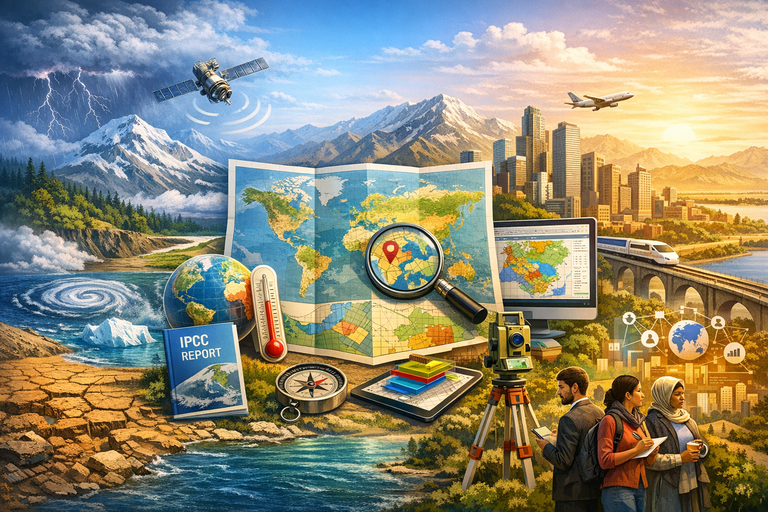
Best Free Geography Books: Climate, Maps, and Human Geography
Geography is the ultimate big-picture discipline. It explains how Earth’s physical systems climate, landforms, oceans, soils, and ecosystems interact with human systems such as cities, migration, culture, economies, and politics. At its best, geography helps us answer fundamental questions: Why do places look the way they do? Why do people live where they live? And how do environmental and human forces shape each other over time?
For decades, high-quality geography education depended heavily on expensive textbooks and proprietary software. Today, that barrier is rapidly disappearing. Universities, governments, and international organizations now publish free, legally accessible geography books and open textbooks that rival or exceed commercial alternatives.
This guide curates the best free geography books and book-length resources, organized around three core pillars of the field:
Climate systems and climate change
Maps, cartography, and GIS fundamentals
Human and population geography
These resources are ideal for students, educators, researchers, and independent learners, particularly in regions where access to paid academic materials is limited.
What Counts as a “Free Geography Book†(and What to Prioritize)
Not every “free PDF†online is reliable, legal, or educationally sound. The strongest free geography books typically fall into one of the following categories:
1. Open Textbooks (OER)
Open Educational Resources are textbooks released under Creative Commons licenses. They are designed for teaching and usually include:
Structured chapters
Maps, diagrams, and case studies
Review questions and exercises
Instructor supplements (in some cases)
2. Government and Intergovernmental Publications
Agencies such as USGS, NOAA, NASA, the United Nations, World Bank, and IPCC produce high-quality, peer-reviewed reports and book-length publications that are free by default. These are especially strong for:
Climate science
Environmental change
Population and development data
Spatial analysis and mapping
3. Author-Hosted Web Textbooks
Many leading geographers and GIS scholars publish complete textbooks online for free. These are widely used in universities and are often updated more frequently than print books.
4. Public-Domain Classics
Older geography texts can be valuable for understanding the history of geographic thought, though they are less suitable for modern GIS or climate science.
What to look for when choosing a free geography book:
Clear scope (physical, human, regional, or GIS)
Reputable author or institution
Multiple format options (PDF, EPUB, HTML)
Maps, figures, datasets, or exercises
Transparent licensing (Creative Commons, public domain, or government publication)
1) Best Free Books for Climate Systems (Weather, Climate, Climate Change)
Climate geography sits at the intersection of atmosphere, oceans, land surfaces, and living systems and connects those processes directly to hazards, resources, and societies.
IPCC Sixth Assessment Report (AR6)
Best for: Advanced students, educators, researchers, and policy readers
Why it stands out:
The IPCC Assessment Reports are the global gold standard for climate science. AR6 synthesizes thousands of peer-reviewed studies into a coherent picture of:
Climate processes and feedbacks
Observed and projected climate change
Regional impacts
Adaptation and mitigation strategies
The reports are dense but unmatched in credibility, data visualization, and geographic coverage.
Free access:
https://www.ipcc.ch/assessment-report/ar6/
Climate Change: Evidence & Causes (Royal Society & National Academies)
Best for: Beginners to intermediate readers
Why it stands out:
This concise book explains climate change clearly, without jargon or political framing. It is ideal for students encountering climate geography for the first time and works well in classrooms.
Free access:
https://royalsociety.org/topics-policy/projects/climate-change-evidence-causes/
Global Warming: Understanding the Forecast – David Archer
Best for: Motivated independent learners and advanced undergraduates
Why it stands out:
This book bridges physical climate mechanisms with forecasting models. It introduces readers to quantitative reasoning while remaining readable, making it an excellent transition from conceptual to analytical climate studies.
Free access:
https://forecast.uchicago.edu/
Natural Hazards and Disasters (Open Textbook)
Best for: Introductory college and advanced secondary students
Why it stands out:
Although broader than climate alone, this open textbook is essential for climate geography. It links atmospheric and hydrological processes to floods, droughts, storms, wildfires, and human vulnerability always with a spatial perspective.
Free access:
https://open.lib.umn.edu/naturalhazards/
How to Study Climate Systems Effectively
Begin with Evidence & Causes for foundational understanding
Use Natural Hazards and Disasters to connect climate processes to real-world impacts
Move to IPCC AR6 or Archer’s book for depth, data, and modeling
2) Best Free Books for Maps, Cartography, and GIS Basics
Maps are the language of geography. Understanding spatial representation, scale, projection, and spatial data is essential for nearly every branch of the discipline.
Essentials of Geographic Information Systems – Campbell & Shin
Best for: GIS beginners and introductory geography labs
Why it stands out:
A complete, structured GIS textbook covering:
Spatial data models
Coordinate systems
Georeferencing
Basic spatial analysis
Cartographic principles
Free access:
https://saylordotorg.github.io/text_essentials-of-geographic-information-systems/
Geospatial Analysis – de Smith, Goodchild & Longley
Best for: Intermediate to advanced GIS learners
Why it stands out:
This web-based textbook focuses on thinking spatially. It explores buffering, spatial autocorrelation, interpolation, modeling, uncertainty, and decision-making skills critical for research and professional GIS work.
Free access:
https://www.spatialanalysisonline.com/
QGIS Training Manual (Official Documentation)
Best for: Hands-on learners and practical labs
Why it stands out:
This is the definitive free guide to QGIS, the world’s leading open-source GIS software. Step-by-step lessons make it ideal for self-study or classroom use.
Free access:
https://docs.qgis.org/latest/en/docs/training_manual/
Map Projections—A Working Manual (USGS Professional Paper 1395)
Best for: Cartography students and serious GIS users
Why it stands out:
A technical but indispensable reference explaining how projections work, why distortion matters, and how to choose projections correctly.
Free PDF:
https://pubs.usgs.gov/pp/1395/report.pdf
Recommended Learning Path (Maps → GIS)
Learn map reading and projection basics
Study Essentials of GIS for structured theory
Practice weekly using the QGIS Training Manual
Advance to Geospatial Analysis for deeper spatial reasoning
3) Best Free Books for Human and Population Geography
Human geography examines how people shape and are shaped by place. Population geography adds demographic structure, movement, and change.
World Regional Geography (Open Textbook)
Best for: Introductory human and regional geography
Why it stands out:
This book builds global literacy by combining regional structure with thematic insights. It’s ideal for understanding spatial patterns across continents and countries.
Free access:
https://open.lib.umn.edu/worldgeography/
The Geography of Transport Systems – Jean-Paul Rodrigue
Best for: Intermediate learners and urban/economic geography students
Why it stands out:
A modern, freely accessible textbook covering transportation networks, globalization, ports, logistics, urban mobility, and spatial interaction.
Free access:
https://transportgeography.org/
World Population Prospects – United Nations (DESA)
Best for: Population geography and development studies
Why it stands out:
The definitive global demographic resource, providing data and analysis on fertility, mortality, age structure, migration, and population projections.
Free access:
https://population.un.org/wpp/
World Development Report – World Bank
Best for: Human geography at the intersection of economics and policy
Why it stands out:
Each annual report focuses on a theme jobs, inequality, migration, urbanization and includes maps, indicators, and spatial comparisons.
Free access:
https://www.worldbank.org/en/publication/wdr
The World Factbook – CIA
Best for: Quick country-level geographic reference
Why it stands out:
While not a textbook, it’s extremely practical for student research, offering standardized data on population, land use, urbanization, resources, and boundaries.
Free access:
https://www.cia.gov/the-world-factbook/
Building Strong Human & Population Geography Skills
Use World Regional Geography as your core framework
Integrate UN population data for evidence-based analysis
Apply transport geography to understand connectivity and globalization
Support arguments with World Bank indicators and reports
Where to Find More High-Quality Free Geography Books
If you’re building a larger JunkyBooks free geography library, these sources are consistently reliable:
Open Textbook Library: https://open.umn.edu/opentextbooks/
BCcampus OpenEd: https://open.bccampus.ca/
OER Commons: https://www.oercommons.org/
Directory of Open Access Books (DOAB): https://www.doabooks.org/
USGS Publications Warehouse: https://pubs.er.usgs.gov/
NASA Earth Observatory: https://earthobservatory.nasa.gov/
Why Geography Is a Perfect Fit for JunkyBooks
Free geography books align naturally with a “free books†platform because they are:
Highly searchable (students actively look for free geography and GIS textbooks)
Globally relevant across education systems
Rich in open and government-funded content
Easy to organize by subfield and skill level
Expandable into topic-specific hubs and Top-10 lists
Suggested Next Expansions for JunkyBooks
If you want, I can transform this into:
Three Top 10 Free Books posts (Climate / GIS / Human Geography)
Beginner vs. advanced study tracks with timelines
An SEO-optimized Geography Hub Page with filters (PDF, EPUB, HTML, license type)
An internal linking plan connecting Geography with Environmental Science, Urban Studies, and Data Analysis