Best Free Books for Improving Academic Writing Skills in 2026
Academic writing is one of the most important skills students can develop throughout their educational journey. Whether you are writing essays, research papers, laboratory reports, dissertations, case studies, or journal articles, your ability to communicate ideas effectively can significantly influence your academic success.
Unfortunately, many students struggle with academic writing. Common challenges include organizing ideas logically, developing strong arguments, citing sources correctly, maintaining a formal tone, and avoiding grammatical errors. While there are countless paid writing courses and textbooks available, the good news is that some of the best academic writing resources are completely free.
Today, universities, educational institutions, and nonprofit organizations provide high-quality open educational resources that help students master academic writing without spending money. These resources cover everything from grammar fundamentals to advanced research writing techniques.
This guide explores the best free books and resources for improving academic writing skills, how they can help you become a stronger writer, and practical strategies for using them effectively.
Why Academic Writing Skills Matter
Academic writing is much more than putting words on paper. It is the process of presenting ideas clearly, logically, and persuasively while supporting arguments with credible evidence.
Strong academic writing skills help students:
- Earn higher grades
- Communicate ideas effectively
- Develop critical thinking abilities
- Produce high-quality research papers
- Avoid plagiarism
- Improve professional communication
- Prepare for graduate studies and research careers
Regardless of your field of study, academic writing remains a fundamental skill that contributes to long-term educational and professional success.
Characteristics of Effective Academic Writing
Before exploring the best free books, it's important to understand what makes academic writing effective.
Good academic writing typically includes:
Clear Structure
Well-organized papers guide readers through ideas logically. Effective writing contains:
- An introduction
- Body paragraphs
- Evidence and analysis
- A conclusion
Strong Thesis Statements
A thesis statement clearly communicates the central argument or purpose of the paper.
Evidence-Based Arguments
Academic claims must be supported by:
- Scholarly sources
- Research findings
- Statistical evidence
- Relevant examples
Formal Language
Academic writing avoids slang, informal expressions, and overly conversational language.
Proper Referencing
Correct citation demonstrates academic integrity and gives credit to original authors.
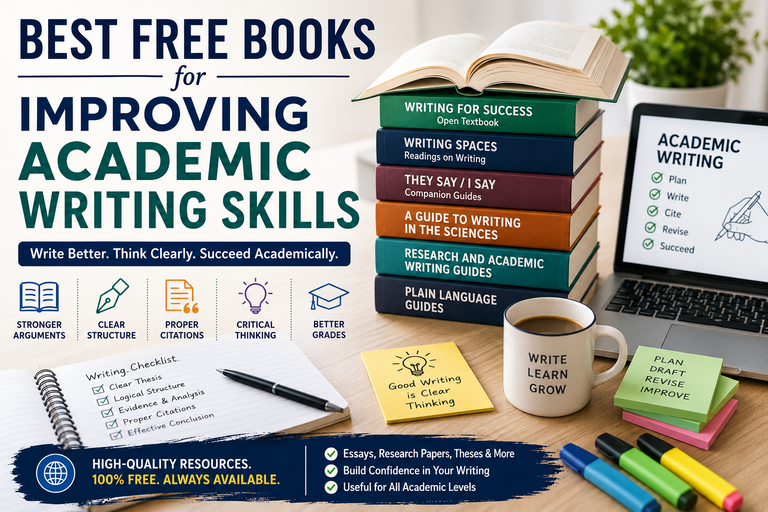
Best Free Books for Improving Academic Writing Skills
1. Writing for Success
Best For:
Beginners and undergraduate students.
One of the most widely recommended open textbooks, Writing for Success provides a complete introduction to academic writing fundamentals.
Topics Covered
- Sentence structure
- Grammar and punctuation
- Paragraph development
- Essay writing
- Research skills
- Revision techniques
Why Students Love It
The book uses simple language and practical examples, making it accessible even for students who lack confidence in their writing abilities.
Key Benefit
It builds a solid foundation for all forms of academic writing.
2. Writing Spaces: Readings on Writing
Best For:
Students seeking a deeper understanding of writing processes.
This open textbook series examines writing from multiple perspectives and helps students understand how writing functions as a communication tool.
Topics Covered
- Rhetorical analysis
- Audience awareness
- Writing processes
- Critical thinking
- Revision strategies
Key Benefit
Students learn not only how to write but why certain writing strategies are effective.
3. The Craft of Research
Best For:
Research papers and thesis writing.
Although the complete book may not always be available for free, many universities provide guides based on its principles.
Topics Covered
- Research question development
- Literature review techniques
- Evidence integration
- Argument construction
- Research paper organization
Key Benefit
Excellent preparation for major academic projects.
4. They Say / I Say Companion Resources
Best For:
Argumentative and analytical writing.
This influential writing framework teaches students how to engage with existing ideas and develop persuasive arguments.
Core Principle
Academic writing is essentially a conversation between scholars.
Students learn how to:
- Introduce opposing viewpoints
- Integrate quotations
- Develop counterarguments
- Strengthen claims
Key Benefit
Improves argumentative essay writing significantly.
5. Purdue Online Writing Lab (OWL)
Best For:
Citation, formatting, and writing support.
Although not a traditional book, Purdue OWL remains one of the most trusted academic writing resources worldwide.
Topics Covered
- APA formatting
- MLA formatting
- Chicago style
- Grammar
- Thesis development
- Research paper organization
Key Benefit
Provides instant answers to common academic writing questions.
6. A Guide to Writing in the Sciences
Best For:
Science, technology, engineering, and mathematics students.
Scientific writing requires a different approach than humanities writing.
This resource teaches students how to communicate technical information clearly and accurately.
Topics Covered
- Scientific reports
- Data interpretation
- Research writing
- Experimental methods
- Scientific arguments
Key Benefit
Develops precision and clarity in technical communication.
7. How to Write and Publish a Scientific Paper Resources
Best For:
Advanced research students.
Many universities provide free materials inspired by this well-known scientific writing guide.
Topics Covered
- Abstract writing
- Literature reviews
- Methodology sections
- Results presentation
- Journal publication preparation
Key Benefit
Excellent preparation for academic publishing.
8. Plain Language Writing Guides
Best For:
Students struggling with clarity.
Many government agencies publish free guides on plain language writing.
Topics Covered
- Simplifying sentences
- Eliminating jargon
- Improving readability
- Writing concise paragraphs
Key Benefit
Helps students write clearly and effectively without unnecessary complexity.
Best Free Books by Writing Skill Area
For Grammar Improvement
Recommended resources include:
- Open grammar textbooks
- University writing handbooks
- Online grammar guides
These resources help students improve:
- Sentence construction
- Subject-verb agreement
- Punctuation
- Word choice
- For Essay Writing
Useful resources focus on:
- Essay planning
- Thesis development
- Argument structure
- Paragraph organization
Students learn how to construct essays that are coherent, persuasive, and academically appropriate.
For Research Writing
Research-focused books teach:
- Source evaluation
- Literature reviews
- Academic argumentation
- Evidence integration
These skills are essential for college and graduate-level assignments.
For Citation and Referencing
Students should study resources that explain:
- APA Style
- MLA Style
- Chicago Style
- Harvard Referencing
Proper citation helps avoid plagiarism and strengthens academic credibility.
How to Use Free Academic Writing Books Effectively
Simply downloading books will not automatically improve writing skills. Students must actively engage with the material.
Step 1: Assess Your Writing Weaknesses
Identify areas requiring improvement.
Ask yourself:
- Do I struggle with grammar?
- Is my essay structure weak?
- Are my arguments unclear?
- Do I make citation mistakes?
Selecting resources based on specific weaknesses accelerates improvement.
Step 2: Practice Consistently
Writing is a skill that improves through repetition.
Practice by:
- Writing summaries
- Creating outlines
- Revising essays
- Completing textbook exercises
Consistent practice produces measurable results.
Step 3: Apply Lessons Immediately
After reading a chapter:
- Write a short essay
- Revise a previous assignment
- Implement newly learned techniques
Immediate application strengthens retention.
Step 4: Develop a Revision Habit
Strong writing emerges through revision.
When editing, evaluate:
- Clarity
- Organization
- Grammar
- Evidence
- Citation accuracy
Multiple revisions often transform average papers into excellent ones.
Common Academic Writing Mistakes Students Make
Writing Long, Complicated Sentences
Many students assume complexity equals sophistication.
In reality, clarity is more valuable than complexity.
Weak Thesis Statements
A vague thesis leads to an unfocused paper.
Always ensure your central argument is specific and clear.
Poor Paragraph Organization
Each paragraph should focus on one main idea supported by evidence.
Lack of Evidence
Unsupported claims weaken credibility.
Every major point should be backed by research or examples.
Incorrect Citation
Improper referencing can lead to plagiarism issues and lower grades.
Informal Language
Avoid slang, contractions, and conversational expressions in academic writing.
Benefits of Using Free Academic Writing Books
Students who consistently use quality writing resources enjoy numerous advantages:
Cost Savings
Access valuable learning materials without spending money.
Flexibility
Study anytime and anywhere.
Comprehensive Learning
Many free resources are as detailed as paid textbooks.
Long-Term Skill Development
Writing skills benefit students throughout their academic and professional careers.
Improved Confidence
Strong writing abilities increase confidence when tackling assignments and research projects.
A Four-Week Academic Writing Improvement Plan
Week 1: Grammar and Sentence Structure
Focus on:
- Grammar fundamentals
- Sentence clarity
- Paragraph organization
Practice rewriting poorly written sentences.
Week 2: Essay Structure
Learn:
- Thesis development
- Introductions
- Body paragraphs
- Conclusions
Write at least two practice essays.
Week 3: Research and Citation
Study:
- Source evaluation
- Research integration
- Citation styles
Practice referencing scholarly sources.
Week 4: Revision and Editing
Focus on:
- Editing techniques
- Proofreading
- Peer review
Revise previously written essays using a checklist.
Final Thoughts
Academic writing is one of the most valuable skills a student can develop. Strong writing improves academic performance, enhances critical thinking, and opens doors to future educational and professional opportunities.
Fortunately, improving your writing does not require expensive textbooks or paid courses. With the wealth of free academic writing books and open educational resources available today, any student can learn to write more clearly, argue more persuasively, and conduct stronger research.
The key is consistency. Read actively, practice regularly, seek feedback, and apply what you learn. Over time, these habits will transform your academic writing and help you achieve greater success in your studies.
Remember: great writers are not born they are developed through learning, practice, and persistence.