How to Understand Difficult Subjects Through Self-Study: Complete Guide
Every student encounters subjects that seem difficult, confusing, or intimidating. Whether it's mathematics, physics, chemistry, economics, statistics, philosophy, computer programming, or advanced literature, some topics can feel impossible to understand at first.
Many students assume that difficulty means they lack intelligence or natural ability. In reality, most learning challenges stem from ineffective study methods, weak foundations, lack of practice, or poor explanations not from a lack of capability.
The good news is that difficult subjects can be mastered through effective self-study. Some of the world's most successful students, researchers, entrepreneurs, and professionals have developed their expertise largely through independent learning.
Self-study is more than studying alone. It is a deliberate and structured process that helps learners understand complex concepts, strengthen critical thinking skills, and develop confidence in their abilities.
This guide explores practical strategies that can help anyone understand difficult subjects through self-study and achieve long-term academic success.
Why Some Subjects Feel Difficult
Before learning how to overcome difficult subjects, it's important to understand why they seem challenging in the first place.
Weak Foundational Knowledge
Many advanced topics build upon earlier concepts.
For example:
- Calculus depends on algebra.
- Organic chemistry relies on basic chemistry principles.
- Macroeconomics requires an understanding of microeconomics.
- Advanced literature analysis depends on reading comprehension skills.
When foundational knowledge is weak, new concepts become difficult to understand.
Fear and Negative Mindsets
Students often develop beliefs such as:
- "I'm not good at math."
- "Science is too difficult."
- "I can never understand this subject."
These beliefs create mental barriers that interfere with learning.
Passive Learning Habits
Many learners spend hours:
- Reading textbooks repeatedly
- Highlighting notes
- Watching lectures passively
While these activities may feel productive, they often result in limited understanding.
Lack of Practice
Subjects involving calculations, problem-solving, or analysis require active practice.
Without applying knowledge, understanding remains superficial.
Poor Study Organization
Trying to learn too much information at once can overwhelm the brain and reduce retention.
Fortunately, all these challenges can be addressed through effective self-study techniques.
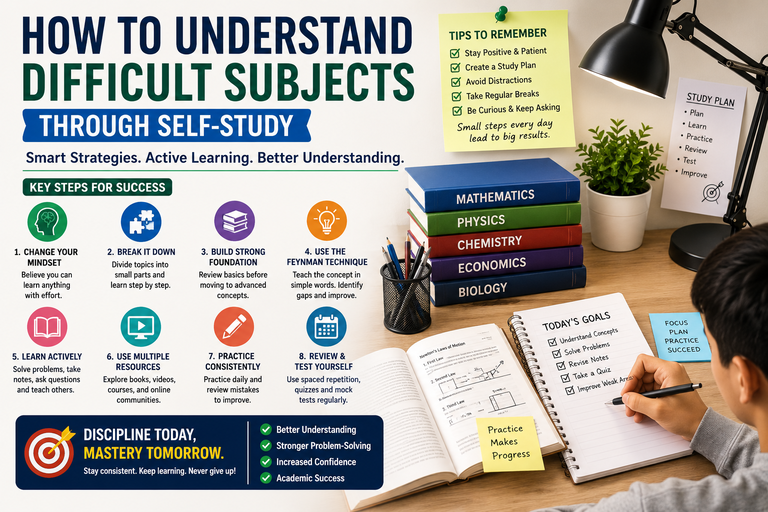
Step 1: Develop a Growth Mindset
Your mindset influences how you approach difficult subjects.
Students with a fixed mindset believe intelligence is permanent. When they struggle, they conclude they are incapable.
Students with a growth mindset understand that skills improve through effort, practice, and persistence.
Instead of saying:
"I can't understand this."
Say:
"I don't understand this yet."
This small shift encourages persistence and continuous learning.
Benefits of a Growth Mindset
- Increased resilience
- Better problem-solving
- Reduced fear of mistakes
- Greater confidence
Remember that every expert was once a beginner.
Step 2: Break Large Topics Into Smaller Parts
One reason subjects feel overwhelming is that students attempt to learn everything simultaneously.
Instead, divide topics into manageable sections.
For example, instead of studying "Physics," break it into:
- Motion
- Forces
- Energy
- Momentum
- Electricity
- Waves
Similarly, rather than studying "Economics" as one large subject, divide it into:
- Supply and demand
- Market structures
- Inflation
- Fiscal policy
- International trade
Breaking subjects into smaller units makes learning more manageable and measurable.
Step 3: Strengthen Your Foundation
Many students try to learn advanced concepts without mastering the basics.
If you consistently struggle with a topic, revisit prerequisite knowledge.
Examples
Calculus Problems?
Review:
- Algebra
- Functions
- Graphs
Chemistry Problems?
Review:
- Atomic structure
- Chemical bonding
- Periodic trends
Economics Problems?
Review:
- Basic market concepts
- Consumer behavior
- Opportunity cost
Strong foundations make advanced learning significantly easier.
Step 4: Use the Feynman Technique
The Feynman Technique is one of the most effective learning methods ever developed.
Named after physicist Richard Feynman, it focuses on simplifying complex ideas.
How It Works
Step 1
Study a concept.
Step 2
Close your notes.
Step 3
Explain the concept in simple language.
Imagine teaching it to a child.
Step 4
Identify areas where your explanation becomes unclear.
Step 5
Review those gaps and repeat the process.
If you cannot explain something simply, you probably do not understand it fully.
Step 5: Practice Active Learning
Active learning produces much better results than passive learning.
Passive Learning
Examples include:
- Re-reading textbooks
- Watching videos without taking notes
- Highlighting entire chapters
Active Learning
Examples include:
- Solving problems
- Teaching others
- Creating summaries
- Answering questions
- Drawing diagrams
Active learning forces the brain to process information deeply.
This improves both understanding and retention.
Step 6: Use Multiple Learning Resources
Not every explanation works for every learner.
If one textbook explanation feels confusing, seek alternative resources.
Useful options include:
- Educational YouTube channels
- Open educational textbooks
- Online courses
- Academic websites
- Discussion forums
- AI-powered learning tools
Sometimes a single alternative explanation can unlock understanding instantly.
Step 7: Practice Consistently
Practice transforms knowledge into mastery.
This is particularly important for subjects such as:
- Mathematics
- Physics
- Chemistry
- Accounting
- Programming
- Statistics
Effective Practice Strategy
Start Easy
Build confidence through basic exercises.
Increase Difficulty Gradually
Move to intermediate-level questions.
Attempt Challenging Problems
Apply concepts in unfamiliar situations.
Review Mistakes
Learning often occurs through error correction.
Every mistake provides valuable feedback.
Step 8: Study in Focused Sessions
Long study sessions often lead to fatigue and reduced concentration.
A more effective approach is studying in focused blocks.
Example Schedule
- Study for 50 minutes
- Take a 10-minute break
- Repeat
This method improves concentration and reduces mental exhaustion.
Many students find techniques such as the Pomodoro Method highly effective.
Step 9: Create Visual Learning Tools
Visual representations simplify complex information.
Useful tools include:
Mind Maps
Show relationships between concepts.
Flowcharts
Illustrate processes and sequences.
Diagrams
Useful in science and engineering.
Tables
Organize large amounts of information.
Flashcards
Support memorization and active recall.
Visual learning helps transform abstract concepts into understandable patterns.
Step 10: Ask Better Questions
Curiosity drives deeper understanding.
When studying, regularly ask:
- Why does this happen?
- How does this work?
- What causes this result?
- How is this concept applied?
- What would happen if conditions changed?
Questions encourage critical thinking and deeper learning.
Step 11: Use Spaced Repetition
Learning fades without review.
Spaced repetition combats forgetting by revisiting information at strategic intervals.
Suggested Review Schedule
- Day 1
- Day 3
- Day 7
- Day 14
- Day 30
This method significantly improves long-term retention.
Step 12: Test Yourself Frequently
Testing is one of the most effective ways to learn.
Methods include:
- Practice exams
- Past questions
- Flashcards
- Quizzes
- Self-created tests
Testing strengthens memory retrieval and reveals weak areas.
Students often overestimate their understanding until they test themselves.
Step 13: Build a Daily Study Routine
Consistency matters more than occasional bursts of effort.
Studying:
- 1–2 hours daily
is generally more effective than:
- 10 hours once a week
Daily study habits strengthen memory and create momentum.
Step 14: Be Patient With Complex Topics
Some concepts require multiple exposures before they become clear.
When a topic feels difficult:
- Take a short break
- Review foundational concepts
- Try a different resource
- Return later with fresh perspective
Persistence often leads to breakthroughs.
Many students understand difficult concepts only after revisiting them several times.
Common Self-Study Mistakes to Avoid
Studying Without a Plan
Lack of structure leads to wasted time.
Memorizing Without Understanding
Understanding should come before memorization.
Ignoring Weak Areas
Many students repeatedly study what they already know.
Focus instead on areas requiring improvement.
Avoiding Practice
Understanding grows through application.
Comparing Yourself to Others
Everyone learns at a different pace.
Focus on personal progress rather than competition.
Giving Up Too Quickly
Complex subjects often require time and persistence.
Sample Four-Week Self-Study Plan
Week 1: Build Foundations
- Review prerequisite concepts
- Create study notes
- Solve basic exercises
Week 2: Develop Understanding
- Learn intermediate concepts
- Practice daily
- Use the Feynman Technique
Week 3: Challenge Yourself
- Solve advanced problems
- Take practice tests
- Review mistakes
Week 4: Consolidate Knowledge
- Revise weak topics
- Complete mock examinations
- Strengthen retention through review
- Benefits of Self-Study
Students who master self-study often experience:
Deeper Understanding
They learn concepts rather than memorize facts.
Better Retention
Active learning improves long-term memory.
Stronger Problem-Solving Skills
Independent learning develops critical thinking.
Greater Confidence
Mastery increases self-belief.
Lifelong Learning Ability
Self-study skills remain valuable beyond formal education.
Improved Academic Performance
Students become more effective learners overall.
When to Seek Help
Self-study does not mean struggling alone indefinitely.
Seek assistance when:
- A concept remains unclear after repeated attempts
- You lack foundational knowledge
- You feel overwhelmed
- Progress has stalled
Helpful sources include:
- Teachers
- Tutors
- Study groups
- Online communities
- Educational forums
Strong learners know when collaboration is beneficial.
Final Thoughts
Understanding difficult subjects through self-study is entirely achievable. Success does not depend on natural talent alone it depends on strategy, consistency, and persistence.
By developing a growth mindset, strengthening your foundations, practicing actively, testing yourself regularly, and maintaining a structured study routine, you can transform even the most challenging subject into one of your strengths.
Remember, difficulty is not evidence that you cannot learn. It is evidence that you are encountering something new and expanding your abilities.
With patience, discipline, and the right self-study methods, any subject can become understandable, manageable, and ultimately enjoyable.