How to Learn an Entire Subject From Scratch Using Free Books
The ability to teach yourself a subject has never been more valuable. In an age where information is abundant and educational resources are available online at no cost, anyone with dedication and a structured approach can acquire knowledge that once required expensive tuition, formal enrollment, or access to specialized institutions.
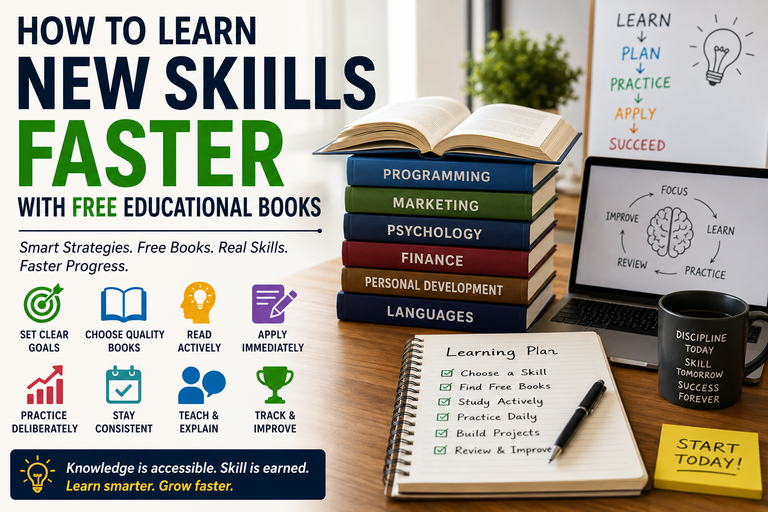
Whether you want to learn programming, economics, psychology, history, mathematics, finance, marketing, biology, or any other field, free books can provide a complete pathway from beginner to advanced levels. However, success in self-education is not determined by the number of books you download. It depends on how effectively you organize, study, apply, and retain what you learn.
Many self-learners fail because they consume information without a plan. They jump between resources, collect hundreds of PDFs, and never develop a systematic learning process. By contrast, successful independent learners follow a clear roadmap, study consistently, practice actively, and measure their progress.
This guide explains how to learn an entire subject from scratch using free books and transform scattered information into genuine expertise.
Why Free Books Are Powerful Learning Tools
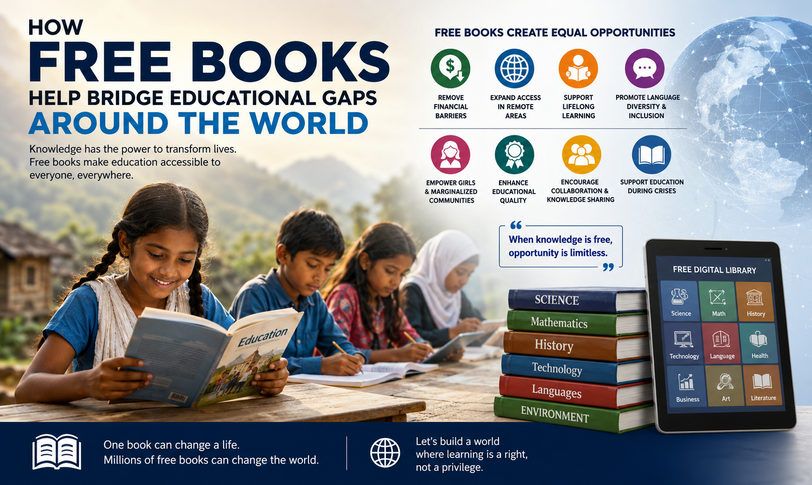
Free educational books offer advantages that many people overlook.
Unlike short articles or videos that often provide fragmented information, books are designed to teach subjects systematically. Authors build concepts gradually, ensuring that foundational knowledge supports more advanced material.
Free books can provide:
- Comprehensive subject coverage
- Structured learning progression
- In-depth explanations
- Exercises and practice questions
- Real-world examples
- Long-term reference material
With access to thousands of free educational books online, the challenge is no longer finding information it is organizing and using it effectively.
Define the Scope of What You Want to Learn
One of the biggest mistakes beginners make is choosing a subject that is too broad.
Saying, "I want to learn science" or "I want to learn programming" creates confusion because these fields contain numerous specialized areas.
Before gathering books, clarify exactly what you want to achieve.
Ask yourself:
- Why do I want to learn this subject?
- Is this for career advancement?
- Is this for academic purposes?
- Is this for personal interest?
- What level of expertise do I want?
For example:
Too Broad
- Learn business
- Learn technology
- Learn mathematics
More Specific
- Learn digital marketing
- Learn web development
- Learn calculus
Highly Focused
- Learn SEO content marketing
- Learn Python for data analysis
- Learn calculus for engineering
The clearer your objective, the easier it becomes to create a learning plan.
Build a Personal Curriculum
Universities do not teach subjects randomly. They organize topics in a logical sequence.
You should do the same.
A personal curriculum acts as your roadmap and helps prevent confusion.
How to Create One
Research:
- University degree structures
- Course outlines
- Educational syllabi
- Professional certification paths
Identify:
- Foundational topics
- Intermediate concepts
- Advanced areas
- Specialized subjects
For example, a self-study roadmap for economics might look like:
Foundation Level
- Basic mathematics
- Introduction to economics
- Economic principles
Intermediate Level
- Microeconomics
- Macroeconomics
- Economic history
Advanced Level
- Econometrics
- Development economics
- International economics
Specialized Level
- Behavioral economics
- Financial economics
- Public policy economics
Creating a roadmap transforms a large subject into manageable stages.
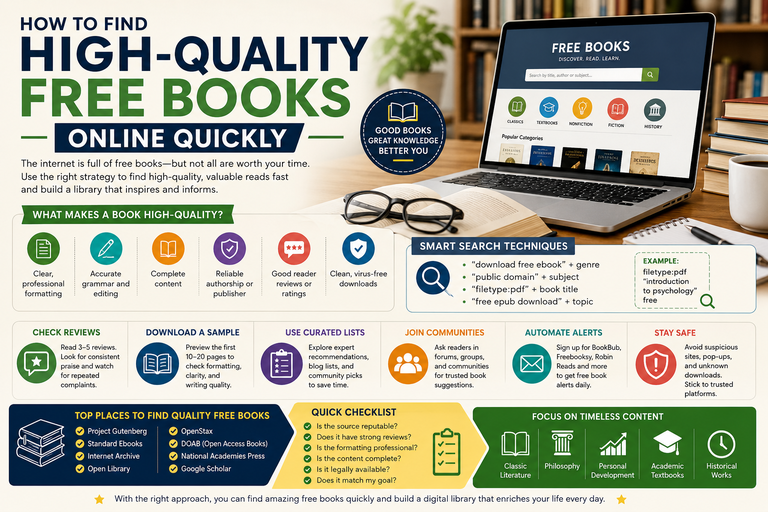
Find High-Quality Free Books
The quality of your resources significantly affects your learning outcomes.
A poorly written book can make simple concepts seem difficult, while an excellent book can make complex topics understandable.
Characteristics of a Good Educational Book
Look for books that provide:
- Clear explanations
- Logical structure
- Practice exercises
- Real-world examples
- Updated information
- Credible authorship
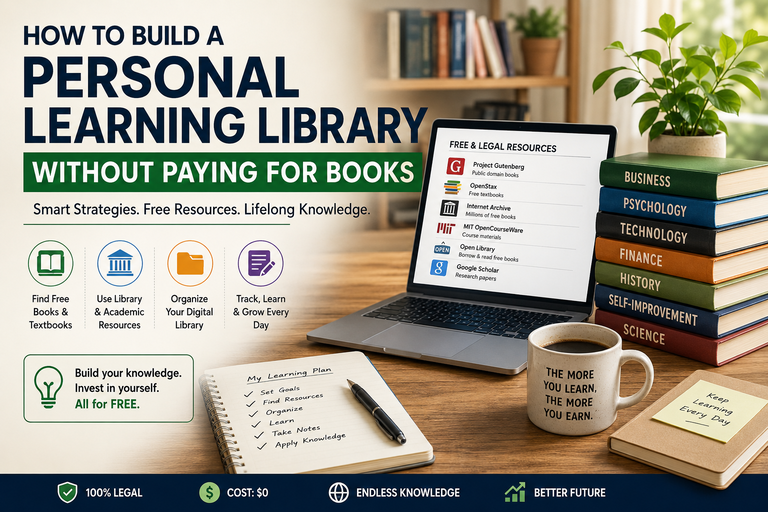
Excellent Sources of Free Books
Open Educational Resources
Open textbooks often rival expensive commercial textbooks in quality.
Popular sources include:
- Open educational textbook repositories
- University open course materials
- Public educational foundations
University Resources
Many universities provide:
- Course notes
- Reading lists
- Textbooks
- Lecture materials
Public Domain Libraries
These contain classic works in:
- Literature
- Philosophy
- History
- Political science
- Economics
Academic Repositories
Useful for advanced learning and research.
Examples include:
- Research papers
- Academic books
- Government publications
- Technical reports
Focus on trusted educational sources rather than random PDF downloads from unknown websites.
Choose One Core Textbook
Many learners make the mistake of studying from multiple books simultaneously.
This often creates confusion because different authors explain concepts differently.
Instead:
Choose:
- One primary textbook
- One optional supplementary resource
Your primary textbook should become the backbone of your learning.
A good core book should:
- Cover major concepts
- Progress logically
- Include exercises
- Explain fundamentals thoroughly
Complete the majority of the core text before heavily relying on additional materials.
Depth is more important than quantity.
Develop Active Reading Habits
Reading is not the same as learning.
Many people finish books and remember very little because they read passively.
Active reading transforms information into understanding.
Take Detailed Notes
After each chapter:
- Summarize key ideas
- Record important definitions
- List major concepts
- Write down questions
Avoid copying text word-for-word.
Instead, rewrite ideas using your own language.
This strengthens comprehension and retention.
Create Concept Maps
Concept maps help visualize relationships between ideas.
For example, in biology:
Cells → Tissues → Organs → Organ Systems
For economics:
Supply → Demand → Market Equilibrium → Pricing
Visual learning enhances understanding and memory.
Use the Feynman Technique
One of the most effective learning methods involves teaching.
After studying a concept:
- Pretend you are teaching it.
- Explain it in simple language.
- Identify areas where your explanation becomes weak.
- Review those areas.
- Repeat until the concept becomes clear.
If you cannot explain something simply, you probably do not understand it deeply enough.
Create a Consistent Study Schedule
Consistency produces better results than occasional intensive study sessions.
Many learners underestimate the power of regular daily effort.
Effective Study Routine Example
Daily Session
Reading: 45–60 minutes
Exercises: 30–45 minutes
Review: 15–20 minutes
Total:
- Approximately 1.5–2 hours daily
Over a year, this can amount to hundreds of hours of focused learning.
Use Multiple Resources Strategically
After completing a primary textbook, additional resources become valuable.
Different authors explain concepts differently.
A second perspective can:
- Clarify difficult topics
- Fill knowledge gaps
- Reinforce understanding
However, avoid switching resources too frequently.
Complete one major resource before moving to another.
Otherwise, you risk becoming trapped in perpetual beginner mode.
Apply What You Learn
Knowledge becomes permanent when it is used.
Application converts theory into skill.
The best method depends on the subject.
Programming
- Build projects
- Write code daily
- Solve coding challenges
Mathematics
- Solve problem sets
- Complete practice exams
- Work through proofs
History
- Analyze historical documents
- Write essays
- Compare historical interpretations
Philosophy
- Evaluate arguments
- Write reflections
- Engage in discussions
Marketing
- Create campaigns
- Analyze case studies
- Build portfolios
Application reveals weaknesses that reading alone cannot expose.
Test Yourself Regularly
Self-assessment is essential for measuring progress.
Without testing, you may overestimate your understanding.
Effective Self-Testing Methods
Practice Questions
Complete:
- End-of-chapter exercises
- Workbook activities
- Problem sets
Recall Testing
Close the book and answer:
- What did I learn today?
- Can I explain it from memory?
- Can I solve problems without notes?
Mock Exams
Use:
- Past university examinations
- Certification practice tests
- Online assessments
Testing strengthens memory and highlights knowledge gaps.
Build Knowledge Layer by Layer
Mastery is gradual.
Avoid rushing toward advanced topics.
Strong foundations accelerate future learning.
A typical progression looks like:
Stage 1: Foundations
Learn terminology and basic concepts.
Stage 2: Intermediate Understanding
Develop analytical thinking and problem-solving skills.
Stage 3: Advanced Competence
Study complex theories and specialized material.
Stage 4: Expert-Level Learning
Read:
- Academic papers
- Industry reports
- Specialized texts
Each stage builds naturally upon the previous one.
Avoid Common Self-Learning Mistakes
Resource Hoarding
Collecting books is not productive learning.
Thousands of downloaded PDFs mean nothing if they remain unread.
Focus on completing resources rather than accumulating them.
Skipping Fundamentals
Many learners jump directly to advanced topics.
This often creates confusion and frustration.
Strong foundations make advanced concepts easier to understand.
Passive Consumption
Highlighting every paragraph or watching endless educational videos without engagement creates an illusion of learning.
Active participation is necessary.
Perfectionism
You do not need to understand every detail before progressing.
Learning is iterative.
As your knowledge grows, earlier concepts often become clearer.
Track Progress Like a University Student
Universities use milestones for a reason.
Progress tracking creates motivation and accountability.
Create measurable goals such as:
- Completed introductory textbook
- Finished 100 practice exercises
- Passed a mock examination
- Built first project
- Completed intermediate textbook
- Read first academic paper
Visible progress encourages persistence.
Stay Motivated During Long-Term Learning
Mastering an entire subject requires patience.
Motivation naturally fluctuates.
The solution is not relying on motivation but building systems.
Strategies for Long-Term Success
Set Weekly Goals
Examples:
- Complete two chapters
- Solve 20 exercises
- Finish one project milestone
Join Learning Communities
Study groups and online forums provide:
- Accountability
- Feedback
- Encouragement
Measure Improvement
Keep records of:
- Books completed
- Projects built
- Tests passed
- Skills acquired
Progress fuels continued effort.
Example Blueprint: Learning Statistics From Scratch
To understand how the process works, consider statistics.
Step 1: Learn Prerequisites
Study:
- Basic arithmetic
- Algebra
- Graph interpretation
Step 2: Study an Introductory Statistics Textbook
Learn:
- Descriptive statistics
- Probability basics
- Data visualization
Step 3: Complete All Exercises
Practice calculations and data analysis.
Step 4: Study Intermediate Statistics
Learn:
- Hypothesis testing
- Regression analysis
- Sampling methods
Step 5: Apply Knowledge
Analyze real datasets.
Use statistical software and spreadsheets.
Step 6: Explore Advanced Topics
Study:
- Mathematical statistics
- Machine learning foundations
- Data science applications
Within six to twelve months of consistent study, many learners can achieve substantial competence.
Turning Self-Education Into Expertise
Learning a subject is not about finishing books—it is about developing understanding, skills, and the ability to solve problems.
As you progress:
- Read increasingly challenging materials.
- Engage with experts.
- Participate in discussions.
- Build projects.
- Conduct independent research.
Over time, your knowledge shifts from memorization to mastery.
The difference between a beginner and an expert is not access to information. It is the ability to organize, apply, and continually expand knowledge.
Final Thoughts
Learning an entire subject from scratch using free books is entirely possible in today's digital world. High-quality educational resources are more accessible than ever, allowing motivated learners to gain knowledge that was once limited to universities and expensive training programs.
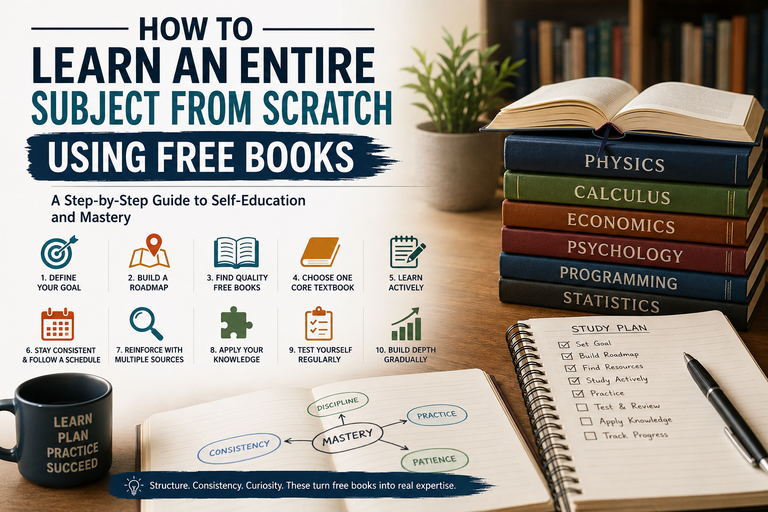
Success depends on following a structured approach:
- Define a clear learning goal
- Build a roadmap
- Choose quality books
- Study actively
- Practice consistently
- Test yourself regularly
- Apply what you learn
- Track your progress
Free books provide the information, but discipline, consistency, and deliberate practice transform that information into expertise.
Self-education is no longer an alternative to traditional learning it is one of the most powerful ways to acquire knowledge, develop skills, and achieve mastery in virtually any subject.