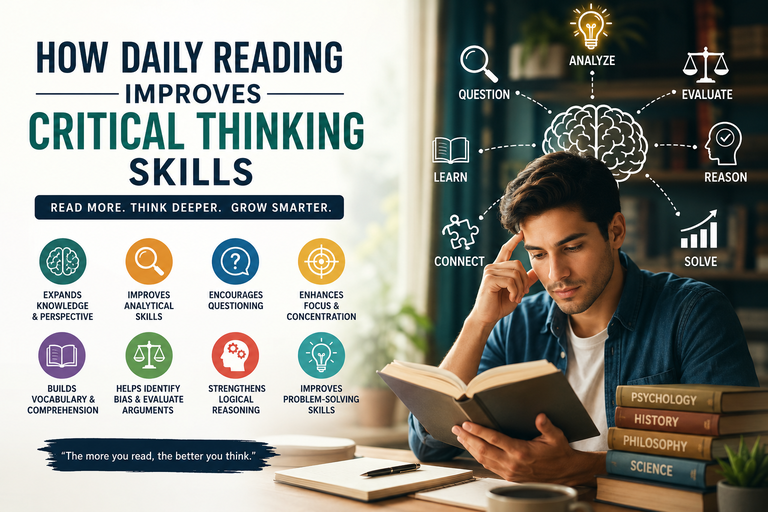
How Daily Reading Improves Critical Thinking Skills
In today's fast-paced digital world, people are exposed to an overwhelming amount of information every day. News articles, social media posts, advertisements, videos, podcasts, and online discussions constantly compete for attention. While access to information has never been easier, the ability to evaluate, analyze, and interpret that information has become increasingly important.
This is where critical thinking comes into play.
Critical thinking enables individuals to assess information objectively, identify logical flaws, distinguish facts from opinions, and make informed decisions. It is one of the most valuable skills for academic success, career development, and everyday life.
One of the most effective and accessible ways to develop critical thinking is through daily reading. Whether reading books, articles, essays, journals, biographies, or research papers, consistent reading exercises the brain and strengthens the mental processes necessary for thoughtful analysis.
Reading is more than simply absorbing words on a page. It is an active intellectual activity that challenges readers to engage with ideas, evaluate arguments, and build meaningful connections between concepts. Over time, these mental exercises significantly enhance critical thinking abilities.
This article explores how daily reading improves critical thinking skills and provides practical strategies for making reading a powerful tool for intellectual growth.
Understanding Critical Thinking
Before exploring the connection between reading and critical thinking, it is important to understand what critical thinking actually means.
Critical thinking refers to the ability to:
- Analyze information objectively
- Evaluate evidence and arguments
- Recognize assumptions
- Identify biases
- Draw logical conclusions
- Solve problems effectively
- Make informed decisions
Rather than accepting information at face value, critical thinkers question claims, examine evidence, and consider multiple perspectives before forming conclusions.
Critical thinking is not about being skeptical of everything. Instead, it is about approaching information with curiosity, reason, and careful judgment.
These skills are increasingly essential in modern society, where misinformation, conflicting viewpoints, and information overload are common challenges.
The Relationship Between Reading and Critical Thinking
Reading and critical thinking are closely connected because reading provides the raw material that stimulates thought.
Every time you read, your brain performs numerous cognitive tasks:
- Decoding language
- Interpreting meaning
- Connecting ideas
- Evaluating information
- Drawing conclusions
- Predicting outcomes
These mental processes strengthen the same cognitive abilities required for critical thinking.
The more consistently you read, the more opportunities your brain has to practice these skills.
1. Reading Expands Knowledge and Perspective
One of the greatest benefits of daily reading is exposure to diverse ideas and viewpoints.
Every book, article, or essay introduces readers to:
- New concepts
- Different cultures
- Alternative beliefs
- Historical events
- Scientific discoveries
- Personal experiences
As knowledge expands, individuals gain a broader understanding of the world around them.
This broader perspective helps readers:
- Compare competing ideas
- Recognize complexity
- Avoid simplistic thinking
- Understand multiple sides of an issue
People who read widely are often better equipped to evaluate situations objectively because they have encountered a variety of viewpoints and experiences.
Critical thinking thrives when individuals move beyond narrow perspectives and consider issues from multiple angles.
2. Reading Strengthens Analytical Skills
Analysis is at the heart of critical thinking.
Whenever readers engage with a text, they must identify:
- Main ideas
- Supporting evidence
- Key arguments
- Relationships between concepts
This process trains the brain to break complex information into manageable components.
For example, while reading a nonfiction book, a reader may need to:
- Determine the author's central argument
- Examine the evidence presented
- Assess the credibility of sources
- Identify weaknesses in reasoning
Repeated exposure to these activities develops strong analytical skills that extend beyond reading and into everyday decision-making.
3. Reading Encourages Curiosity and Questioning
Strong critical thinkers are naturally curious.
They do not simply accept information as true. Instead, they ask questions such as:
- Is this claim supported by evidence?
- What assumptions are being made?
- Could there be another explanation?
- What information is missing?
- Who benefits from this perspective?
Reading encourages this habit of inquiry.
When readers encounter unfamiliar ideas, controversial opinions, or surprising information, they are prompted to investigate further.
Over time, questioning becomes a natural part of how they process information, leading to deeper understanding and stronger critical thinking.
4. Reading Improves Concentration and Mental Focus
Critical thinking requires sustained attention.
Complex ideas cannot be evaluated effectively when the mind is distracted.
Daily reading helps improve:
- Focus
- Attention span
- Mental endurance
- Information retention
Unlike short social media posts or quick videos, books and long-form articles require readers to follow ideas over extended periods.
This mental discipline strengthens the brain's ability to stay engaged with complex information, making it easier to analyze and evaluate ideas thoughtfully.
5. Reading Enhances Vocabulary and Language Skills
Language is the foundation of thought.
The more words a person understands, the more precisely they can comprehend and express ideas.
Regular reading helps individuals:
- Expand vocabulary
- Understand nuanced meanings
- Improve communication skills
- Interpret complex texts
A richer vocabulary allows readers to recognize subtle distinctions between concepts, which is essential for critical analysis.
For example, understanding the difference between words such as "evidence," "assumption," "theory," and "fact" can significantly improve one's ability to evaluate arguments accurately.
6. Reading Develops Logical Reasoning
Many forms of writing present information through logical structures.
Academic papers, essays, and nonfiction books often follow a sequence that includes:
- Presenting a claim
- Providing evidence
- Explaining reasoning
- Drawing conclusions
By reading these structured arguments regularly, readers learn how logical reasoning works.
They become better at:
- Identifying cause-and-effect relationships
- Following logical sequences
- Evaluating evidence
- Detecting flawed arguments
These skills strengthen decision-making and improve the ability to assess information critically.
7. Reading Improves Memory and Cognitive Connections
Critical thinking often depends on the ability to connect new information with existing knowledge.
Daily reading strengthens memory by encouraging readers to:
- Recall previous information
- Compare concepts
- Identify patterns
- Build knowledge networks
As readers accumulate knowledge across different subjects, they become more capable of recognizing relationships between ideas.
For instance, someone reading about economics may draw connections to history, psychology, or politics.
These mental connections contribute to deeper understanding and more sophisticated critical thinking.
8. Reading Helps Identify Bias and Misinformation
In today's information-rich environment, the ability to detect bias is crucial.
Authors, organizations, and media outlets often present information from particular perspectives.
Daily reading helps readers become more skilled at identifying:
- Emotional language
- Selective evidence
- Hidden assumptions
- Persuasive techniques
- Misleading arguments
Over time, readers learn to distinguish between:
- Facts and opinions
- Evidence and speculation
- Objective reporting and biased commentary
These abilities are essential for navigating modern media and making informed judgments.
9. Reading Encourages Reflection and Independent Thought
Reading provides opportunities for self-reflection.
Many texts challenge readers to reconsider their beliefs, assumptions, and perspectives.
After reading, individuals often reflect on questions such as:
- Do I agree with this argument?
- What evidence supports my position?
- How does this relate to my experiences?
- Has this changed my perspective?
Reflection transforms passive reading into active learning.
This deeper engagement helps readers develop independent opinions rather than simply adopting the views of others.
10. Reading Enhances Problem-Solving Skills
Critical thinking and problem-solving are closely linked.
Books and articles frequently present:
- Real-world challenges
- Historical events
- Scientific discoveries
- Business case studies
- Personal experiences
By examining how others have approached and solved problems, readers gain valuable insights into different problem-solving strategies.
They learn to:
- Analyze situations
- Evaluate options
- Anticipate consequences
- Develop creative solutions
These skills can be applied to academic, professional, and personal challenges.
11. Reading Builds Patience and Intellectual Discipline
Deep thinking requires patience.
Many important ideas cannot be understood instantly.
Reading teaches individuals to:
- Engage with complexity
- Tolerate ambiguity
- Work through difficult concepts
- Seek deeper understanding
In an age of instant information and short attention spans, reading encourages a slower, more thoughtful approach to learning.
This intellectual discipline supports careful analysis and better decision-making.
12. Reading Improves Evaluation of Arguments
Every day, people encounter arguments in advertisements, news reports, political discussions, and workplace conversations.
Regular reading helps individuals assess the quality of these arguments.
They become more adept at identifying:
- Strong evidence
- Weak reasoning
- Logical fallacies
- Unsupported claims
- Contradictory information
As a result, they are less likely to be influenced by manipulation or misinformation and more likely to make informed choices.
Best Types of Reading for Developing Critical Thinking
While all reading offers benefits, certain materials are particularly effective for strengthening critical thinking skills.
Nonfiction Books
Subjects such as:
- History
- Psychology
- Science
- Economics
- Philosophy
encourage analytical thinking and evidence-based reasoning.
Academic Articles
Research papers challenge readers to evaluate methods, data, and conclusions.
Essays and Opinion Pieces
These expose readers to arguments that require careful evaluation.
Biographies and Autobiographies
Life stories provide insights into decision-making, leadership, and problem-solving.
Quality Journalism
Well-researched journalism helps readers understand complex issues and evaluate multiple perspectives.
Literary Fiction
Complex stories often explore human behavior, ethics, and social issues, encouraging deeper reflection.
How to Read Actively for Maximum Critical Thinking Benefits
Reading alone is valuable, but active reading amplifies its impact.
Ask Questions
While reading, ask:
- What is the author's main argument?
- What evidence supports this claim?
- Are there alternative viewpoints?
- Do I find this convincing?
Take Notes
Recording thoughts and observations improves engagement and retention.
Highlight Key Ideas
Mark important concepts, evidence, and insights.
Summarize in Your Own Words
Summarizing ensures genuine understanding rather than passive recognition.
Discuss What You Read
Conversations expose you to alternative interpretations and deepen comprehension.
Revisit Challenging Material
Complex ideas often reveal new insights upon repeated reading.
Building a Sustainable Daily Reading Habit
Consistency is essential for developing critical thinking through reading.
Consider these practical strategies:
Start Small
Begin with 15–20 minutes of reading daily.
Set Clear Goals
Decide how many pages, chapters, or minutes you will read each day.
Create a Reading Routine
Read at the same time each day to establish a habit.
Minimize Distractions
Choose a quiet environment where you can focus fully.
Read Diverse Materials
Explore different subjects and perspectives to broaden your understanding.
Track Progress
Maintain a reading journal or use a reading app to monitor growth.
Overcoming Common Reading Challenges
Lack of Time
Read during breaks, commutes, or before bed. Even short sessions can be effective.
Difficulty Concentrating
Start with shorter reading periods and gradually increase your reading time.
Information Overload
Focus on quality rather than quantity. Understanding is more important than speed.
Loss of Motivation
Choose topics that genuinely interest you while gradually expanding into new areas.
The Long-Term Benefits of Reading for Critical Thinking
People who maintain a daily reading habit often experience long-term advantages, including:
- Better decision-making
- Stronger communication skills
- Greater intellectual confidence
- Enhanced academic performance
- Improved professional effectiveness
- Increased adaptability to change
- More informed citizenship
These benefits accumulate over time, making reading one of the most valuable investments in personal growth.
Conclusion
Daily reading is one of the most powerful and accessible tools for developing critical thinking skills. By exposing readers to new ideas, strengthening analytical abilities, enhancing focus, expanding knowledge, and encouraging reflection, reading trains the mind to think more deeply and independently.
In an age where information is abundant but not always accurate, critical thinking has become an essential skill for success. Reading provides the mental exercise necessary to evaluate information carefully, recognize bias, solve problems effectively, and make informed decisions.
The goal is not simply to read more books or articles. The goal is to engage with ideas, question assumptions, and continuously expand your understanding of the world.
Every page you read is an opportunity to sharpen your mind. By making reading a daily habit, you invest in a skill that will benefit you for a lifetime: the ability to think clearly, critically, and independently.