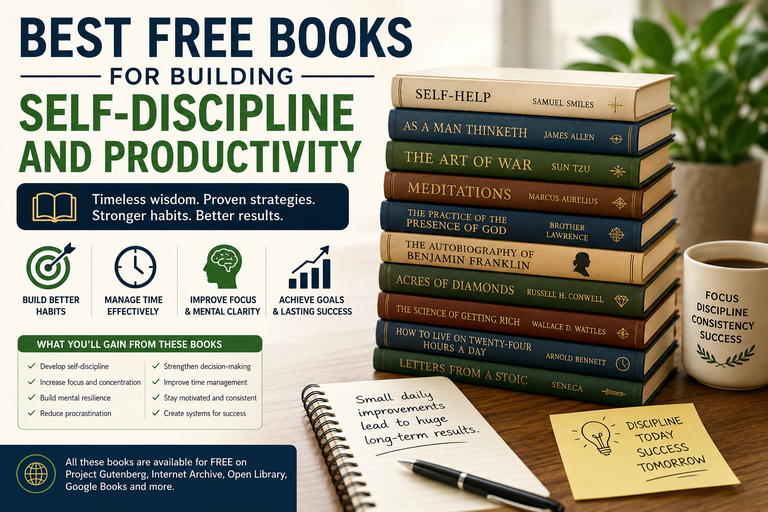
Best Free Books for Building Self-Discipline and Productivity
Success in any area of life rarely happens by accident. Whether pursuing academic excellence, career advancement, financial stability, or personal growth, two qualities consistently separate high achievers from the rest: self-discipline and productivity.
Self-discipline is the ability to control impulses, stay committed to goals, and take action even when motivation is lacking. Productivity, on the other hand, is the ability to use time, energy, and resources effectively to achieve meaningful results. Together, these skills form the foundation of long-term success.
The good news is that self-discipline and productivity are not traits people are born with—they are skills that can be learned and developed. One of the most effective ways to cultivate these skills is through reading.
Fortunately, many excellent books on discipline, focus, habits, time management, and personal development are available for free through public-domain libraries and digital archives. These timeless works continue to inspire millions of readers and provide practical lessons that remain relevant in today's fast-paced world.
This article explores some of the best free books for building self-discipline and productivity, the lessons they offer, and how you can apply their teachings to create a more focused and successful life.
Why Read Books on Self-Discipline and Productivity?
In an age dominated by social media, constant notifications, and endless distractions, maintaining focus has become increasingly difficult. Books on self-discipline and productivity offer valuable guidance for overcoming these challenges.
They can help you:
- Develop consistent habits
- Improve concentration and focus
- Manage time more effectively
- Build resilience and perseverance
- Reduce procrastination
- Strengthen decision-making abilities
- Increase accountability
- Create systems for long-term success
Unlike quick motivational content, books provide deeper insights and proven strategies that can lead to lasting behavioral change.
1. Self-Help by Samuel Smiles
Overview
Published in 1859, Self-Help is widely regarded as one of the first modern personal development books. Samuel Smiles argues that success is primarily achieved through personal responsibility, perseverance, hard work, and continuous self-improvement.
The book contains numerous examples of individuals who overcame obstacles through determination and disciplined effort.
Key Lessons
- Success is built through consistent effort.
- Character matters as much as talent.
- Small improvements compound over time.
- Persistence often outweighs natural ability.
Why It Improves Productivity
The book encourages readers to focus on daily actions rather than waiting for perfect circumstances. This mindset is essential for developing productive habits and achieving long-term goals.
2. As a Man Thinketh by James Allen
Overview
First published in 1903, this short but powerful book explores the relationship between thoughts, habits, and life outcomes.
James Allen emphasizes that our actions and circumstances are largely shaped by our mindset and thought patterns.
Key Lessons
- Thoughts influence behavior.
- Habits are formed through repeated thinking.
- Personal responsibility is critical for growth.
- Positive thinking supports positive action.
Why It Improves Productivity
Productivity begins in the mind. By learning to manage thoughts and cultivate constructive mental habits, readers can improve focus, discipline, and motivation.
3. The Art of War by Sun Tzu
Overview
Although originally written as a military strategy guide more than two thousand years ago, The Art of War contains timeless lessons about preparation, planning, leadership, and discipline.
Today, entrepreneurs, business leaders, athletes, and productivity experts frequently apply its principles to modern challenges.
Key Lessons
- Strategic planning is essential.
- Preparation reduces obstacles.
- Discipline creates consistency.
- Understanding strengths and weaknesses improves performance.
Why It Improves Productivity
The book teaches readers to work smarter rather than harder by emphasizing deliberate action and strategic decision-making.
4. Meditations by Marcus Aurelius
Overview
Written by Roman Emperor Marcus Aurelius, Meditations is one of the most influential works of Stoic philosophy.
The book is a collection of personal reflections on responsibility, self-control, resilience, and purposeful living.
Key Lessons
- Focus on what you can control.
- Accept challenges with composure.
- Avoid unnecessary distractions.
- Practice discipline consistently.
Why It Improves Productivity
Stoic principles help readers remain calm, focused, and productive despite setbacks, stress, and uncertainty.
5. The Practice of the Presence of God by Brother Lawrence
Overview
This spiritual classic teaches mindfulness and intentionality in everyday activities.
Brother Lawrence emphasizes performing even simple tasks with care, consistency, and attention.
Key Lessons
- Focus on the present moment.
- Value consistency over intensity.
- Approach daily responsibilities with purpose.
- Develop awareness and mindfulness.
Why It Improves Productivity
The ability to stay present and attentive is essential for maintaining focus and completing tasks effectively.
6. The Autobiography of Benjamin Franklin
Overview
Benjamin Franklin remains one of history's most admired examples of self-improvement and disciplined living.
His autobiography details his efforts to cultivate virtues, improve habits, and pursue lifelong learning.
Key Lessons
- Track personal habits.
- Create systems for accountability.
- Pursue continuous improvement.
- Reflect regularly on personal progress.
Franklin's Virtue System
Franklin developed a personal tracking system for thirteen virtues, including:
- Temperance
- Industry
- Resolution
- Order
- Frugality
He monitored his performance daily, an approach that resembles modern habit-tracking techniques.
Why It Improves Productivity
The book demonstrates how structured self-monitoring can dramatically improve discipline and personal effectiveness.
7. Acres of Diamonds by Russell H. Conwell
Overview
This motivational classic encourages readers to recognize opportunities that already exist within their current circumstances.
Rather than constantly searching elsewhere for success, Conwell argues that many opportunities are closer than we realize.
Key Lessons
- Success often begins with existing resources.
- Persistence creates opportunities.
- Focus beats constant searching.
- Consistent effort produces results.
Why It Improves Productivity
The book helps readers avoid distractions and direct their energy toward meaningful action.
8. The Science of Getting Rich by Wallace D. Wattles
Overview
Despite its title, this book focuses more on mindset, purposeful action, and disciplined thinking than on wealth itself.
Many modern personal development philosophies trace their origins to ideas introduced in this work.
Key Lessons
- Focus attention on goals.
- Act consistently toward desired outcomes.
- Avoid scattered effort.
- Maintain productive thought patterns.
Why It Improves Productivity
The emphasis on clarity, focus, and deliberate action aligns closely with contemporary productivity principles.
9. How to Live on Twenty-Four Hours a Day by Arnold Bennett
Overview
This classic time-management guide addresses a challenge that remains universal: making the most of limited time.
Arnold Bennett reminds readers that every person receives the same twenty-four hours each day.
Key Lessons
- Time is your most valuable resource.
- Small improvements accumulate over time.
- Scheduling increases productivity.
- Personal growth requires intentional effort.
Why It Improves Productivity
The book provides practical strategies for managing time more effectively and reducing wasteful habits.
10. Letters from a Stoic by Seneca
Overview
Seneca's letters contain practical advice on self-discipline, focus, priorities, and purposeful living.
Many modern productivity concepts echo the wisdom found in these ancient writings.
Key Lessons
- Protect your time carefully.
- Eliminate unnecessary distractions.
- Focus on what truly matters.
- Practice self-control consistently.
Why It Improves Productivity
The book encourages readers to live intentionally and avoid activities that contribute little to personal growth.
Additional Free Resources for Personal Development Books
Beyond the titles listed above, several online platforms offer thousands of free books on productivity, self-improvement, leadership, and personal development.
Project Gutenberg
One of the largest collections of public-domain books, offering tens of thousands of free titles.
Internet Archive
Provides access to books, educational materials, historical documents, and multimedia resources.
Open Library
Allows readers to borrow digital books from an extensive online collection.
Standard Ebooks
Offers professionally formatted editions of public-domain books optimized for modern devices.
Google Books
Contains a large collection of free and public-domain works.
Public Library Apps
Many local libraries provide free access to digital books through applications such as:
- Libby
- Hoopla
- BorrowBox
These services often include modern productivity and personal development titles in addition to classic works.
How to Apply What You Learn
Reading alone does not create change. The greatest benefits come from applying the lessons you discover.
Take Notes
Record important ideas, quotes, and action steps while reading.
Focus on One Improvement at a Time
Avoid trying to implement too many changes simultaneously.
Choose one habit and practice it consistently before moving to the next.
Create Systems
Successful people rely on systems rather than motivation alone.
Examples include:
- Daily planning routines
- Habit trackers
- Time-blocking schedules
- Accountability systems
Review Regularly
Revisit your notes and favorite passages to reinforce learning and maintain momentum.
Measure Progress
Track habits, productivity levels, and goal completion to identify areas for improvement.
Benefits of Reading Productivity and Discipline Books
Consistent exposure to personal development literature can lead to:
- Better time management
- Increased focus
- Improved self-control
- Stronger work ethic
- Greater resilience
- Reduced procrastination
- Enhanced decision-making skills
- Higher levels of personal and professional achievement
These benefits accumulate over time and can positively influence every area of life.
Conclusion
Building self-discipline and productivity does not require expensive seminars, premium courses, or costly coaching programs. Some of the most valuable lessons on focus, habits, perseverance, and personal effectiveness are available completely free through classic books that have stood the test of time.
Works such as Meditations, As a Man Thinketh, Self-Help, Letters from a Stoic, and How to Live on Twenty-Four Hours a Day continue to provide practical wisdom for modern readers seeking greater discipline and productivity.
The key is not simply reading these books but applying their lessons consistently. Small improvements made every day can compound into remarkable results over months and years.
Choose one book, commit to reading it carefully, take action on its teachings, and begin building the habits that support lasting success. Your future productivity and personal growth may depend on the choices you make today.