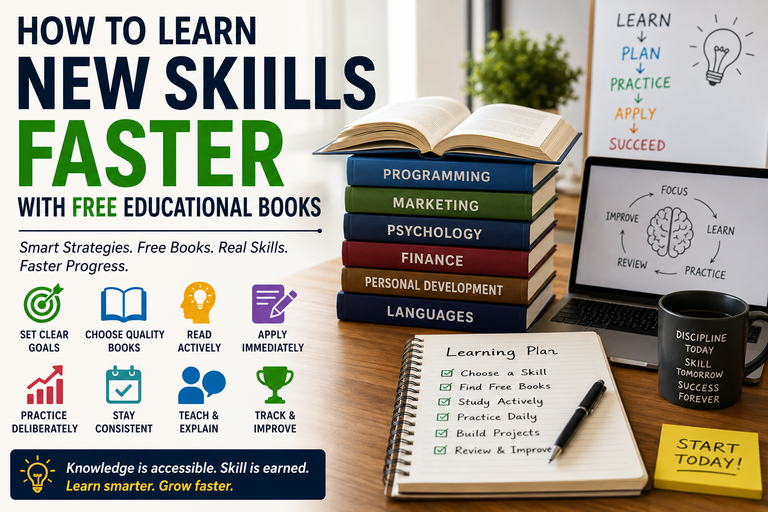
How to Learn New Skills Faster With Free Educational Books
The ability to learn new skills quickly has become one of the most valuable advantages in today's rapidly changing world. Technology evolves constantly, industries transform, and job requirements shift faster than ever before. Whether you want to improve your career prospects, start a business, master a hobby, or simply expand your knowledge, continuous learning is essential.
Fortunately, gaining new knowledge no longer requires enrolling in expensive courses or pursuing formal degrees. Thousands of high-quality educational books are available for free online, covering subjects such as programming, business, finance, psychology, graphic design, languages, leadership, marketing, and personal development.
However, simply downloading free books does not guarantee success. Many learners accumulate dozens of PDFs, read sporadically, and struggle to convert information into practical skills. The key to learning faster lies in how you use educational books, not just how many you collect.
This guide explains proven strategies that help transform free educational books into powerful tools for accelerated skill development.
Why Free Educational Books Are Powerful Learning Tools
Educational books remain one of the most effective learning resources available. Unlike short articles, social media content, or fragmented online tutorials, books provide structured and comprehensive knowledge.
Some major advantages include:
Depth of Knowledge
Books allow authors to explore topics thoroughly. Instead of presenting isolated tips, they explain principles, frameworks, and practical applications that build lasting understanding.
Organized Learning Structure
Most educational books are designed to guide readers from beginner concepts to advanced applications. This structured approach makes learning more efficient.
Self-Paced Learning
Unlike courses with strict deadlines, books allow learners to study according to their schedules and revisit difficult sections whenever necessary.
Long-Term Reference Material
Educational books serve as valuable resources long after the initial reading. You can return to specific chapters whenever you need clarification or refresh your understanding.
Cost-Free Access
With thousands of open-access books available online, learners can acquire valuable knowledge without financial barriers.
When combined with effective study techniques, free educational books can deliver learning outcomes comparable to many paid programs.
Step 1: Choose the Right Skill and Be Specific
One of the biggest mistakes learners make is selecting goals that are too broad.
For example:
Vague Goal:
"I want to learn business."
This objective is difficult to pursue because business is a massive field.
Instead, create specific learning targets such as:
- Learning digital marketing for small businesses
- Understanding personal financial management
- Building Python automation scripts
- Improving public speaking skills
- Learning data analysis with Excel
- Mastering social media advertising
Specific goals provide several advantages:
- Easier resource selection
- Better focus
- Reduced information overload
- Measurable progress
- Faster results
The more clearly you define the skill, the faster you can learn it.
Step 2: Find High-Quality Free Educational Books
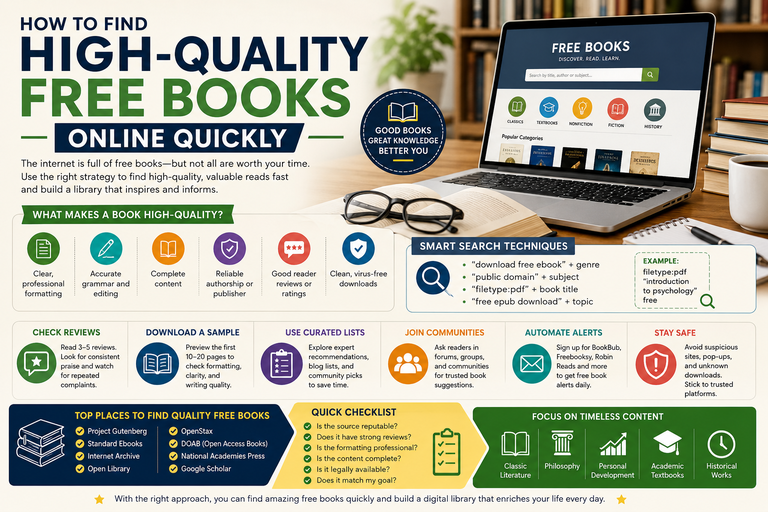
Not all free books offer the same value. Learning speed depends heavily on the quality of the resources you choose.
Open Educational Platforms
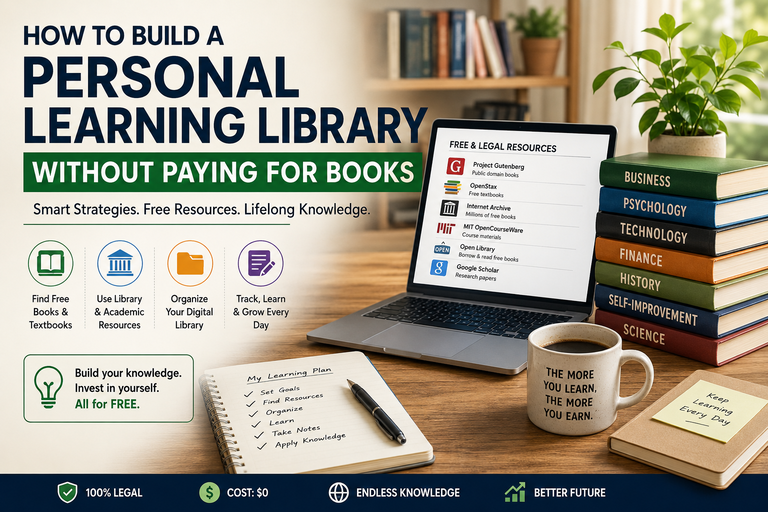
Several trusted organizations provide free educational materials reviewed by experts.
OpenStax
Offers peer-reviewed textbooks covering science, mathematics, economics, business, and social sciences.
Directory of Open Access Books (DOAB)
Provides access to thousands of academic books from reputable publishers.
MIT OpenCourseWare
Combines educational texts with lecture materials from university-level courses.
Project Gutenberg
An excellent source for classic literature, philosophy, and historical works.
Google Books
Offers previews and occasionally complete educational texts.
Industry and Professional Websites
Many professionals publish free educational guides, manuals, and introductory books to demonstrate expertise.
Examples include:
- Marketing handbooks
- Coding tutorials
- Financial planning guides
- Leadership workbooks
- Entrepreneurship manuals
These resources often contain practical knowledge directly applicable to real-world situations.
Promotional Offers
Online bookstores frequently provide free educational books through limited-time promotions.
Keeping an eye on these promotions can help you build a valuable digital library at no cost.
Step 3: Read With Purpose Instead of Reading Passively
Reading without a clear objective often results in poor retention.
Before opening any educational book, ask yourself:
- What problem do I want to solve?
- What skill do I want to develop?
- What result should I achieve after completing this book?
For example:
Instead of:
"I want to learn about marketing."
Set a goal such as:
"I want to create an effective marketing plan for a small business."
Having a specific purpose creates a focused learning experience and helps identify the most relevant information.
Step 4: Apply the Three-Phase Learning Method
One of the fastest ways to learn from books is to divide the learning process into three phases.
Phase 1: Preview
Before reading in detail:
- Scan the table of contents
- Review chapter titles
- Read summaries
- Examine diagrams and illustrations
- Identify key concepts
Previewing creates a mental framework that helps organize new information.
Phase 2: Active Reading
During reading:
- Take notes in your own words
- Highlight important ideas selectively
- Ask questions
- Connect concepts to previous knowledge
- Summarize each chapter
Avoid copying large sections of text. Rewriting concepts forces your brain to process information more deeply.
Phase 3: Immediate Application
Application is where real learning occurs.
After each chapter:
- Practice the skill
- Complete exercises
- Build a project
- Teach the concept
- Apply it in real situations
Examples:
Coding
Write a small program immediately after learning a concept.
Marketing
Develop a sample campaign using newly learned strategies.
Finance
Create a personal budget using financial principles from the book.
Public Speaking
Practice presentation techniques in everyday conversations.
Knowledge becomes skill only through application.
Step 5: Use Just-in-Time Learning
Many learners make the mistake of reading entire books before taking action.
A more effective approach is called just-in-time learning.
The process works like this:
- Identify a problem.
- Find the relevant chapter.
- Learn the solution.
- Apply immediately.
- Return later for deeper study.
For example, if you need to create a website, focus first on chapters related to website creation rather than reading every chapter in a programming book.
This approach accelerates learning by linking knowledge directly to practical needs.
Step 6: Combine Reading With Deliberate Practice
Reading introduces concepts, but practice develops expertise.
Researchers consistently find that high performers engage in deliberate practice rather than passive repetition.
Deliberate practice involves:
Focusing on Specific Sub-Skills
Instead of improving "graphic design," focus on:
- Typography
- Color theory
- Layout design
- Visual hierarchy
Increasing Difficulty Gradually
Challenge yourself slightly beyond your current level.
Seeking Feedback
Feedback helps identify weaknesses and accelerate improvement.
Sources of feedback include:
- Mentors
- Online communities
- Colleagues
- Self-evaluation
Repeating Consistently
Improvement comes from repeated, focused effort.
Books provide knowledge.
Practice develops competence.
Step 7: Create a Simple Weekly Learning System
Consistency is more important than intensity.
A structured learning schedule can dramatically improve progress.
Example Weekly Framework
Days 1–2
Read one or two chapters.
Day 3
Review notes and summarize key lessons.
Days 4–5
Apply concepts through exercises or projects.
Day 6
Build something practical using your new knowledge.
Day 7
Evaluate progress and identify areas for improvement.
Following a consistent system prevents procrastination and information overload.
Step 8: Use the Feynman Technique
One of the most effective learning methods is teaching.
The Feynman Technique works through four steps:
Step 1
Study a concept.
Step 2
Explain it in simple language as if teaching a beginner.
Step 3
Identify gaps in your understanding.
Step 4
Review and simplify your explanation further.
If you cannot explain a concept clearly, you probably do not understand it fully.
Teaching reveals weaknesses and strengthens comprehension.
Step 9: Limit the Number of Books
A common mistake among self-learners is collecting too many resources.
This often leads to:
- Information overload
- Reduced focus
- Incomplete learning
- Analysis paralysis
A better strategy is:
- Choose one primary book.
- Select one supplementary resource.
- Complete both thoroughly.
- Move on to the next topic.
Mastery comes from depth, not accumulation.
Step 10: Build a Personal Knowledge System
Successful learners organize information for future use.
Consider using tools such as:
- Notion
- OneNote
- Obsidian
- Evernote
- Physical notebooks
- Flashcards
- Mind maps
Store:
- Key concepts
- Frameworks
- Action steps
- Personal insights
- Lessons learned
- Common mistakes
A personal knowledge system transforms scattered information into a reusable learning asset.
Step 11: Focus on Output Rather Than Input
Many learners measure success by the number of pages read.
A better question is:
"What can I create with what I've learned?"
Examples of productive outputs include:
- Blog posts
- Websites
- Business plans
- Marketing campaigns
- Data dashboards
- Presentations
- Research summaries
- Automation tools
Output demonstrates real learning.
Reading creates potential.
Producing creates results.
Step 12: Track Progress Visually
Visible progress increases motivation and consistency.
Track metrics such as:
- Chapters completed
- Hours studied
- Practice sessions completed
- Projects finished
- Skills mastered
Simple tracking methods include:
- Progress charts
- Habit trackers
- Learning journals
- Checklists
- Digital dashboards
Watching progress accumulate reinforces positive learning habits.
Step 13: Review and Reinforce Knowledge
Learning is not complete after reading.
Without review, much of the information will be forgotten.
Use spaced repetition:
After One Day
Conduct a quick review.
After One Week
Summarize key concepts again.
After One Month
Apply the knowledge in a new project or situation.
Repeated exposure strengthens memory and improves long-term retention.
Common Mistakes That Slow Learning
Avoid these common traps:
Reading Without Practicing
Knowledge alone does not create competence.
Learning Too Many Skills Simultaneously
Focus on one major skill at a time.
Highlighting Everything
Excessive highlighting reduces effectiveness.
Avoiding Difficult Sections
Growth often occurs in challenging areas.
Consuming Without Producing
Always create something with what you learn.
Constantly Switching Resources
Finish valuable books before moving to new ones.
Avoiding these mistakes can dramatically accelerate progress.
Example: Learning Graphic Design Faster With Free Books
Suppose you want to become a better graphic designer.
A structured approach might look like this:
Week 1
Download a free design fundamentals book.
Week 2
Study typography principles.
Week 3
Recreate five professional layouts.
Week 4
Learn color theory.
Week 5
Design sample posters using new concepts.
Week 6
Share work online and gather feedback.
Week 7
Revise designs based on feedback.
Week 8
Build a small portfolio.
This combination of reading, practice, feedback, and iteration produces rapid improvement.
The Long-Term Benefits of Learning Through Free Educational Books
Developing skills through educational books offers benefits beyond immediate knowledge acquisition.
These include:
- Greater self-discipline
- Improved critical thinking
- Enhanced problem-solving abilities
- Increased adaptability
- Better career opportunities
- Lifelong learning habits
- Greater confidence in tackling new challenges
As your ability to learn improves, acquiring future skills becomes easier and faster.
Conclusion
Free educational books have transformed access to knowledge. Today, anyone with an internet connection can learn valuable skills that were once available only through expensive institutions and training programs.
However, learning faster requires more than simply reading. It demands a deliberate system built around clear goals, active engagement, immediate application, consistent practice, and regular review.
To maximize your results:
- Choose a specific skill
- Use high-quality educational books
- Read actively
- Apply concepts immediately
- Practice deliberately
- Focus on producing real-world outcomes
- Track progress consistently
- Review what you learn
The most successful learners understand a simple truth: information is abundant, but skill comes from action.
Knowledge is freely available.
Mastery is earned through consistent practice.
Use free educational books strategically, and they can become one of the most powerful tools for accelerating personal and professional growth.