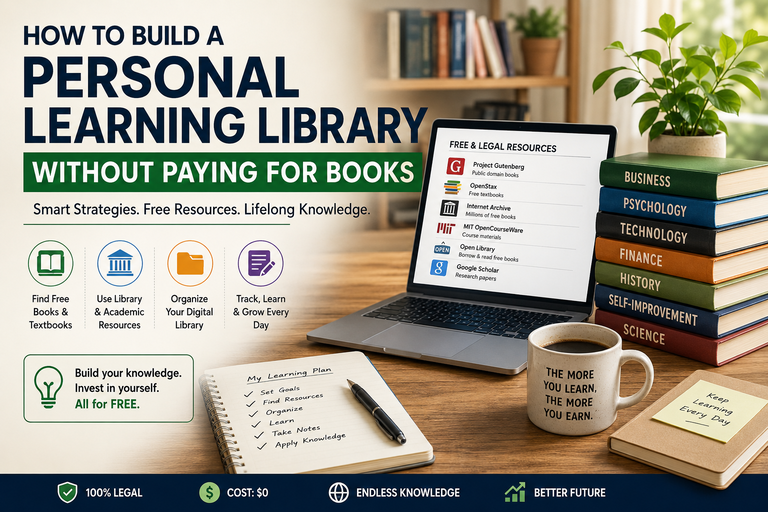
How to Build a Personal Learning Library Without Paying for Books
Knowledge has never been more accessible than it is today. In previous generations, building a personal library often required significant financial investment, physical storage space, and access to bookstores or academic institutions. Today, however, the internet has transformed the way we acquire and organize information. Thousands of high-quality books, textbooks, research publications, and educational resources are available legally and free of charge.
A personal learning library is more than a collection of books. It is a carefully curated system of knowledge that supports your goals, expands your expertise, and provides resources you can revisit throughout your life. Whether you want to improve your professional skills, earn academic qualifications, start a business, or simply become a more informed person, building a learning library can accelerate your growth.
The best part is that you don't need to spend money to create one. By leveraging public-domain works, open educational resources, digital library services, and free online publications, you can build a library worth hundreds or even thousands of dollars at no cost.
This guide explains how to create a valuable, organized, and sustainable personal learning library without paying for books.
Why Build a Personal Learning Library?
Before discussing where to find free books, it is important to understand why a personal learning library matters.
A well-designed learning library offers several advantages:
Continuous Access to Knowledge
Unlike temporary courses or borrowed resources, a personal library gives you ongoing access to information whenever you need it.
Faster Learning
Having relevant resources organized in one place reduces the time spent searching for information and allows you to focus on learning.
Long-Term Skill Development
A personal library supports consistent growth in areas that matter most to your career, education, and personal interests.
Improved Retention
When books, notes, summaries, and learning materials are stored together, it becomes easier to review concepts and reinforce understanding.
Greater Independence
A strong learning library allows you to become a self-directed learner who can acquire new skills without relying entirely on formal education.
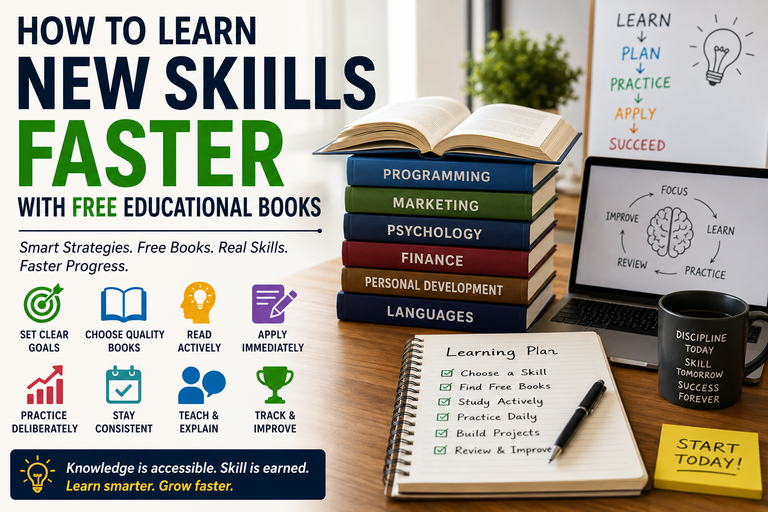
Define Your Learning Goals First
One of the most common mistakes people make is downloading hundreds of books without a clear purpose. This often leads to information overload and a library filled with materials that are never used.
Before collecting resources, identify your learning objectives.
Ask yourself:
- What skills do I want to develop?
- What knowledge will help me achieve my goals?
- What subjects interest me most?
- Am I learning for work, education, entrepreneurship, or personal growth?
Common learning categories include:
- Programming and software development
- Business and entrepreneurship
- Personal finance and investing
- Marketing and sales
- Psychology and self-development
- Health and wellness
- History and philosophy
- Data science and artificial intelligence
- Leadership and management
- Academic research
When your goals are clear, every book you add serves a purpose.
Use Public Domain Libraries for Timeless Knowledge
Public domain books are works whose copyrights have expired or are no longer protected. These books are completely legal to download, share, and read.
Many of history's most influential books are available through public domain collections.
Popular Public Domain Resources
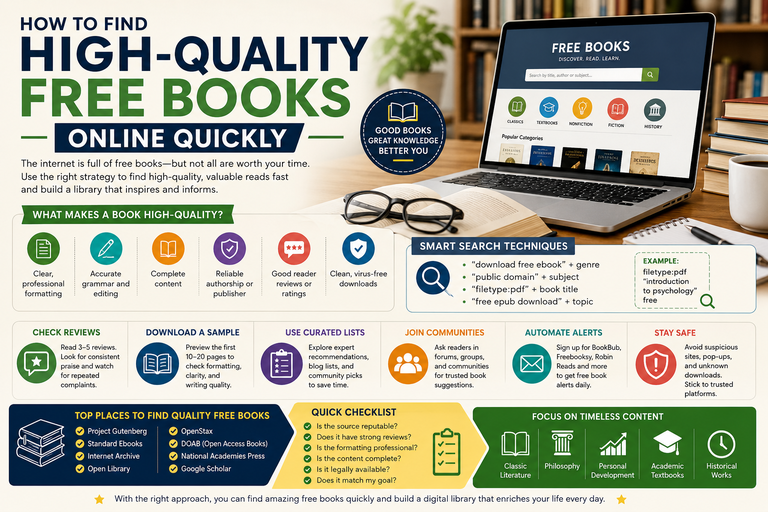
- Project Gutenberg
- Standard Ebooks
- Internet Archive
- Open Library
These platforms contain valuable resources in areas such as:
- Literature
- Economics
- Philosophy
- History
- Political science
- Science fundamentals
- Psychology
Many classic books continue to provide insights that remain relevant today. Reading foundational works helps build deep understanding that complements modern learning materials.
Access Free Academic Textbooks
Educational institutions around the world increasingly support open-access learning. This movement has led to the publication of thousands of free textbooks that rival traditional commercial alternatives.
Excellent Sources for Free Textbooks
OpenStax
OpenStax provides peer-reviewed textbooks used in universities worldwide.
Subjects include:
- Biology
- Chemistry
- Physics
- Statistics
- Business
- Economics
- Psychology
Directory of Open Access Books (DOAB)
DOAB offers a large collection of scholarly books from reputable academic publishers.
MIT OpenCourseWare
MIT publishes course materials, lecture notes, textbooks, and assignments from many of its programs.
Open Research Library
This platform provides access to academic books and educational resources across numerous disciplines.
National Academies Press
Offers free access to authoritative publications on science, engineering, health, and public policy.
These resources can help you acquire university-level knowledge without paying tuition or textbook fees.
Use Your Local Library's Digital Services
Many people overlook one of the most valuable educational resources available: the public library.
Modern libraries often provide digital access to:
- eBooks
- Audiobooks
- Research databases
- Scholarly journals
- Magazines
- Educational courses
Popular library platforms include:
- Libby
- OverDrive
- Hoopla
A single library card can unlock access to thousands of books that would otherwise cost substantial amounts of money.
Take Advantage of Free eBook Promotions
Many publishers and authors offer books for free as part of promotional campaigns.
Popular sources include:
- Amazon Kindle Free Books
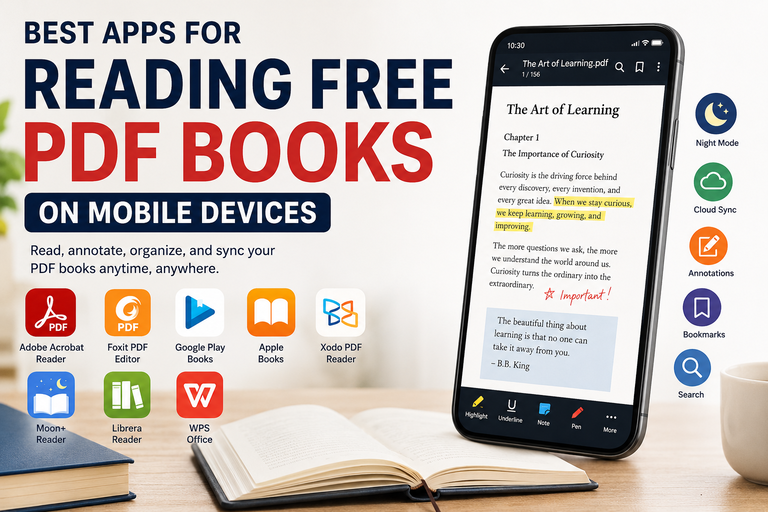
- Google Play Books
- Kobo Free Books
- Apple Books Free Titles
When using promotional offers:
Check Reviews
Look for books with strong ratings and positive reader feedback.
Focus on Quality
Avoid downloading books simply because they are free.
Prioritize Evergreen Topics
Books covering leadership, productivity, communication, business fundamentals, and technical skills often provide long-lasting value.
These promotions can help you build a collection of modern and practical resources.
Explore Government and Institutional Publications
Governments, universities, and international organizations publish extensive educational materials that are freely accessible.
Examples include:
Scientific and Technical Resources
- NASA research publications
- Environmental reports
- Engineering documents
Economic and Business Resources
- World Bank reports
- International Monetary Fund publications
- Government financial literacy guides
Health and Medical Resources
- World Health Organization publications
- Public health reports
- Medical education materials
These resources are often written by experts and supported by extensive research.
Build a Digital Library System
Finding books is only part of the process. Organization determines how useful your library becomes over time.
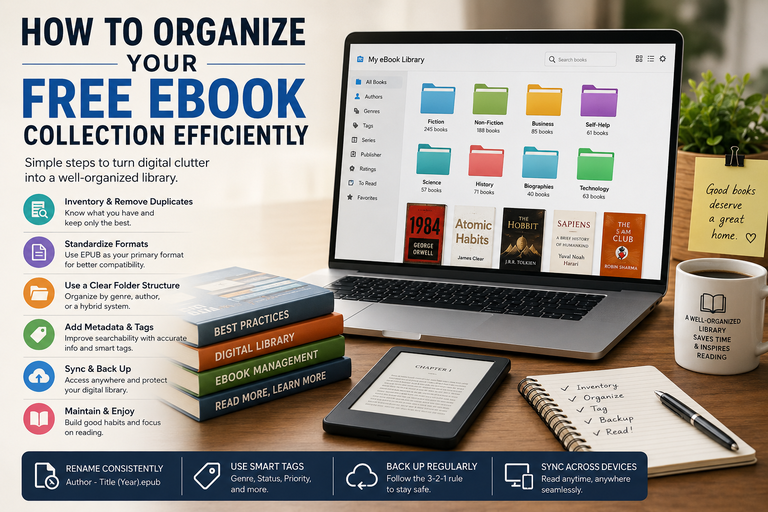
Create a Master Folder Structure
A simple structure might look like this:
Learning Library/
│
├── Business/
├── Technology/
├── Psychology/
├── Health/
├── Finance/
├── History/
└── Personal Development/
Organizing resources by subject makes retrieval faster and more efficient.
Standardize File Names
Consistent naming improves searchability.
Example:
Author - Book Title (Year).pdf
This format keeps your collection clean and professional.
Use eBook Management Software
As your library grows, managing hundreds of files manually becomes difficult.
Calibre
Calibre is one of the most powerful free eBook management tools available.
Features include:
- Metadata editing
- Format conversion
- Tagging and categorization
- Search and filtering
- Digital catalog creation
- Device synchronization
Using a dedicated management system transforms a simple folder collection into a functional knowledge database.
Curate Rather Than Hoard
The temptation to download everything is strong.
However, information overload can reduce learning effectiveness.
Instead:
- Download selectively
- Focus on relevance
- Remove duplicates
- Delete low-quality resources
- Review your collection regularly
A library of 100 carefully selected books is often more valuable than a collection of 10,000 unread files.
Include Both Theory and Practice
A balanced learning library should support both understanding and application.
For every major subject, try to include:
Foundational Books
Explain core concepts and principles.
Practical Guides
Provide actionable techniques and strategies.
Case Studies
Show real-world examples.
Workbooks and Exercises
Encourage active learning.
Reference Materials
Offer quick access to essential information.
For example, a programming library might include:
- Computer science fundamentals
- Coding tutorials
- Language reference manuals
- Project-based learning resources
This combination promotes deeper learning.
Leverage Creative Commons and Open Licenses
Many modern authors intentionally release books under open licenses.
Search for:
- Open access books
- Creative Commons textbooks
- Open educational resources (OER)
- Free licensed publications
These materials are often professionally produced and legally shareable.
The open-access movement continues to expand, making high-quality education increasingly accessible.
Integrate Multimedia Learning Resources
Books are valuable, but they should not be your only resources.
Consider including:
- Research papers
- Whitepapers
- Lecture notes
- Study guides
- Slide presentations
- Educational PDFs
- Course handouts
- Infographics
Keeping all learning materials within a single system creates a more complete knowledge base.
Keep Your Library Updated
A learning library should evolve alongside your interests and goals.
Schedule regular reviews to:
- Remove outdated content
- Replace old editions
- Add new discoveries
- Improve folder organization
- Archive completed materials
Regular maintenance keeps your collection useful and relevant.
Back Up Your Collection
Losing years of accumulated knowledge can be frustrating.
Follow the 3-2-1 backup strategy:
Three Copies
Keep three versions of your library.
Two Storage Methods
For example:
- Computer
- External hard drive
One Off-Site Backup
Use cloud storage such as:
- Google Drive
- Dropbox
- OneDrive
A reliable backup system protects your investment of time and effort.
Create a "Current Focus" Section
Many learners struggle because they try to study too many books at once.
Create a dedicated folder:
Learning Library/
└── Current Focus/
Place three to five actively studied resources inside.
Benefits include:
- Better concentration
- Reduced distractions
- Improved completion rates
- Clear learning priorities
Update the folder monthly as your goals change.
Track What You Learn
A library becomes significantly more valuable when paired with a learning-tracking system.
Keep:
- Reading logs
- Study journals
- Book summaries
- Key insights
- Project notes
- Action plans
Tracking progress helps convert information into practical knowledge.
Create Personal Summaries and Knowledge Notes
Reading alone is not enough. The most successful learners actively process information.
After completing a book:
Write a Summary
Capture the main ideas in your own words.
Extract Key Frameworks
Document models, systems, and strategies.
Build Reference Sheets
Create one-page summaries for quick review.
Record Actionable Insights
Identify specific lessons you can apply immediately.
Over time, your notes become a personalized knowledge repository that may be more valuable than the original books.
Prioritize Long-Term Value
Not all books provide equal returns.
Focus on resources that teach:
- Foundational principles
- Critical thinking
- Problem-solving skills
- Technical expertise
- Professional competencies
Avoid filling your library with:
- Trend-driven content
- Low-quality PDFs
- Repetitive materials
- Unverified information
High-quality resources compound in value over time.
Example: Building a Free Business Learning Library
Suppose your goal is to learn business and entrepreneurship.
You could:
- Download economics classics from public-domain libraries.
- Access free business textbooks through OpenStax.
- Collect marketing and management books from retailer promotions.
- Add World Bank and industry reports.
- Organize everything under a dedicated Business folder.
- Create summaries for each completed resource.
- Store business templates and case studies alongside your books.
Within a few months, you could assemble a comprehensive business library that would otherwise cost hundreds or even thousands of dollars.
Conclusion
Building a personal learning library without paying for books is not only possible it is easier today than at any point in history. Through public-domain collections, open-access textbooks, digital library services, government publications, and free eBook promotions, anyone can create a powerful educational resource at zero cost.
The true value of a learning library does not come from the number of books it contains. It comes from careful curation, effective organization, regular use, and the knowledge you gain from it.
Start with your goals, gather high-quality resources, organize them thoughtfully, and continuously refine your collection. Over time, your personal learning library will become a lifelong asset that supports learning, professional growth, and intellectual development.