How to Study Effectively Using Only Free Online Resources
Studying with free online resources is no longer a backup plan it can be a full, effective education strategy. You can learn almost any subject without paying for textbooks, courses, or tutoring, as long as you replicate what tuition usually provides: structure, practice, feedback, and accountability.
This article provides a complete, practical system for studying effectively using only free online resources whether you’re preparing for exams, switching careers, or teaching yourself a new subject from scratch.
1) Start with a Clear Goal
Free resources are abundant, so the first skill is choosing what to focus on and what to ignore. Vague goals lead to random studying.
Turn Your Goal into an Outcome
Instead of general goals like:
-
“Learn biology”
-
“Get better at programming”
-
“Study economics”
Use outcome-focused goals:
-
“Pass the AP Biology exam in 10 weeks”
-
“Build and deploy a simple web app”
-
“Write a 2,000-word essay explaining inflation with data and citations”
Define Your Scope in One Paragraph
Write a short scope statement:
-
What you are learning
-
What you are not learning (yet)
-
How you’ll prove mastery (exam score, project, portfolio, or paper)
This prevents drifting into endless browsing or random topics.
2) Build a “Free Curriculum”
Free learning often suffers from fragmentation. To counter this, create a structured curriculum using a primary resource (“spine”) and supplements.
Spine + Supplements Method
Spine (choose one):
-
An open textbook (e.g., OpenStax)
-
A full free course syllabus (MIT OpenCourseWare, university sites)
-
Exam specifications (AP, IB, CLEP, professional certifications)
Supplements (1–3 options):
-
Alternative explanations (videos or second textbooks)
-
Extra practice problems
-
Community or forum for questions
Trying to learn from 10+ resources at once slows progress. Keep it simple.
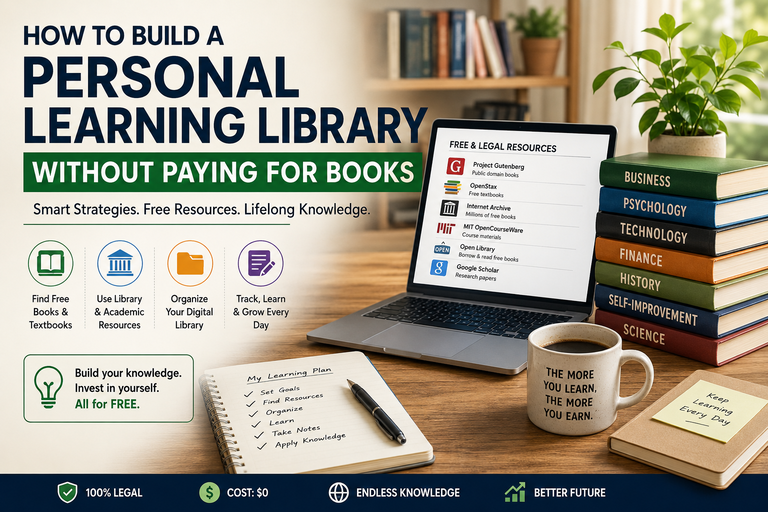
High-Quality Free Curricula Sources
-
OpenStax (peer-reviewed textbooks)
-
MIT OpenCourseWare (full course content)
-
Khan Academy (structured, practice-heavy learning)
-
Coursera/edX (audit courses for free)
-
Saylor Academy (free full courses, optional low-cost exams)
-
University repositories (syllabi, lecture notes, problem sets)
-
Government/NGO training sites (finance, public health, statistics)
3) Use Active Learning
Simply reading or watching is not studying. True learning requires retrieval and application.
The Study Loop
For each topic:
-
Preview (5 min): skim headings, definitions, examples
-
Learn (20–40 min): read/watch carefully
-
Recall (10 min): close resources and write what you remember
-
Practice (20–60 min): solve problems, write responses, complete drills
-
Review (5 min): check solutions, log mistakes
Daily Retrieval Practice
-
Answer questions without notes
-
Summarize a concept on one page
-
Take a timed quiz
-
Teach the concept aloud as if tutoring someone
4) Make Practice the Main Event
Skill-based subjects require frequent, structured practice.
For Math, Science, Programming
-
Solve problem sets daily
-
Keep an “error log” of mistakes
-
Redo problems after 2–3 days
-
Interleave old and new topics
For Writing or Humanities
-
Write short pieces regularly
-
Use rubrics to evaluate your work
-
Compare against strong examples
-
Revise intentionally
For Language Learning
-
Combine input (reading/listening) and output (speaking/writing)
-
Use spaced repetition for vocabulary
-
Practice pronunciation with shadowing and recordings
-
Engage in language exchange for feedback
5) Build Feedback into Your System
Feedback accelerates improvement. Free resources don’t grade you automatically, so create your own feedback loops.
Free Feedback Methods
-
Forums and communities: Stack Exchange, subject-specific subreddits
-
Open-source coding communities: code reviews, pull requests
-
Peer study groups: Discord, WhatsApp, Telegram
-
Public practice: blogs, essays, recorded presentations
-
Answer keys & solution manuals
-
Past exams & marking schemes
Self-Feedback Checklist
-
Did I define terms correctly?
-
Can I reproduce methods without notes?
-
Can I solve a new problem?
-
Can I explain why the solution works?
6) Manage Information Overload
Free learning fails when you hoard resources instead of finishing tasks.
Overload Prevention Rules
-
Use one primary spine for 80% of learning
-
Add new resources only to fill specific gaps
-
Limit active resources to:
1 spine + 1 backup explanation + 1 practice source + 1 community
Build a Simple Resource Library
-
Keep a document with spine resources, practice links, and a syllabus tracker
-
Put extras in an “optional later” list
7) Use Proven Study Techniques
Spaced Repetition
Review over increasing intervals (1, 3, 7, 14 days) to retain knowledge longer.
Interleaving
Mix topics instead of repeating one type of problem to improve flexibility.
Dual Coding
Combine words with diagrams, flowcharts, or concept maps.
Elaboration & “Why” Questions
Ask:
-
Why does this rule exist?
-
What changes if assumptions are removed?
-
How does this connect to what I already know?
8) Build a Sustainable Weekly Schedule
Consistency is more important than intensity.
Example Weekly Plan
-
Mon–Thu: new content + practice (60–120 min/day)
-
Fri: cumulative review + error-log fixes (60–90 min)
-
Sat: project work or practice test (90–180 min)
-
Sun: rest or light review
Daily Structure
-
10 min: review (spaced repetition)
-
45–90 min: study loop
-
10 min: plan next session
9) Use Free Tools to Stay Organized and Accountable
Organization Tools
-
Google Docs / Notion (notes, syllabus, planning)
-
Anki (spaced repetition)
-
Zotero (research sources)
-
GitHub (track coding projects)
-
Simple spreadsheets (progress tracking)
Accountability Tools
-
Study-with-me livestreams or co-working rooms
-
Public goal posts (weekly updates)
-
Study pacts with friends
-
Habit trackers
10) Subject-Specific Free Resource Stacks
Math: OpenStax + Khan Academy + forum support
Programming: Free textbook/course + coding projects + GitHub/community feedback
History/Social Science: Open textbook + writing exercises + peer review
Language Learning: Grammar book + graded readers + exchange communities
11) Common Mistakes and Fixes
-
Watching videos without practice: do at least equal time practicing
-
Switching resources constantly: commit to one spine for 30 days
-
Never testing yourself: do weekly quizzes + monthly full tests
-
No projects/artifacts: create essays, reports, presentations, designs
-
Studying only when motivated: schedule small, consistent sessions
12) A Complete “Free-Only” Study Workflow
-
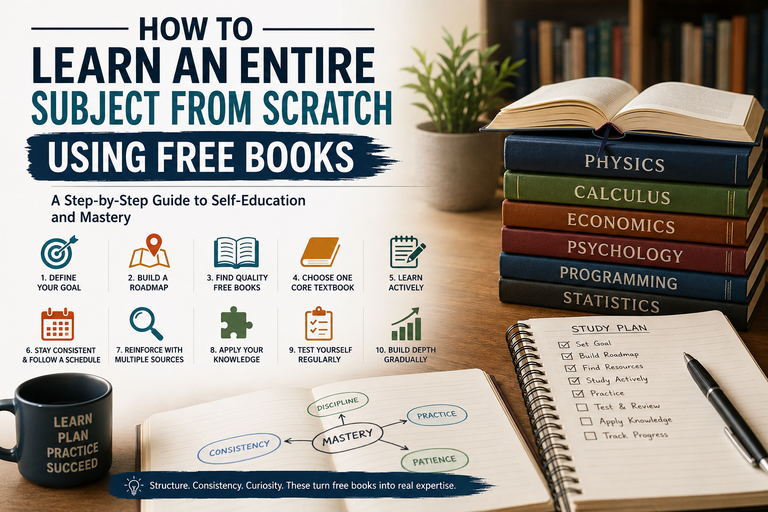
Choose a goal and define scope
-
Pick a spine resource (open textbook/course)
-
Create a checklist syllabus
-
Study using the loop: preview → learn → recall → practice → review
-
Keep an error log; revisit mistakes weekly
-
Use spaced repetition for key concepts
-
Weekly cumulative quizzes; monthly practice exams/projects
-
Build portfolio artifacts every 2–4 weeks
-
Adjust resources only to fill clear gaps
Conclusion: Free Online Resources Work if You Replace “Tuition Features”
Paid education bundles structure, practice, feedback, and accountability. Free online resources often match or exceed content quality but you must provide the system.
By committing to clear goals, following a structured spine, practicing rigorously, testing yourself, and building feedback loops, you can study effectively often at a level comparable to formal coursework using only free online resources.