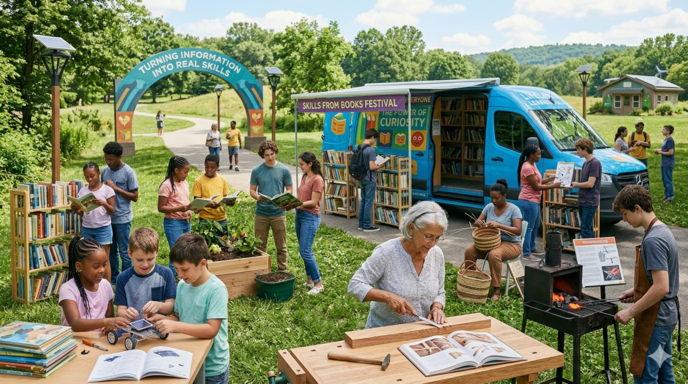
How to Turn Information From Books Into Real Skills
Books are among the richest sources of knowledge available. They can teach principles, share experience, reveal methods, and introduce ideas that might otherwise take years to discover. But there is a critical gap between knowing and doing. Reading about leadership does not make you a leader. Studying programming concepts does not mean you can build software. Highlighting a chapter on communication does not guarantee better conversations.
This is the central challenge of self-education: how do you turn information from books into real, usable skills?
The answer lies in shifting from passive consumption to active application. Skills are not formed by reading alone they are built through practice, feedback, repetition, and real-world use. Books provide the map, but you must walk the path.
The Difference Between Information and Skill
To make progress, it helps to understand the distinction:
-
Information is knowledge you can explain or recognize
-
Skill is the ability to perform effectively in real situations
You might understand how persuasive speaking works, but until you stand up, speak, adjust, and improve through repetition, you don’t truly have the skill.
Books accelerate learning by giving you frameworks, strategies, and insights but skills require embodiment. They must be practiced, tested, and refined.
Why Reading Alone Feels Productive But Falls Short
Reading creates a sense of progress. It feels meaningful because you’re engaged and learning new ideas. But this feeling can be misleading.
Here’s why:
1. Familiarity Creates Illusion of Mastery
Recognizing an idea is not the same as applying it under pressure.
2. Books Simplify Reality
Real life is messy full of uncertainty, emotions, and unpredictability.
3. Knowledge Stays Abstract
Without action, ideas remain theoretical.
4. Memory Fades Quickly
If you don’t use what you read, you lose it.
The most effective learners are not those who read the most—but those who apply what they read consistently.
Start With a Clear Purpose
Before you open a book, ask:
-
What skill do I want to build?
-
Where will I use it?
-
What does improvement look like?
For example:
-
“I want to write clearer emails”
-
“I want to manage my finances better”
-
“I want to lead more effective meetings”
A clear goal transforms reading from passive intake into targeted skill-building.
Read Actively, Not Passively
Active reading turns ideas into usable tools.
Instead of just reading:
-
Write notes in your own words
-
Summarize key ideas after each chapter
-
Ask: “How can I apply this?”
-
Identify one action per chapter
A powerful question to guide you:
“Where would this show up in my real life?”
This bridges the gap between theory and action.
Focus on a Few Ideas That Matter
Trying to implement everything leads to overload.
Instead:
👉 Choose 1–3 key ideas per book
Example (productivity book):
-
Plan tomorrow the night before
-
Work in focused blocks
-
Do weekly reviews
Mastering a few ideas deeply is far more effective than skimming many.
Turn Ideas Into Clear Actions
Vague advice doesn’t translate into skill.
Convert concepts into behaviors:
-
“Be a better listener” → Ask follow-up questions, don’t interrupt
-
“Improve writing” → Draft a clear main idea first, simplify sentences
-
“Think strategically” → Review goals weekly, evaluate consequences
Use this formula:
Concept → Action → Situation
This makes learning practical and executable.
Practice in Real Situations
Skills are context-dependent. You must practice where the skill actually matters.
Examples:
-
Communication → Use techniques in real conversations
-
Leadership → Apply ideas in meetings
-
Writing → Draft real emails or articles
-
Coding → Build real projects
The closer practice is to reality, the stronger the skill becomes.
Use Deliberate Practice
Not all practice leads to improvement. What works is focused, intentional practice.
Deliberate practice involves:
-
Breaking skills into parts
-
Practicing one part at a time
-
Getting feedback
-
Correcting mistakes
-
Repeating with focus
Example (writing):
-
Practice introductions separately
-
Improve sentence clarity
-
Strengthen arguments
Skill grows through focused refinement, not just repetition.
Teach What You Learn
If you can’t explain it, you don’t fully understand it.
Ways to teach:
-
Explain to a friend
-
Write summaries
-
Keep a learning journal
-
Share insights online
Teaching forces clarity and reveals gaps in your understanding.
Test Yourself Through Action
Ask:
“What can I now do that I couldn’t do before?”
Test by:
-
Applying the idea in real life
-
Solving problems without notes
-
Creating something from scratch
Examples:
-
Build a budget after reading finance
-
Run a meeting after reading leadership
-
Write an article after reading writing
Skill is proven through independent action.
Build Feedback Loops
Feedback turns effort into improvement.
Sources of feedback:
-
Mentors and peers
-
Real-world results
-
Self-review (recordings, notes)
Ask:
-
What worked?
-
What didn’t?
-
What should I change?
Without feedback, mistakes repeat. With feedback, skills evolve.
Use Repetition to Build Mastery
One reading is not enough.
Reinforce learning by:
-
Reviewing notes regularly
-
Re-reading after practice
-
Applying ideas repeatedly
-
Using spaced repetition
Skill develops through consistent application over time.
Build Projects Around What You Read
Projects turn knowledge into tangible results.
Examples:
-
Writing → Publish articles
-
Coding → Build an app
-
Fitness → Create a training plan
-
Business → Launch a small idea
Projects expose real challenges and force deeper learning.
Apply Immediately
The longer you wait, the more you forget.
After reading, ask:
-
What can I apply today?
-
What can I test this week?
Example:
-
Learn a communication tip → Use it in your next conversation
-
Read about productivity → Apply it tomorrow morning
Speed of application matters.
Reflect on Your Experience
After applying, reflect:
-
What happened?
-
What worked?
-
What didn’t?
-
What will I change next time?
Reflection transforms experience into insight.
A simple journal can accelerate growth:
-
What I tried
-
What happened
-
What I learned
-
What I’ll improve
Combine Reading With Experience
The best learning cycle is:
Read → Apply → Reflect → Improve → Read again
Each new book becomes more valuable because it solves real problems you’ve encountered.
Measure Your Progress
Skills improve faster when progress is visible.
Track:
-
Speed
-
Quality
-
Accuracy
-
Confidence
-
Results
Example:
-
Writing → clearer structure, fewer edits
-
Speaking → better engagement
-
Productivity → more completed tasks
Measurement keeps learning grounded.
Avoid Common Mistakes
-
Reading too much, applying too little
-
Highlighting everything
-
Trying to change everything at once
-
Avoiding feedback
-
Confusing motivation with progress
-
Staying in theory
The biggest mistake: not taking action
A Simple Framework
-
Choose a skill
-
Read one good book
-
Extract key ideas
-
Turn them into actions
-
Practice in real life
-
Get feedback
-
Reflect and adjust
-
Repeat
This cycle works for almost any skill.
Final Insight: Books Are Starting Points
Books can change your thinking but only action changes your ability.
The goal is not to become someone who knows more.
The goal is to become someone who can do more, better.
The most effective reader is not the one with the longest reading list, but the one who can close a book, step into the real world, and apply what they’ve learned with confidence.
Information becomes skill when it is practiced.
And practice, sustained over time, is what turns knowledge into mastery.