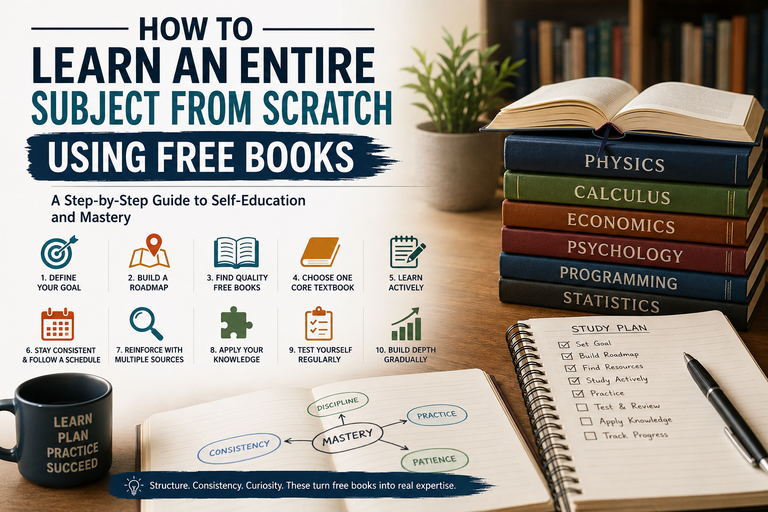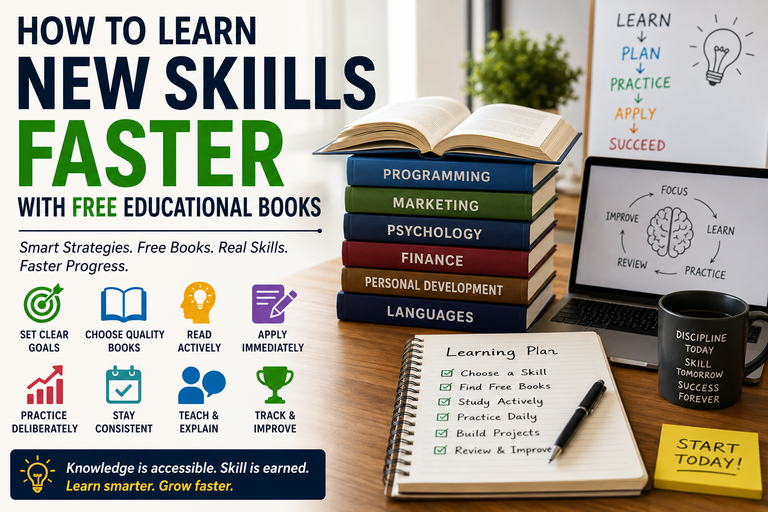
Free eBooks can take you from complete beginner to highly competent sometimes even professional-level if you treat them as more than passive reading. The difference between “I’ve read about it” and “I can actually do it” lies in structure, deliberate practice, and proof.
This guide shows you how to build a complete, repeatable system for mastering almost any subject using free eBooks as your primary resource.
1) Why Free eBooks Can Be Enough (And When They Aren’t)
What eBooks Do Exceptionally Well
1. Depth and structure
Books are coherent. Unlike scattered blog posts or short videos, a well-written book builds ideas in sequence. Concepts connect. Definitions evolve. Mental models form.
2. Reference value
You can search, highlight, bookmark, annotate, and revisit sections instantly. Digital search alone makes revision dramatically more efficient.
3. Low distraction learning
Long-form text forces sustained attention. This builds deep understanding rather than surface-level familiarity.
4. Breadth of options
Between public domain classics, open textbooks, author-uploaded drafts, institutional publications, and academic repositories, nearly every subject is covered.
Where eBooks May Fall Short
-
Hands-on skills (lab sciences, surgery, trades, performance arts) require real practice environments.
-
Fast-moving fields (software frameworks, legal regulations, cybersecurity) can outdate quickly.
-
Assessment limitations – Books rarely grade your work.
Solution: Use eBooks for structured core knowledge. Add projects, current documentation, and feedback loops for application.
2) Step One: Choose the Right Free Sources (Legally and Reliably)
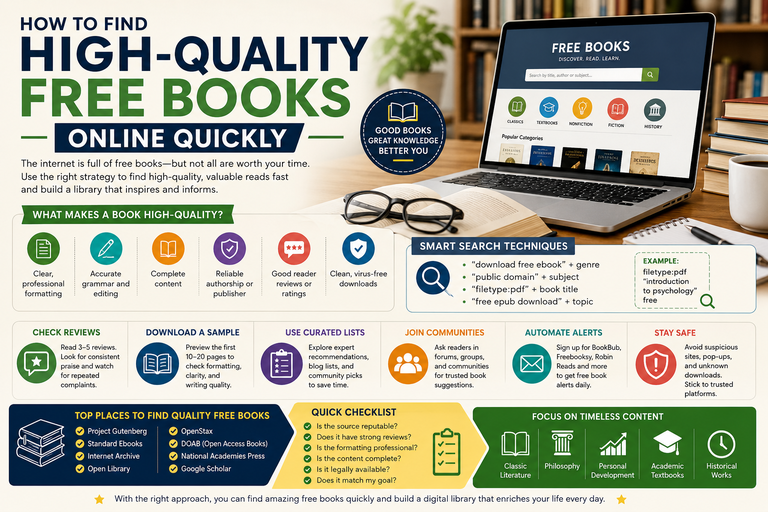
Not all free PDFs are accurate or legal. Prioritize reputable sources.
High-Quality Legal Sources
-
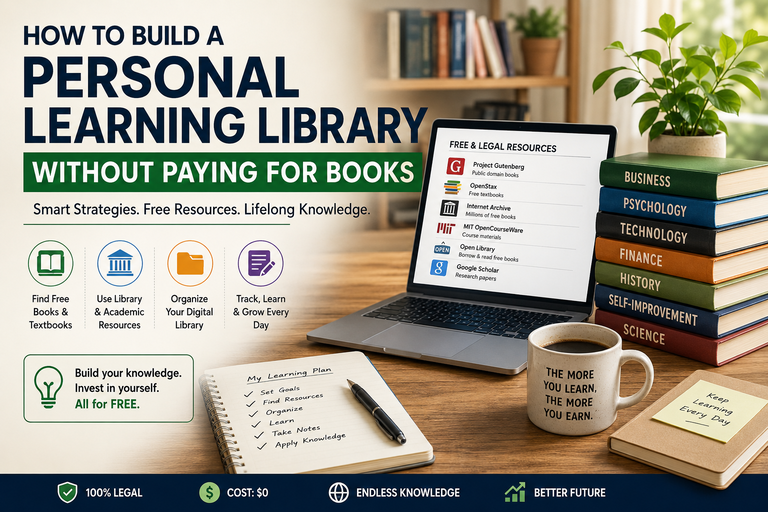
OpenStax – Peer-reviewed open textbooks (math, science, economics, etc.).
-
MIT OpenCourseWare – Free course materials, syllabi, lecture notes.
-
Project Gutenberg – Public domain classics (literature, philosophy, history).
-
Internet Archive – Borrowable scans and open materials (check rights).
-
Directory of Open Access Books – Peer-reviewed academic open access books.
-
OAPEN – Scholarly open access titles.
-
Government and NGO publications.
-
University repositories (theses, monographs).
-
Author or publisher websites offering free editions.
Safety and Quality Checklist
Before committing:
-
Verify author credentials.
-
Check publication/edition date.
-
Skim the table of contents for logical flow.
-
Read 5–10 pages: is it at your level?
-
Confirm exercises, examples, or case studies exist.
Choosing the right book is 30% of success.
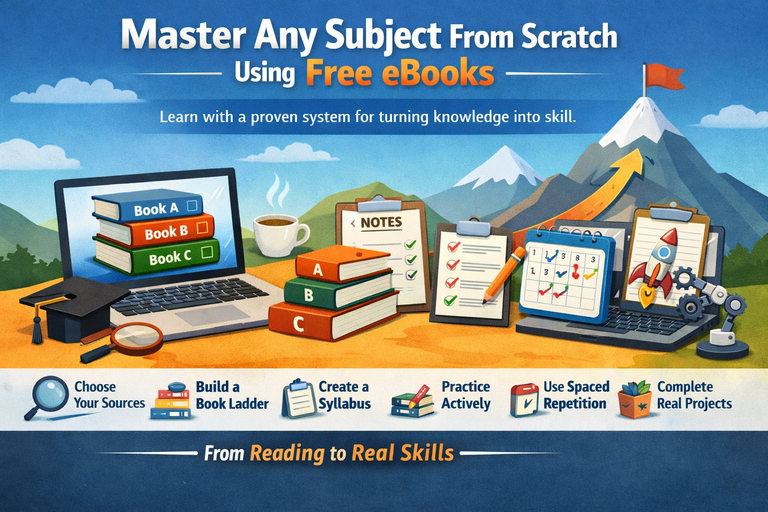
3) Step Two: Build the “Three-Book Ladder”
One of the biggest mistakes beginners make is choosing a single, dense “definitive” book and quitting halfway.
Instead, use a ladder:
Book A — Beginner Primer
Purpose: vocabulary, intuition, big picture.
Traits: simple explanations, minimal prerequisites, lots of examples.
Book B — Core Textbook
Purpose: structured mastery.
Traits: comprehensive coverage, exercises, end-of-chapter problems.
Book C : Advanced or Applied Book
Purpose: specialization and real-world application.
Traits: case studies, advanced problems, domain depth.
Example Ladders
-
Programming: Beginner guide → Data structures textbook → Systems/design patterns.
-
Economics: Intro primer → Principles textbook → Econometrics or game theory.
-
Psychology: Overview → Research methods text → Specialized subfield.
The ladder prevents overwhelm and builds confidence progressively.
4) Step Three: Create a Personal Syllabus
eBooks don’t enforce pacing. You must.
Simple Syllabus Template
For each chapter:
-
Learning objectives – “I can explain… solve… apply…”
-
Reading target – Pages or sections.
-
Output task – Notes, flashcards, problems, mini-project.
-
Self-test questions – Closed-book questions you must answer.
Pacing Guidelines
-
Beginners: 30–60 minutes daily, 5–6 days/week.
-
Use time blocks with defined tasks.
-
Produce one tangible output per session.
Use the 80/20 Rule
Identify:
-
Foundational concepts.
-
Frequently tested skills.
-
Core methods.
Master these first. Everything else builds on them.
5) Step Four: Read Actively
Passive reading creates recognition, not competence.
The 3-Pass Reading Method
Pass 1: Survey (5–15 minutes)
Skim headings, diagrams, summaries.
Write 3–5 questions the chapter should answer.
Pass 2: Study
Read in small chunks (1–3 pages).
Pause and paraphrase from memory.
Pass 3: Recall + Practice (Non-negotiable)
Close the book.
Answer:
-
What are the main ideas?
-
What methods matter?
-
What would a test ask?
Then solve problems or write a short explanation.
Create a One-Page Chapter Brief
After each chapter:
-
10–15 bullet points.
-
5 key definitions (in your own words).
-
3 typical examples.
-
5 self-test questions (answers separate).
Over time, these become your custom textbook.
6) Step Five: Use Exercises as Your Learning Engine
Mastery happens through retrieval and correction.
If the Book Has Exercises
-
Attempt without solutions.
-
Check answers.
-
For mistakes, write:
-
What I misunderstood.
-
The correct method.
-
A “warning label” (the trap).
-
-
Reattempt similar problems 2–7 days later.
If the Book Has No Exercises
Create your own:
-
Turn headings into questions.
-
Write mini quizzes.
-
Use free past exam papers.
-
Teach the concept in writing.
-
Summarize and critique arguments.
Practice is not optional it is the subject.
7) Step Six: Build Projects to Prove Competence
Projects convert knowledge into capability.
Examples by Field
-
Programming: Build and deploy a tool.
-
History: Write a source-based essay with citations.
-
Finance: Build a financial model and explain assumptions.
-
Language learning: Write essays, record speeches.
-
Design: Create a full case study.
The 3-Level Project Path
-
Rebuild – Replicate book examples.
-
Remix – Modify variables or constraints.
-
Create – Solve a new problem independently.
Rebuild → Remix → Create accelerates real mastery.
8) Step Seven: Add Spaced Repetition
Without review, you forget.
Simple Review Schedule
-
Day 0: Learn chapter.
-
Day 1: 10–20 minute recall.
-
Day 3: Quick summary review.
-
Day 7: Mixed practice.
-
Day 14/30: Cumulative test or milestone.
Flashcards Work Best For:
-
Definitions
-
Formulas
-
Key distinctions
-
Procedural steps
They’re less effective for deep reasoning use essays and problem-solving for that.
9) Step Eight: Prevent Outdated or Weak Content
Triangulate important topics using:
-
Another open textbook.
-
University lecture notes.
-
Recent review papers (for evolving fields).
-
Official documentation.
Warning Signs
-
No citations.
-
Strong claims without evidence.
-
Very old editions in fast-moving fields.
-
Anecdotal advice presented as science.
Quality control is your responsibility in self-study.
10) Step Nine: Build Feedback Loops
Feedback is the missing ingredient in solo learning.
Ways to Get Feedback
-
Post work in online communities.
-
Join study groups.
-
Compare to model answers.
-
Use published rubrics.
-
Request critique from peers.
If No Human Feedback Is Available
Use a self-checklist:
-
Clarity – Is this understandable to a beginner?
-
Correctness – Can I justify each step?
-
Completeness – Did I cover edge cases?
-
Transfer – Can I solve a new problem?
Feedback turns reading into refinement.
11) Example: 30-Day From-Scratch Plan
Week 1 – Primer (Book A)
-
Choose subject scope.
-
Select three-book ladder.
-
Read primer chapters.
-
Write one-page briefs.
-
End with small “rebuild” project.
Weeks 2–3 – Core Textbook (Book B)
-
4–5 sessions/week.
-
Read → Exercise → Summarize.
-
One remix project per week.
-
End of week 3: timed self-made exam.
Week 4 – Applied Depth (Book C)
-
Select chapters aligned to your goal.
-
Complete a “create” project.
-
Write a final report explaining:
-
What you built.
-
Methods used.
-
What you’d improve.
-
After 30 days, you won’t know everything but you’ll have:
-
A structured foundation.
-
Demonstrable proof of skill.
-
A repeatable system.
12) Common Mistakes
Collecting too many books
Fix: One ladder at a time.
Over-highlighting
Fix: Highlight only what becomes a question.
Avoiding exercises
Fix: Practice is the real learning.
Never testing yourself
Fix: Weekly closed-book quizzes.
Binary thinking about understanding
Fix: Measure mastery by output:
“Can I solve this?”
“Can I explain this?”
“Can I apply this?”
13) A Practical Toolkit for Digital eBooks
Features to Exploit
-
Search for recurring concepts.
-
Bookmark key sections.
-
Export highlights.
-
Use split-screen (book + notes).
Note Formats That Work
-
One-page chapter briefs.
-
Error logs (mistakes + corrections).
-
Teach-back paragraphs.
-
Dated problem notebooks.
Your notes should be lean, usable, and revisitable.
Conclusion: Information Becomes Mastery Through Structure
Free eBooks can absolutely help you master a subject from scratch but only if you transform reading into a deliberate system.
Choose a book ladder.
Create a syllabus.
Practice heavily.
Test yourself.
Build projects.
Seek feedback.
The future of self-education isn’t about unlimited information. It’s about building a repeatable process that converts information into skill one chapter, one exercise set, and one finished project at a time.