
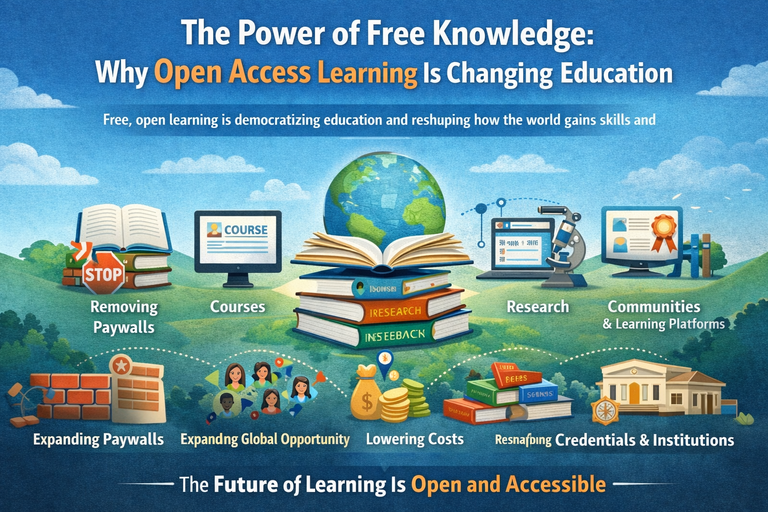
The Power of Free Knowledge: Why Open Access Learning Is Changing Education
Open access learning free or openly licensed educational content, research, and training available to anyone with an internet connection is reshaping how the world gains skills and credentials. It is not simply “online learning.” It represents a structural shift in who gets to learn, how quickly knowledge spreads, and what institutions are required to teach it.
For centuries, education was constrained by geography, tuition costs, limited library access, and institutional admissions. Today, high-quality textbooks, lectures, research papers, tutorials, and practice tools increasingly live in the open. The result is a powerful democratization of knowledge that is changing schools, universities, workplaces, and even the social contract around opportunity.
This article explores what open access learning truly means, why it is accelerating, how it is transforming education, what challenges remain, and what the next phase may look like.
1) What “Open Access Learning” Really Means
Open access learning is not one single platform or model. It includes several overlapping movements:
Open Educational Resources (OER)
Open Educational Resources (OER) are teaching materials textbooks, assignments, syllabi, lecture slides, and videos published under open licenses (often Creative Commons). These licenses allow users not only to read content but also to reuse, adapt, translate, and redistribute it legally.
Examples include:
-
OpenStax – Peer-reviewed, openly licensed textbooks used worldwide.
-
OER Commons – A curated platform of openly licensed teaching materials.
The power of OER lies in flexibility. Educators can modify materials to suit local contexts rather than being locked into expensive, static editions.
Open Courses and Open Courseware
Some universities publish full course content publicly lecture notes, problem sets, exams, and reading lists without requiring enrollment.
A prominent example is:
-
MIT OpenCourseWare – Free access to course materials from hundreds of university classes.
Learners can follow the same curriculum as enrolled students minus formal grading or credit. This dramatically reduces the informational gatekeeping of elite institutions.
Open Access Research
Academic research has traditionally been locked behind expensive journal paywalls. Open access publishing removes these barriers, making scientific and scholarly papers freely available.
This shift accelerates:
-
Innovation
-
Cross-border collaboration
-
Evidence-based policymaking
-
Higher-level self-education
When researchers, entrepreneurs, and students can access the latest findings without institutional subscriptions, knowledge diffusion speeds up globally.
Free Learning Platforms and Communities
Not all free learning is “open” in licensing terms, but it still expands access. Platforms like:
-
Coursera
-
edX
-
YouTube
offer free instructional content, tutorials, and community interaction. While certificates may require payment, much of the learning material itself is accessible.
Together, these ecosystems reduce the marginal cost of distributing knowledge to nearly zero. Once created, a resource can educate millions without increasing tuition fees.
2) Why Open Access Is Accelerating Now
The Economics of Digital Distribution
Physical textbooks require manufacturing and shipping. Digital materials do not. As education moves online, the economic logic favors open, scalable distribution.
Tuition and Student Debt Pressures
In many countries, rising tuition costs and student debt burdens have encouraged learners to seek alternatives. Even enrolled students frequently rely on open materials to supplement or replace expensive textbooks.
Global Demand for Upskilling
Technology and labor markets evolve rapidly. Workers must reskill and adapt throughout their careers. Open access learning provides flexible, low-cost pathways for continuous professional development.
The Open-Source Mindset
The success of open-source software demonstrated that collaborative, decentralized creation can rival or outperform proprietary models. That philosophy has extended into education: communities now build, translate, refine, and distribute educational materials collaboratively.
AI and Search Tools
Free information has existed online for decades but it was often overwhelming. Modern search engines and AI systems help learners find relevant materials, clarify difficult concepts, and practice effectively. This dramatically increases the usability of open content.
3) How Open Access Learning Is Changing Education
A) Shifting Power Toward Learners
Traditionally, institutions controlled curriculum, libraries, lectures, and credentials. Open access weakens that monopoly.
Learners can now:
-
Study university-level material without admission.
-
Compare multiple perspectives.
-
Choose pace, depth, and sequence.
Institutions still matter but they now compete with the open web for authority and attention.
B) Making Education Modular and Personalized
Open resources allow education to be assembled like building blocks:
-
A free textbook for fundamentals.
-
Lecture notes from a university.
-
Practice problems from another institution.
-
A simulation tool from a nonprofit.
-
Peer feedback in an online forum.
Education becomes customizable rather than one-size-fits-all.
C) Reducing the Cost of Learning Materials
Textbook costs can significantly affect course choices and completion rates. Open textbooks remove that barrier, improving affordability and potentially improving equity.
D) Expanding Global Reach
Open access enables learners in low-resource environments to use the same foundational materials as those in wealthier regions. It also facilitates:
-
Cross-border study groups.
-
International research collaboration.
-
Faster diffusion of technical knowledge.
E) Redefining the Role of Teachers
As content becomes abundant, teaching shifts from content delivery to:
-
Coaching and mentoring.
-
Facilitating discussion.
-
Providing feedback.
-
Designing assessments.
-
Connecting knowledge to real-world problems.
In open ecosystems, teachers become guides and curators rather than gatekeepers.
4) Open Access and Equity: Promise vs. Reality
Open access reduces content barriers but not all barriers.
What Open Access Helps
-
Removes textbook paywalls.
-
Enables self-education.
-
Supports underfunded schools.
-
Expands research access globally.
What It Does Not Automatically Solve
-
Internet and device access.
-
Time constraints for working learners.
-
Language barriers.
-
Accessibility for disabilities.
-
Lack of mentorship.
-
Credential recognition.
Content may be free but support systems often are not.
5) The Credential Problem
Learning may be free, but proof often isn’t.
Traditional institutions retain power because they offer recognized credentials. Open learning can develop skills but society still needs reliable verification.
Emerging Solutions
-
Competency-based exams.
-
Micro-credentials and stackable certificates.
-
Skills portfolios.
-
Industry-recognized certifications.
-
Verified digital badges.
The likely future: open content paired with paid or publicly funded assessment layers.
6) Benefits for Educators and Institutions
Open access learning is not anti-institutional it can strengthen education systems.
For Teachers
-
Reduced preparation time.
-
Adaptable materials.
-
Collaboration with global peers.
-
Improved resource consistency.
For Institutions
-
Lower total cost of attendance.
-
Increased student retention.
-
Expanded global reputation.
-
Focus on mentorship, labs, and high-quality assessment.
Open publishing can amplify institutional impact far beyond campus walls.
7) Challenges and Criticisms
Quality Control
Open platforms vary widely in rigor. Learners must distinguish:
-
Evidence-based material vs. opinion.
-
Current research vs. outdated claims.
Improved curation and digital literacy are essential.
Sustainability
High-quality content requires funding and expertise. Sustainable models include:
-
Government support.
-
Foundation grants.
-
Institutional funding.
-
Freemium services (free content, paid certification).
-
Community contributions.
Representation and Language
Much open content is concentrated in dominant languages. Expanding translation efforts and culturally relevant examples is critical for global equity.
Privacy Concerns
Some free platforms monetize data and attention. As learning becomes digital, protecting privacy becomes a central ethical issue.
8) The Next Era of Open Access Learning
AI-Supported Open Learning
AI tutors can make open content interactive answering questions, generating practice problems, and adapting explanations. This reduces the guidance gap in self-study.
However, verification and critical thinking remain crucial to avoid misinformation.
Ecosystem Models
The most effective future model may combine:
-
Open textbooks and courses.
-
Peer communities.
-
Real-world projects.
-
Affordable, trustworthy assessments.
Rather than a single dominant platform, education may operate as an interconnected ecosystem.
Public Policy and Knowledge as Infrastructure
Some governments may increasingly treat educational content as public infrastructure funded openly because the societal returns in productivity, health, and civic engagement outweigh costs.
9) How Learners Can Use Open Access Effectively Today
A practical approach:
-
Choose a high-quality open textbook or course as your foundation.
-
Define a clear outcome (exam, project, publication).
-
Practice actively problem sets, essays, applications.
-
Cross-check important concepts with multiple sources.
-
Join communities for feedback.
-
Build proof of skill (portfolio or certification).
Open access works best when structured and practiced not passively consumed.
Conclusion: Free Knowledge Is Transforming Education
Open access learning is transforming education by removing paywalls, expanding global reach, reducing material costs, and enabling lifelong learning across borders. It shifts education from a scarce, institution-controlled product to an abundant, shareable resource.
But the future is not just about free content. The next frontier is making mentorship, feedback, accessibility, and credible assessment as scalable as information itself.
When support systems become as open as knowledge, education will not merely be accessible it will be genuinely equitable.