Top Skills You Can Learn for Free Using Online Books
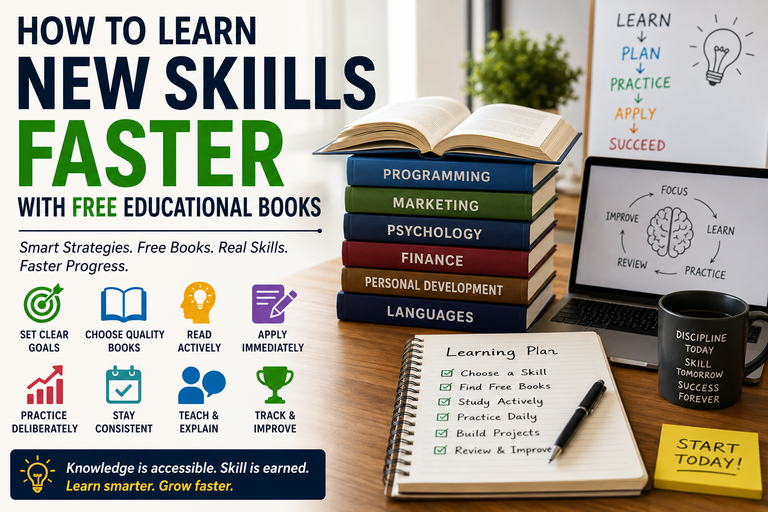
Online books open textbooks, public domain classics, open access handbooks, and legally free technical guides can teach you marketable, life-changing skills without tuition fees. While videos and short courses are popular, books remain one of the fastest paths to real competence because they provide depth, sequence, and long-term reference value.
Unlike short-form content, books are structured. They build concepts in layers, explain assumptions, and provide exercises. When used deliberately, they can replace (or strongly supplement) formal coursework.
Below are some of the most valuable skills you can learn largely and sometimes entirely from free online books, plus how to approach each skill strategically.
1) Programming Fundamentals (Python, JavaScript, Java, C, etc.)
Why It’s Worth Learning
Programming is a force-multiplier skill. It allows you to automate tasks, build digital products, analyze data, and qualify for high-demand technical roles.
What You Can Learn from Books
-
Variables, control flow, and functions
-
Data structures (lists, arrays, dictionaries)
-
Debugging and testing strategies
-
Object-oriented programming
-
Basic algorithms and design patterns
-
Building command-line tools and small applications
Best Book-Based Approach
Start with a beginner-friendly programming book in one language. After mastering syntax and basic logic:
-
Move to a data structures and algorithms text.
-
Progress to an applied book focused on building real-world projects.
Books teach thinking patterns, not just syntax and that’s what employers value.
Free Book Sources
-
Open computer science textbooks (e.g., via OpenStax)
-
University course notes from MIT OpenCourseWare
-
Author-posted programming books and official documentation manuals
-
Public domain logic texts via Project Gutenberg
2) Data Analysis and Data Science Foundations
Why It’s Worth Learning
Data literacy is useful in business, healthcare, marketing, public policy, sports, and nearly every industry.
What You Can Learn from Books
-
Data cleaning and exploratory data analysis
-
Statistics fundamentals (distributions, hypothesis testing)
-
Data visualization principles
-
Introductory machine learning (regression, classification)
Best Book-Based Approach
Pair:
-
An introductory statistics textbook
-
A practical data analysis book using real datasets
Work through exercises carefully statistics mastery comes from repetition.
Free Book Sources
-
Open statistics textbooks from universities
-
Open access books on R/Python workflows
-
Government statistical methodology guides
-
The Directory of Open Access Books
-
OAPEN
3) Mathematics for Real-World Problem Solving
Why It’s Worth Learning
Mathematics unlocks deeper understanding in finance, engineering, programming, analytics, and science.
What You Can Learn
-
Algebra and trigonometry
-
Calculus
-
Linear algebra (vectors, matrices)
-
Probability and discrete mathematics
Best Book-Based Approach
Use an open textbook with abundant exercises and solutions. Do not just read—solve problems daily. Mastery comes from practice.
Free Book Sources
-
OpenStax math series
-
University lecture notes and problem sets
-
Public domain math books via Internet Archive
4) Writing and Communication (Professional, Academic, Creative)
Why It’s Worth Learning
Clear writing improves career prospects, leadership ability, persuasion, and research quality.
What You Can Learn
-
Grammar and style fundamentals
-
Argument structure and reasoning
-
Academic citation practices
-
Business writing (emails, reports, proposals)
-
Story structure and creative techniques
Best Book-Based Approach
-
Study a writing handbook or style guide.
-
Write weekly.
-
Revise using structured checklists.
Books teach principles practice builds skill.
Free Book Sources
-
Open writing handbooks from universities
-
Public domain rhetoric texts via Project Gutenberg
-
University writing center guides
5) Public Speaking and Presentation Skills
Why It’s Worth Learning
Presentation skill increases your influence whether in meetings, classrooms, interviews, or sales.
What You Can Learn
-
Structuring persuasive talks
-
Storytelling techniques
-
Slide design principles
-
Handling Q&A sessions
-
Managing nervousness
Best Book-Based Approach
Learn structure and rhetoric from a book, then:
-
Record practice presentations
-
Review and critique yourself
-
Refine delivery
Free Book Sources
-
Open communication textbooks
-
University speaking guides
-
Public domain persuasion texts
6) Financial Literacy (Budgeting, Investing, Personal Finance)
Why It’s Worth Learning
Financial knowledge compounds over time and protects you from debt traps and poor financial decisions.
What You Can Learn
-
Budgeting systems
-
Interest calculations and inflation
-
Debt repayment strategies
-
Investment basics (risk, diversification)
-
Retirement planning concepts
Best Book-Based Approach
First understand the math behind money (interest, compounding), then build your own budget and tracking spreadsheet.
Free Book Sources
-
Government financial education manuals
-
Open textbooks in economics
-
Public domain classics (interpret critically)
7) Digital Marketing (SEO, Content, Email, Analytics)
Why It’s Worth Learning
Marketing skills empower freelancers, entrepreneurs, nonprofits, and career switchers.
What You Can Learn
-
Positioning and customer research
-
Copywriting fundamentals
-
SEO principles
-
Email marketing funnels
-
Performance analytics
Best Book-Based Approach
Books for fundamentals + updated documentation for platform tools (since tools change quickly).
Free Book Sources
-
Open marketing textbooks
-
Business school open course materials
-
Open access business and communications books
8) Graphic Design Fundamentals
Why It’s Worth Learning
Design literacy improves presentations, branding, user interfaces, and marketing credibility.
What You Can Learn
-
Visual hierarchy and layout grids
-
Typography fundamentals
-
Color theory and contrast
-
Branding consistency
Best Book-Based Approach
Study principles, then replicate real-world designs for practice. Evaluate your work using a rubric.
Free Book Sources
-
University design course notes
-
Open access visual communication books
-
Public domain art instruction books
9) Critical Thinking, Logic, and Media Literacy
Why It’s Worth Learning
This is a meta-skill. It strengthens decision-making and protects against misinformation.
What You Can Learn
-
Argument structure (claims, evidence, warrants)
-
Logical fallacies
-
Cognitive biases
-
Evaluating research claims
Best Book-Based Approach
Read a logic textbook and apply it weekly by analyzing news articles, advertisements, and speeches.
Free Book Sources
-
Open philosophy and reasoning textbooks
-
University media literacy handbooks
-
Public domain logic works
10) Psychology and Human Behavior
Why It’s Worth Learning
Understanding behavior improves leadership, negotiation, teaching, and personal growth.
What You Can Learn
-
Learning and motivation theories
-
Social psychology basics
-
Cognitive biases
-
Research methods
Best Book-Based Approach
Use an introductory psychology textbook plus a research methods text to learn how evidence works.
Free Book Sources
-
OpenStax Psychology
-
Open behavioral science books
-
Public domain foundational works
11) Project Management
Why It’s Worth Learning
Project management improves outcomes in tech, construction, healthcare, education, and operations.
What You Can Learn
-
Scope and timeline planning
-
Risk management
-
Agile vs. waterfall methods
-
Stakeholder communication
Best Book-Based Approach
Read a fundamentals text, then manage a small real project (even personal) using templates and retrospectives.
Free Book Sources
-
Open management textbooks
-
Government operations manuals
-
Business school open materials
12) Research Skills
Why It’s Worth Learning
Research ability strengthens academic work, business intelligence, content creation, and self-education.
What You Can Learn
-
Formulating research questions
-
Evaluating sources
-
Synthesizing information
-
Avoiding plagiarism
Best Book-Based Approach
Use an information literacy handbook, then practice by writing literature reviews or annotated bibliographies.
Free Book Sources
-
University library handbooks
-
Open access research methodology books
-
Writing center publications
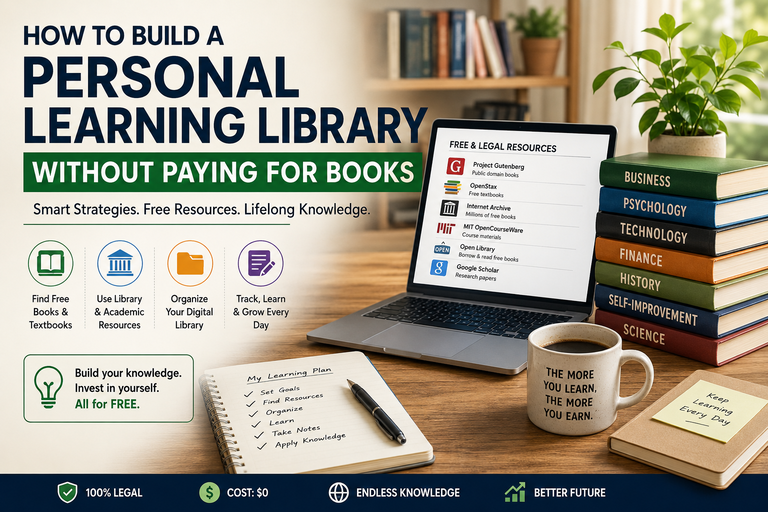
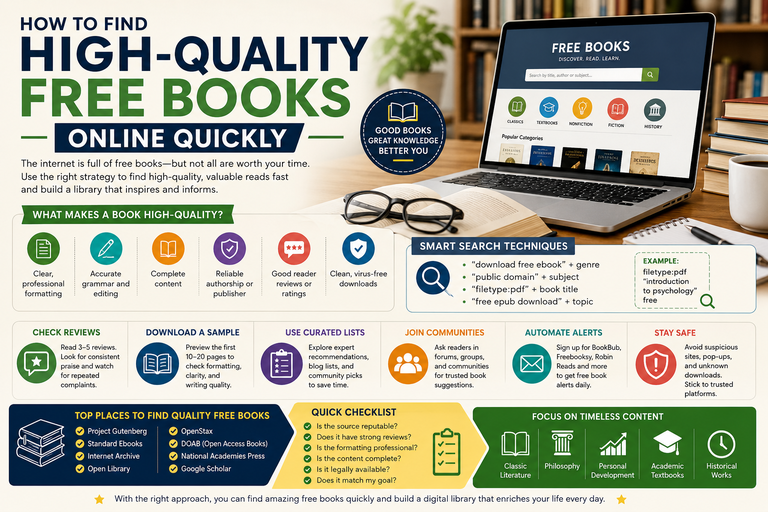
Where to Find Free Online Books (Legally)
To stay legal and safe, prioritize:
-
OpenStax
-
MIT OpenCourseWare
-
Directory of Open Access Books
-
OAPEN
-
Project Gutenberg
-
Internet Archive
-
University repositories
-
Government and NGO digital libraries
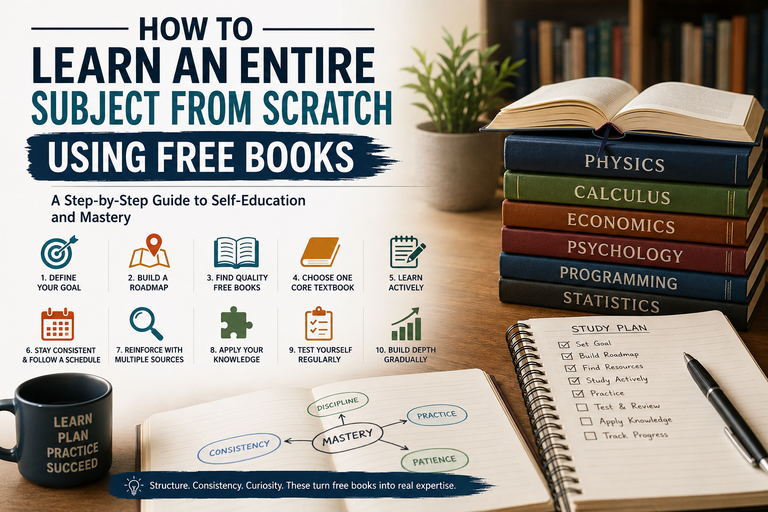
How to Actually Master These Skills Using Books (A Proven Method)
Free books only work if you treat them like a curriculum.
1) Use a “Book Ladder”
Beginner primer → Core textbook → Applied/advanced book
2) Study Actively
-
After each section, close the book and explain it from memory
-
Create 5–10 self-test questions per chapter
3) Practice More Than You Read
-
Complete exercises
-
Build mini-projects if none are provided
4) Create Portfolio Artifacts
Produce tangible outputs:
-
A program
-
A data analysis report
-
A presentation
-
A design mockup
-
A financial model
-
A marketing plan
5) Get Feedback
Communities, mentors, peers, or structured rubrics transform knowledge into competence.
Conclusion: Free Online Books Can Teach High-Value Skills If You Treat Them Like a Curriculum
The greatest advantage of online books is not that they are free it’s that they provide structured, comprehensive learning paths. When you combine that structure with deliberate practice, testing, and real-world projects, you can build career-ready skills without paying tuition.
The internet offers endless content. Books offer depth.
Choose depth and build skills that compound for life.