Writing Mistakes
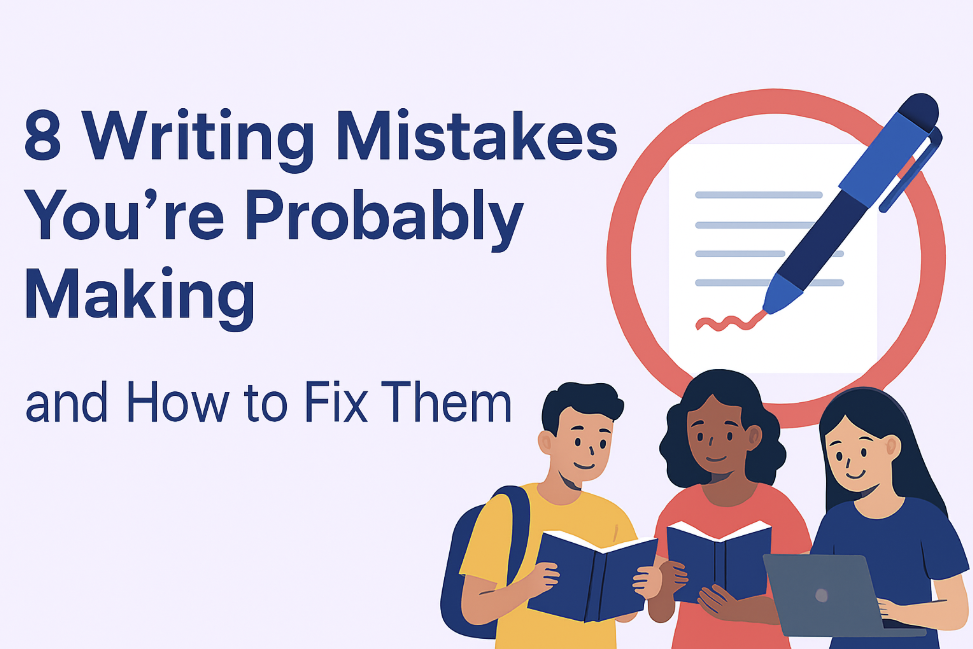
8 Writing Mistakes You’re Probably Making and How to Fix Them
You have your idea. You know your stuff. And you write it down. But the final draft feels flat, like a weak handshake. It just does not connect.
That frustrating gap between your thoughts and the page is usually crowded with simple errors.
Everyone makes them, even people who write all day long. These are not grand failures of creativity. They are tiny, correctable habits that confuse your meaning.
Spotting them changes everything. Fixing them turns your good intention into powerful communication.
Let us break down eight of these regular mistakes and, more importantly, how to solve each one for good!
Writing Mistakes You’re Probably Making and How to Fix Them
Weak Opening Hook
Forget starting with a bland statement of fact. If you do so, your reader might get frustrated and click away. Those first words are a spotlight, not a label. You need to shine it on a problem they feel, a question they harbor, or a scene they recognize. Do not introduce your topic right away. Introduce the problem that your topic will solve.
A powerful hook snaps the reader to attention. It makes a silent promise that reading further will be worth their time. Think about what kept you reading last time. Was it a personal confession? A surprising contradiction? Implement that strategy. Your opening line is a doorway. Make sure it leads somewhere interesting, not into an empty room.
How to Fix It?
Lead with your most arresting point. Use a specific image or a pointed question.
Here are a few strategies to improve your introductions:
Open with the core problem your reader wants to solve.
State a result they desire but doubt they can achieve.
Share a two-line story that reflects the entire article’s point.
Eliminate any sentence that could begin with “In this modern era.”
Overusing Passive Voice
Who is doing the thing? Your sentences keep that a secret. “The report was completed” hides the actor. “Mistakes were made” avoids blame. This structure ruins your text. With passive voice, writing becomes an observation of events, not a description of action. It feels indirect, even vague.
The active voice is straightforward and strong. “The team completed the report” has energy. “I made mistakes” owns the action. Passive voice has its place, maybe in scientific writing or to emphasize an action’s object. But using it as a default is a terrible habit. Your writing will sound like a corporate memo from a boring department.
How to Fix It
Search for “was” or “were” followed by a past-tense verb. Find who did the action and put them up front. Change “The decision was reached by the committee” to “The committee reached the decision.” The actor becomes the star of the sentence.
Eventually, your prose immediately tightens. Moreover, sentences become shorter and more confident. Clarity improves by a huge margin because responsibility is clear. Make this edit your new reflex. As a result, your writing will sound more professional and direct almost overnight.
Wordiness and Redundancy
Why use five words when one strong word works? Extra phrases add up and crowd the page. “At this point in time” is just “now.” “In the event that” means “if.” Redundancy says the same thing twice, like “future planning” or “true facts.” This noise crowds your real point. Readers must clear it away to understand you.
Concise writing is kind writing. It respects your reader’s time and intelligence. Your goal is to deliver meaning with precision, not volume. Every unnecessary word is a bump in your reader’s path.
How to Fix It
Attack every sentence. Cut every word that does not pull its weight. Replace long phrases with sharp, single words. “In order to” becomes “to.” “Due to the fact that” becomes “because.”
Hunt down and destroy redundant pairs. “Basic fundamentals” are just fundamentals. “Final outcome” is simply the outcome. Choose a stronger verb over a weak verb plus an adverb. “She walked quickly” can become “she hurried” or “she rushed.” This creates clean, forceful sentences.
Vague Language
Words like “good,” “bad,” “things,” and “very” are empty fillers. They fill space without nourishing the reader’s understanding. “We had a good meeting” tells nothing. Was it productive, short, decisive, or fun? The reader is left guessing your specific meaning.
Specifics build trust. They create a shared picture in your mind and your reader’s mind.
Details are proof. They transform your writing from a vague suggestion into a clear message. Vagueness actually feels lazy and uncommitted. It leaves your real point hidden in a fog.
How to Fix It
Swap every weak word for a concrete detail. Instead of “a significant improvement,” try “a fifteen percent increase in speed.” Change “several examples” to “three clear examples.” Use numbers, names, and exact descriptions.
To fix the issue, you can rephrase unclear sentences with precise language using an AI-powered paraphraser tool. This smart online tool not only refines the text but also makes it clearer and more direct, helping readers grasp its meaning quickly.
Misplaced Modifiers
Your descriptive phrase is in the wrong spot. It modifies the wrong noun. This creates accidental jokes. “She saw a cat scrolling through her phone.” The cat is not scrolling. The phrase “scrolling through her phone” is misplaced. It should be next to “she.”
Your brain knows what you meant, so your eyes skip the error. A new reader trips right over it. The sentence becomes confusing or ridiculous. The modifier must sit directly beside the word it describes. Keep them close together.
How to Fix It
Anchor your descriptive phrases to the correct noun. Move them next door.
Below are some ways to avoid the issue:
Check sentences that begin with “-ing” words carefully.
Look for phrases that could describe more than one thing in the sentence.
Place small adverbs like “only” right before the word they limit.
A simple repositioning fixes the whole messy meaning.
Inconsistent Tense
You are writing about the past, then suddenly you jump to the present. It confuses your reader. They lose their way in your narrative. Tense is the timeline of your writing.
Choosing one and sticking to it keeps your reader focused. Random shifting feels careless and confusing.
Pick a primary tense for your piece. Telling a story? Use the past. Explaining how something works? Use the present. You can shift tenses when comparing times, like past events to present results. But swinging back and forth for no reason makes your writing feel unstable.
How to Fix It
Decide on your main tense. Be consistent within each section.
Here’s how you can write consistent tenses:
Proofread your work, looking only at verb tenses.
Read paragraphs aloud to hear awkward shifts.
Remember, a present-tense story might contain a past-tense memory.
Maintain a clear timeline so your reader is not lost in time.
Copying Others
Using someone’s words or ideas without credit is theft. It wrecks your credibility forever. Sometimes it happens by accident. You read something, it sticks in your head, and later you write it down, thinking it was your thought. The result is the same. It is a serious professional and ethical failure.
Your own analysis and voice are your real value. Building on research is fine, but you must build. You cannot just copy the foundation. Always, credit your sources for quotes and specific ideas. Citation is not optional. It is honesty.
How to Fix It
Take notes with absolute care. Put direct quotes in big quotation marks immediately. Explain the idea from your memory without looking at the source. Then cite the source of the idea.
You should also use a plagiarism checker free before submitting any important work. This tool compares your text against a vast database of online journals, published books, and websites. It finds accidental matches you might have missed. This final check protects your work and your reputation.
Weak Conclusions
Your article just stops. Or it poorly repeats the introduction. This leaves your reader hanging, feeling unsatisfied. A conclusion must do more than summarize. It is your last word, your final impression. It should answer the big “So what?” hanging in the air. A weak ending makes the whole journey feel pointless.
A powerful conclusion ties your main points together into one clear takeaway. It shows the reader why everything you just said matters in a larger sense. It can offer a final insight, a call to action, or a resonant thought. It provides closure.
How to Fix It
End by reflecting on the broader meaning of your argument. Finish with impact. Use these simple strategies while writing conclusions:
Connect your specific points to a wider truth or application.
Answer the “So what?” question for your reader directly.
Do not add new information or arguments at the end.
Leave them with a single, strong idea to remember.
To Conclude
These mistakes are just habits, and habits can be broken. Do not try to fix all eight at once. That is overwhelming. Pick one, maybe the one you know you do, and hunt it down in your next email or report. Eliminate it. See how much cleaner your writing feels.
Then tackle another. Each error you remove sharpens your voice and strengthens your connection with the reader. Your words have power. Do not let these simple, fixable errors keep them locked away.