
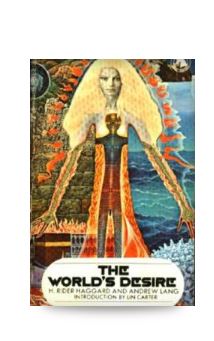
The period in which the story of The World’s Desire is cast, was a period when, as Miss Braddon remarks of the age of the Plantagenets, “anything might happen.” Recent discoveries, mainly by Dr. Schliemann and Mr. Flinders Petrie, have shown that there really was much intercourse between Heroic Greece, the Greece of the Achaeans, and the Egypt of the Ramessids.
This connection, rumoured of in Greek legends, is attested by Egyptian relics found in the graves of Mycenae, and by very ancient Levantine pottery, found in contemporary sites in Egypt. Homer himself shows us Odysseus telling a feigned, but obviously not improbable, tale of an Achaean raid on Egypt.
Meanwhile the sojourn of the Israelites, with their Exodus from the land of bondage, though not yet found to be recorded on the Egyptian monuments, was probably part of the great contemporary stir among the peoples.
These events, which are only known through Hebrew texts, must have worn a very different aspect in the eyes of Egyptians, and of pre-historic Achaean observers, hostile in faith to the Children of Israel.
The topic has since been treated in fiction by Dr. Ebers, in his Joshua. In such a twilight age, fancy has free play, but it is a curious fact that, in this romance, modern fancy has accidentally coincided with that of ancient Greece.
Most of the novel was written, and the apparently “un-Greek” marvels attributed to Helen had been put on paper, when a part of Furtwängler’s recent great lexicon of Mythology appeared, with the article on Helen. The authors of The World’s Desire read it with a feeling akin to amazement.
Their wildest inventions about the Daughter of the Swan, it seemed, had parallels in the obscurer legends of Hellas. There actually is a tradition, preserved by Eustathius, that Paris beguiled Helen