Free Books That Teach Skills Employers Want in 2026 | Build Career-Ready Skills for Free
The job market in 2026 is evolving faster than ever. Technological advancements, artificial intelligence, automation, remote work, and digital transformation have reshaped what employers expect from job candidates. While academic qualifications remain important, companies increasingly prioritize practical skills such as critical thinking, digital literacy, communication, adaptability, project management, and AI collaboration.
The good news is that acquiring these skills no longer requires spending thousands of dollars on university programs or premium online courses. Thanks to open educational resources, public-domain books, university repositories, and digital libraries, learners can access world-class educational materials for free.
Whether you're a student preparing for your first job, a professional seeking career advancement, or an entrepreneur looking to stay competitive, free books can provide valuable knowledge and practical skills that align with modern workplace demands.
This guide explores the best free books and learning resources that can help you develop the skills employers are actively seeking in 2026.
Why Employers Care More About Skills Than Ever
Organizations today operate in rapidly changing environments. New technologies emerge constantly, industries evolve quickly, and job roles often require continuous learning.
As a result, employers increasingly value candidates who demonstrate:
- Adaptability
- Problem-solving ability
- Digital competence
- Communication skills
- Leadership potential
- Data literacy
- Project management expertise
- Emotional intelligence
- AI literacy
Instead of focusing solely on degrees, many hiring managers now assess whether candidates can apply knowledge to solve real-world problems.
This shift creates an opportunity for self-learners. By strategically reading high-quality books and applying what they learn, individuals can build employer-valued competencies without significant financial investment.
1. AI Literacy and Digital Fluency
Why AI Skills Matter in 2026
Artificial intelligence is now integrated into nearly every industry, from healthcare and finance to education and marketing. Employers increasingly expect workers to understand how AI tools function and how they can be used responsibly and effectively.
Even non-technical professionals benefit from AI knowledge because AI-assisted workflows are becoming standard across organizations.
Recommended Free Books
Artificial Intelligence: Foundations of Computational Agents
Authors: David L. Poole and Alan K. Mackworth
This comprehensive text introduces fundamental AI concepts including:
- Intelligent agents
- Search algorithms
- Machine learning principles
- Knowledge representation
- Decision-making systems
Skills Developed
- Computational thinking
- AI literacy
- Problem-solving
- Algorithmic reasoning
Data Science for Beginners (Open-Source Editions)
Data-driven decision-making is now essential in business environments.
This type of introductory resource helps learners understand:
- Data collection
- Data visualization
- Statistical thinking
- Python fundamentals
- Data interpretation
Skills Developed
- Data literacy
- Analytical thinking
- Business intelligence
- Quantitative reasoning
The Linux Command Line
Author: William Shotts
This practical guide teaches users how computer systems operate beyond graphical interfaces.
Skills Developed
- Technical confidence
- Automation basics
- System administration concepts
- Command-line proficiency
These competencies demonstrate adaptability and technical awareness—qualities highly valued by employers.
2. Critical Thinking and Problem-Solving
Why Problem Solving Remains a Top Hiring Criterion
Technology can automate many routine tasks, but employers still depend on humans to solve complex problems, evaluate information, and make strategic decisions.
Strong critical thinkers are valuable across industries because they can:
- Analyze situations logically
- Identify root causes
- Evaluate evidence
- Develop effective solutions
Recommended Free Books
How to Think Like a Computer Scientist
Author: Allen B. Downey
Despite its title, this book is useful even for non-programmers.
It teaches:
- Structured thinking
- Logical reasoning
- Problem decomposition
- Analytical approaches
Skills Developed
- Critical thinking
- Logical analysis
- Strategic reasoning
A Rulebook for Arguments
Author: Anthony Weston
This classic work helps readers develop stronger reasoning and communication skills.
Skills Developed
- Argument construction
- Logical analysis
- Persuasive communication
- Evidence-based reasoning
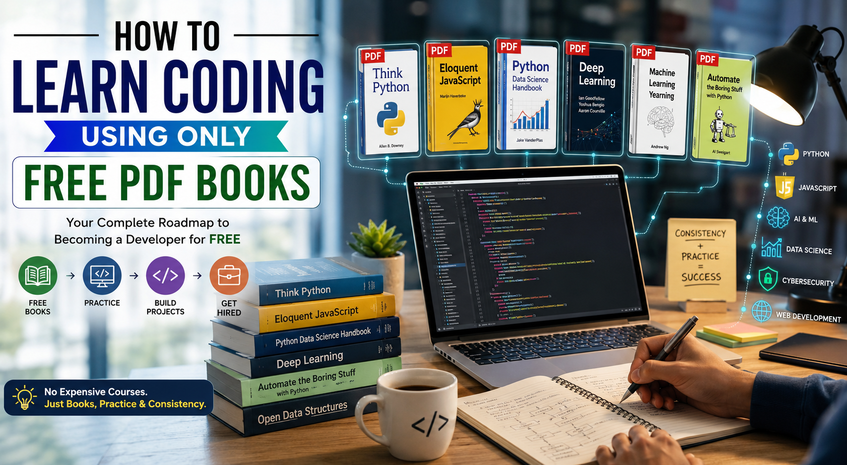
Think Python
Author: Allen B. Downey
Programming strengthens cognitive skills that employers value.
Readers learn how to:
- Break complex problems into smaller components
- Test solutions systematically
- Think analytically
Skills Developed
- Computational thinking
- Analytical reasoning
- Debugging mindset
3. Communication and Professional Writing
Why Communication Skills Are Essential
Remote and hybrid work environments have made written communication more important than ever.
Employees frequently communicate through:
- Emails
- Reports
- Project documentation
- Presentations
- Digital collaboration platforms
Poor communication can reduce productivity, while effective communication improves teamwork and decision-making.
Recommended Free Books
Business Communication for Success
University of Minnesota
This workplace-focused textbook covers:
- Professional writing
- Business presentations
- Workplace communication
- Persuasive messaging
Skills Developed
- Professional communication
- Business writing
- Presentation skills
Technical Writing Essentials
Technical writing has become increasingly important in industries such as:
- Technology
- Healthcare
- Engineering
- Finance
Skills Developed
- Documentation
- Instructional writing
- Clarity and precision
The Elements of Style
Authors: William Strunk Jr. and E.B. White
This timeless classic teaches:
- Grammar fundamentals
- Concise writing
- Clear expression
Skills Developed
- Writing proficiency
- Editing skills
- Professional communication
4. Leadership and Emotional Intelligence
The Rise of Emotional Intelligence in the Workplace
Modern leadership extends beyond technical expertise. Employers increasingly seek individuals who can:
- Motivate teams
- Manage conflict
- Demonstrate empathy
- Build positive workplace relationships
Emotional intelligence is now considered one of the strongest predictors of leadership effectiveness.
Recommended Free Books
Leadership and Influencing Change
This resource explores:
- Organizational leadership
- Team management
- Change implementation
- Stakeholder engagement
Skills Developed
- Leadership
- Team coordination
- Strategic influence
Practical Leadership
A practical introduction to leadership concepts.
Skills Developed
- Decision-making
- Delegation
- Team development
- Coaching skills
Self-Reliance
Author: Ralph Waldo Emerson
A timeless work focused on independence, resilience, and personal growth.
Skills Developed
- Confidence
- Self-leadership
- Personal accountability
As a Man Thinketh
Author: James Allen
A classic text emphasizing mindset and self-improvement.
Skills Developed
- Mental resilience
- Goal orientation
- Personal development
5. Project Management and Productivity
Why Execution Matters
Organizations value employees who can transform ideas into measurable results.
Project management skills help professionals:
- Meet deadlines
- Coordinate resources
- Manage risks
- Deliver outcomes efficiently
Recommended Free Books
Project Management for Instructional Designers
This practical guide introduces project management fundamentals.
Skills Developed
- Planning
- Scheduling
- Stakeholder management
- Resource allocation
Agile Project Management
Agile methodologies dominate modern workplaces.
Readers learn:
- Sprint planning
- Scrum principles
- Continuous improvement
- Team collaboration
Skills Developed
- Agile thinking
- Team coordination
- Workflow management
Getting Things Done (Library Access)
David Allen's productivity framework remains influential worldwide.
Skills Developed
- Time management
- Organization
- Personal productivity
6. Marketing, Digital Branding, and Entrepreneurship
Why Digital Awareness Is Valuable
Today's professionals are expected to understand online platforms, branding, and digital communication—even outside marketing roles.
Recommended Free Books
Digital Marketing Essentials
This resource introduces:
- Search engine optimization (SEO)
- Content marketing
- Social media strategies
- Marketing analytics
Skills Developed
- Digital marketing
- Content strategy
- Data-driven decision making
Entrepreneurship and Innovation Toolkit
A practical guide to innovation and business development.
Skills Developed
- Opportunity recognition
- Business planning
- Innovation management
Small Business Management
Provides foundational business knowledge.
Skills Developed
- Financial planning
- Operations management
- Strategic thinking
7. Financial Literacy and Business Acumen
Why Financial Knowledge Matters
Employers appreciate candidates who understand how organizations create value and manage resources.
Financial literacy helps professionals make better decisions and contribute more effectively to organizational goals.
Recommended Free Books
Principles of Economics
Open Educational Resources
Topics include:
- Supply and demand
- Market structures
- Economic growth
- Global trade
Skills Developed
- Economic reasoning
- Strategic thinking
- Business awareness
Financial Accounting
Readers learn:
- Financial statements
- Budgeting
- Cost analysis
- Business reporting
Skills Developed
- Financial literacy
- Analytical skills
- Budget management
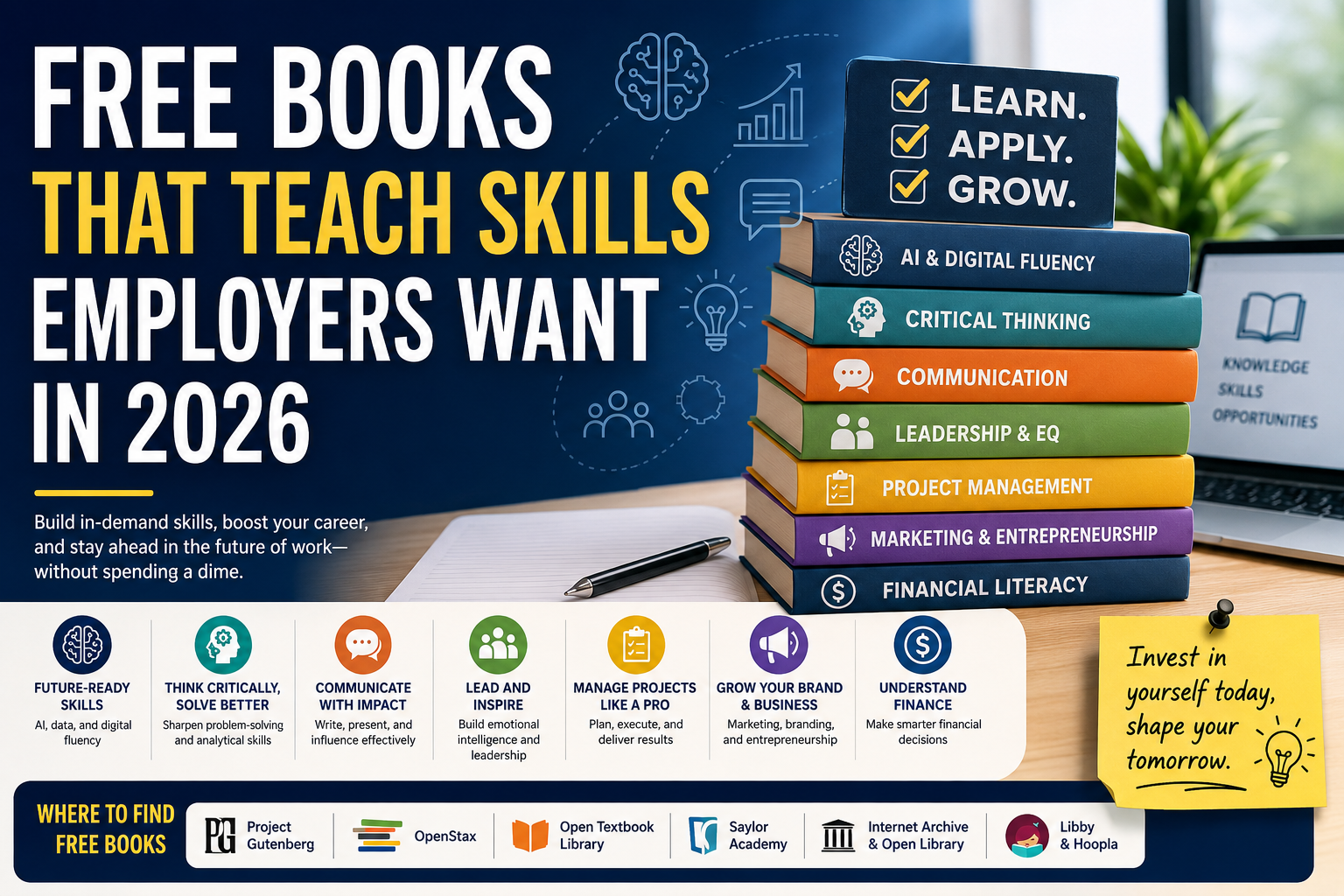
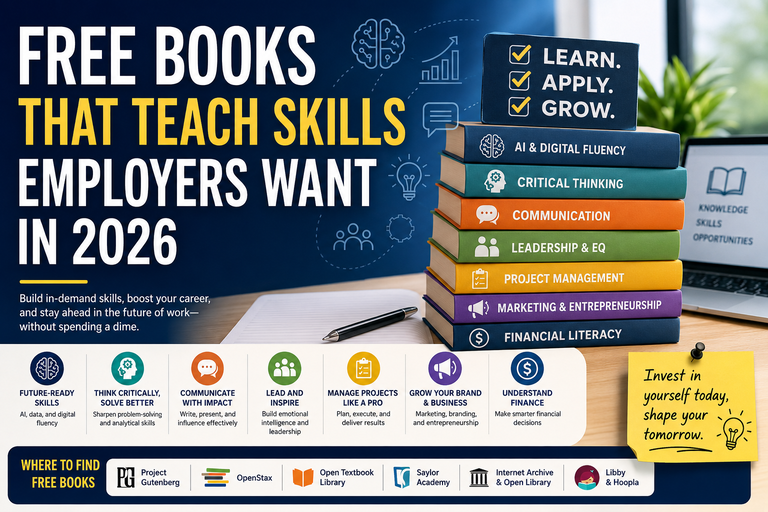
Where to Access Free Books Legally
Students and professionals can find high-quality educational books through several reputable platforms:
Project Gutenberg
Offers thousands of public-domain classics.
OpenStax
Provides peer-reviewed college textbooks at no cost.
Open Textbook Library
Hosts hundreds of academic textbooks across disciplines.
Saylor Academy
Combines free learning materials with educational courses.
Internet Archive and Open Library
Enable legal borrowing of digital books.
Libby and Hoopla
Offer free access to library resources through participating public libraries.
University Repositories
Many universities publish textbooks, research books, and educational materials under open-access licenses.
How to Convert Reading Into Employable Skills
Reading books alone is not enough. Employers value demonstrated capability.
To maximize career benefits:
Build Real Projects
Apply concepts immediately.
Examples include:
- Creating a data dashboard
- Building a website
- Designing a marketing campaign
- Developing a project plan
Create a Portfolio
Document your work online.
Potential platforms include:
- Personal websites
- GitHub repositories
- Professional portfolios
Share Knowledge Publicly
Publishing insights demonstrates expertise.
Options include:
- Blog posts
- LinkedIn articles
- Industry discussions
Earn Complementary Certifications
Combine book knowledge with free or affordable certifications to strengthen credibility.
Participate in Communities
Join professional groups where you can:
- Ask questions
- Share ideas
- Collaborate on projects
- Expand your network
The Most In-Demand Skills Employers Want in 2026
Current hiring trends consistently highlight the following competencies:
Technical Skills
- AI literacy
- Data analysis
- Digital tools proficiency
- Automation awareness
Human Skills
- Critical thinking
- Communication
- Leadership
- Emotional intelligence
Business Skills
- Financial literacy
- Project management
- Strategic planning
- Entrepreneurship
Career Skills
- Adaptability
- Continuous learning
- Problem solving
- Collaboration
Fortunately, free educational books can help learners develop all of these competencies.
Conclusion
The modern economy rewards individuals who continuously learn and adapt. In 2026, access to education is no longer the primary challenge. Instead, success depends on initiative, discipline, and the ability to apply knowledge effectively.
Free books provide a powerful pathway to professional growth. Whether your goal is securing a better job, earning a promotion, changing careers, or building a business, high-quality learning resources are readily available at no cost.
The most successful professionals are not always those with the most expensive education. They are often the individuals who consistently learn, apply new knowledge, and demonstrate measurable value.
Start with one book, develop one skill, complete one project, and keep building. Over time, those small steps can create significant career opportunities and long-term professional success.