How to Learn Coding Using Only Free PDF Books in 2026: Complete Beginner-to-Developer Guide
The demand for coding skills continues to grow across virtually every industry. From web development and mobile applications to artificial intelligence, cybersecurity, cloud computing, and data science, programming has become one of the most valuable skills in the modern digital economy.
Many aspiring programmers believe they need expensive coding bootcamps, university degrees, or premium online courses to become professional developers. While these options can be helpful, they are not the only path to success.
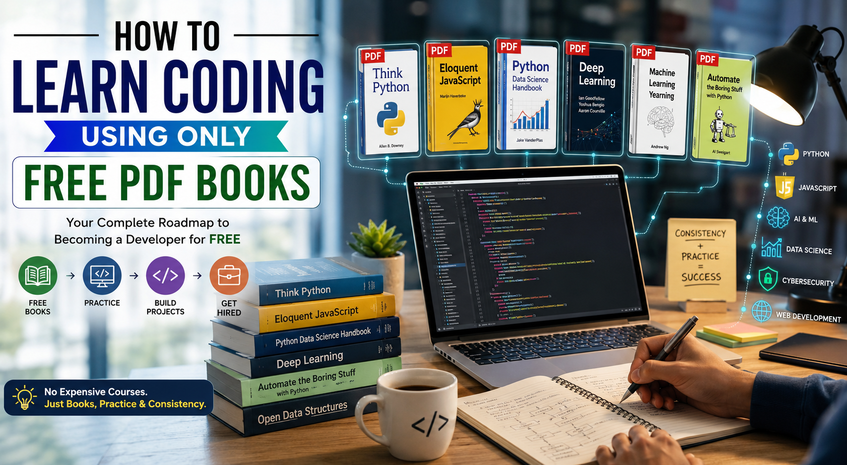
In reality, thousands of successful developers have learned programming through self-study using books, documentation, and hands-on practice. Today, countless high-quality programming books are legally available for free in PDF format through open educational platforms, universities, nonprofit organizations, and authors who freely share their work.
With discipline, consistency, and a structured learning plan, anyone can learn coding using only free PDF books.
This guide explains why books remain powerful learning tools, identifies the best free coding books available, provides a practical roadmap for learning, and shows how to transform book knowledge into real-world programming skills.
Why Learn Coding from Free PDF Books?
Despite the popularity of video courses, programming books offer several advantages that make them highly effective learning resources.
1. Deep Understanding of Concepts
Many online tutorials focus on showing learners how to build something quickly. While this can be useful, it often leaves gaps in understanding.
Books typically provide detailed explanations of:
- Why code works
- How programming concepts connect
- Common mistakes and solutions
- Underlying computer science principles
This deeper understanding helps learners become better problem-solvers rather than simply copying code.
2. Structured Learning Path
One of the biggest challenges beginners face is information overload.
Programming books are usually designed with a logical progression:
- Basic concepts
- Intermediate techniques
- Advanced topics
- Real-world applications
This structure reduces confusion and prevents learners from jumping randomly between unrelated topics.
3. Better Focus and Concentration
Online learning often comes with distractions:
- Advertisements
- Notifications
- Social media
- Recommended videos
Books provide a focused environment that encourages deeper concentration and better retention.
4. Completely Free Access
Thanks to open educational initiatives, students can legally access hundreds of high-quality programming books without spending money.
This makes coding education accessible regardless of financial background.
Choosing Your Programming Goal
Before downloading books, determine what type of programmer you want to become.
Your goal will influence which languages and learning resources you prioritize.
Web Development
Focus on:
- HTML
- CSS
- JavaScript
- React
- Node.js
Career opportunities include:
- Frontend Developer
- Backend Developer
- Full-Stack Developer
Data Science
Focus on:
- Python
- Statistics
- Data Analysis
- Machine Learning
Potential roles include:
- Data Analyst
- Data Scientist
- Business Intelligence Analyst
Artificial Intelligence and Machine Learning
Learn:
- Python
- Mathematics
- Deep Learning
- Neural Networks
Career options include:
- Machine Learning Engineer
- AI Researcher
- Data Scientist
Mobile App Development
Focus on:
- Android Development
- Kotlin
- Flutter
- React Native
Possible careers:
- Android Developer
- Mobile Application Developer
Cybersecurity
Learn:
- Networking
- Linux
- Security Concepts
- Ethical Hacking
Career opportunities:
- Security Analyst
- Penetration Tester
- Cybersecurity Consultant
Software Engineering
Develop broad knowledge in:
- Algorithms
- Databases
- Programming Languages
- System Design
This path provides flexibility across multiple technology sectors.
Step 1: Learn Programming Fundamentals
Every programmer should master core concepts before specializing.
These concepts form the foundation of all programming languages.
Essential Topics
Variables
Variables store information used by programs.
Examples include:
- Names
- Numbers
- Dates
- User input
Conditional Statements
Conditionals help programs make decisions.
Examples:
- If statements
- Else statements
- Switch statements
Loops
Loops automate repetitive tasks.
Common loop types:
- For loops
- While loops
Functions
Functions allow code reuse and organization.
Benefits include:
- Cleaner code
- Reduced duplication
- Easier maintenance
Data Structures
Data structures organize information efficiently.
Examples include:
- Arrays
- Lists
- Dictionaries
- Sets
Best Free PDF Books for Beginners
Think Python – Allen B. Downey
This book is widely regarded as one of the best introductions to programming.
Topics include:
- Variables
- Functions
- Recursion
- Object-oriented programming
Why it's valuable:
- Beginner-friendly explanations
- Numerous exercises
- Practical examples
How to Think Like a Computer Scientist
This book teaches computational thinking rather than just syntax.
Key lessons:
- Problem-solving
- Logical reasoning
- Algorithm design
These skills remain useful regardless of which programming language you eventually use.
Automate the Boring Stuff with Python
This practical book teaches programming through real-world tasks.
Projects include:
- File management
- Spreadsheet automation
- Web scraping
- Data processing
It is ideal for beginners who want immediate practical results.
Step 2: Master Data Structures and Algorithms
After understanding programming basics, focus on data structures and algorithms.
These topics are crucial because employers often evaluate them during technical interviews.
Why Data Structures Matter
Efficient software depends on how data is organized.
Examples include:
- Lists
- Stacks
- Queues
- Trees
- Graphs
Understanding these structures improves coding efficiency and problem-solving ability.
Recommended Free Books
Problem Solving with Algorithms and Data Structures Using Python
Covers:
- Searching algorithms
- Sorting algorithms
- Recursion
- Trees
- Graphs
Excellent for interview preparation.
Open Data Structures
Provides detailed explanations of:
- Linked lists
- Binary trees
- Hash tables
- Performance analysis
Suitable for learners transitioning to intermediate programming.
Step 3: Choose a Specialization
Once your fundamentals are strong, begin focusing on a specific area.
Learning Web Development Through Free Books
Eloquent JavaScript
One of the most respected JavaScript books available.
Topics include:
- Modern JavaScript
- Browser programming
- Asynchronous programming
- Object-oriented development
You Don’t Know JS
This series explores JavaScript at a deeper level.
Topics include:
- Scope
- Closures
- Objects
- Async programming
Ideal for serious web developers.
Learning Data Science Through Free Books
Python Data Science Handbook
A comprehensive guide covering:
- NumPy
- Pandas
- Data visualization
- Machine learning workflows
Essential for aspiring data scientists.
An Introduction to Statistical Learning
Provides beginner-friendly explanations of:
- Regression
- Classification
- Machine learning algorithms
Often recommended as an entry point into predictive analytics.
Learning Artificial Intelligence and Machine Learning
Deep Learning
Written by leading AI researchers.
Topics include:
- Neural networks
- Deep learning architectures
- Optimization techniques
This book serves as a valuable long-term reference.
Machine Learning Yearning
Created by AI educator Andrew Ng.
Focuses on:
- Practical AI development
- Model improvement strategies
- Machine learning project design
Excellent for understanding real-world AI workflows.
Learning Cybersecurity Through Books
Cybersecurity requires understanding both systems and vulnerabilities.
Recommended resources include:
- Open Security Training materials
- Network security textbooks
- Ethical hacking guides
- Linux administration books
Topics to learn:
- Networking
- Cryptography
- Web security
- Vulnerability assessment
Step 4: Practice While Reading
Reading alone does not build programming skills.
Programming is a practical discipline.
Every chapter should be accompanied by coding exercises.
Effective Practice Strategy
Type Every Example Yourself
Avoid copying and pasting.
Typing code improves understanding and memory retention.
Modify Existing Programs
After completing examples:
- Change variables
- Add new features
- Experiment with outputs
This reinforces learning.
Break the Code Intentionally
Introduce errors and attempt to fix them.
Debugging is one of the most valuable skills developers acquire.
Complete Chapter Exercises
Most programming books include practice questions.
Treat these exercises seriously.
They transform passive learning into active learning.
Step 5: Build Real Projects
Projects bridge the gap between theory and professional skills.
Employers care more about demonstrated ability than certificates.
Beginner Projects
Consider building:
- Calculator applications
- Number guessing games
- Password generators
- To-do lists
- Expense trackers
Intermediate Projects
Build:
- Weather applications
- Blogging platforms
- Task management systems
- Portfolio websites
Advanced Projects
Develop:
- Machine learning models
- E-commerce websites
- REST APIs
- Real-time chat applications
Building a Strong Portfolio
Your portfolio proves your capabilities.
Create a public repository using GitHub.
For every completed project:
Include:
- Source code
- Documentation
- Screenshots
- Installation instructions
A strong portfolio often matters more than certificates.
A Six-Month Coding Roadmap Using Free Books
Month 1
Focus on:
- Programming basics
- Variables
- Functions
- Loops
Goal:
Complete one beginner programming book.
Month 2
Continue practicing fundamentals.
Goal:
Solve at least 50 coding exercises.
Month 3
Study:
- Data structures
- Algorithms
- Problem-solving techniques
Goal:
Complete one algorithms textbook.
Month 4
Choose a specialization.
Goal:
Build two small projects.
Month 5
Study intermediate concepts.
Goal:
Build a larger project demonstrating practical skills.
Month 6
Prepare for employment opportunities.
Focus on:
- Portfolio improvement
- GitHub contributions
- Technical interview practice
Best Websites for Free Coding PDF Books
Always use legal and reputable sources.
Open Textbook Library
Provides peer-reviewed educational books.
OpenStax
Offers free university-level textbooks.
Green Tea Press
Hosts several excellent programming books.
GitHub
Many authors release complete books as open-source projects.
Internet Archive
Provides borrowing access to millions of books.
University Course Websites
Many professors publish lecture notes and textbooks freely.
Google Scholar
Useful for locating open-access educational materials.
Study Techniques for Maximum Success
Use the 30-30 Method
Spend:
- 30 minutes reading
- 30 minutes coding
This balances theory and practice.
Take Detailed Notes
Document:
- New concepts
- Errors encountered
- Solutions discovered
These notes become valuable references later.
Teach Others
Explaining concepts strengthens understanding.
You can:
- Write blog posts
- Create tutorials
- Answer questions online
Teaching accelerates mastery.
Remain Consistent
Consistency beats intensity.
Studying one hour daily often produces better results than studying eight hours once per week.
Common Mistakes Beginners Make
Reading Without Coding
Programming requires active practice.
Learning Too Many Languages at Once
Focus on one language initially.
Depth is more valuable than breadth.
Skipping Fundamentals
Advanced topics become difficult without strong basics.
Fear of Debugging
Every programmer encounters errors.
Debugging is part of the learning process.
Chasing Perfect Understanding
You do not need to understand everything immediately.
Progress comes through repetition and experience.
Benefits of the Book-Only Learning Approach
Learning exclusively through books develops:
- Self-discipline
- Deep understanding
- Independent problem-solving
- Research skills
- Long-term learning habits
These qualities often distinguish exceptional developers from average ones.
Can You Get a Programming Job Using Only Free Books?
Absolutely.
Many employers focus on:
- Technical skills
- Problem-solving ability
- Project quality
- Portfolio strength
- Interview performance
They rarely care whether knowledge came from:
- University courses
- Bootcamps
- Paid courses
- Free books
If you can build useful software and demonstrate your skills, opportunities will follow.
Final Thoughts
Learning to code does not require a large budget. The internet provides access to thousands of free programming books covering every major field of software development.
Success depends less on the resources you use and more on how consistently you apply them.
Choose a programming path, start with a beginner-friendly book, practice every day, build projects, and gradually develop a portfolio that showcases your abilities.
Knowledge is available to everyone.
The true investment is your commitment, curiosity, and persistence.
Start with one book today, complete it thoroughly, build something useful, and continue learning. Over time, those small steps can transform you from a beginner into a professional developer—all without spending money on expensive courses.