How Students Can Create a Complete Learning System Using Free Books
For generations, quality education was often associated with expensive textbooks, costly courses, and access to elite institutions. Today, that reality has changed dramatically. The rise of open educational resources (OER), digital libraries, public-domain collections, and freely accessible academic materials has made it possible for students to build a comprehensive learning system without spending money on books.
However, simply downloading dozens of free books does not guarantee learning success. Many students fall into the trap of collecting resources without creating a structured plan for using them. As a result, they accumulate information but struggle to develop knowledge, skills, and mastery.
The true power of free educational books lies in building a complete learning system a structured framework that guides learning from beginner to advanced levels while incorporating practice, review, assessment, and continuous improvement.
This guide explains how students can create an effective learning system using free books, enabling them to achieve academic goals, develop professional skills, and pursue lifelong learning at little to no cost.
Understanding What a Complete Learning System Is
Before gathering resources, it's important to understand what makes a learning system complete.
A learning system is more than a collection of books. It is a structured process designed to help you acquire knowledge, practice skills, measure progress, and retain information over time.
A complete learning system includes:
- Clear learning objectives
- A structured curriculum
- Core textbooks
- Supplementary resources
- Practical exercises
- Review mechanisms
- Progress tracking
- Assessment methods
- Continuous improvement strategies
When all these components work together, learning becomes organized, measurable, and sustainable.
Why Students Need a Learning System
Many learners struggle not because they lack intelligence or motivation but because they lack structure.
Without a system, students often:
- Jump between topics randomly
- Download excessive materials
- Lose focus
- Forget previously learned concepts
- Fail to measure progress
A structured learning system provides:
Direction
You know exactly what to study next.
Consistency
You maintain regular study habits.
Accountability
You can track accomplishments and identify weaknesses.
Long-Term Retention
Systematic review ensures information remains in memory.
The result is more effective learning with less frustration.
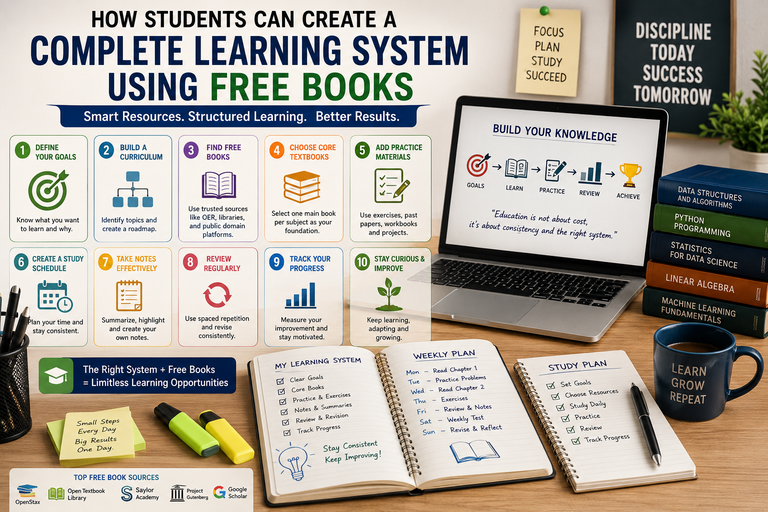
Step 1: Define Clear Learning Goals
Every successful learning system begins with a specific objective.
Ask yourself:
- What do I want to learn?
- Why do I want to learn it?
- What outcome am I aiming for?
Examples include:
Academic Goals
- Pass university examinations
- Improve grades
- Complete coursework
Professional Goals
- Learn programming
- Develop data analysis skills
- Improve business knowledge
Personal Goals
- Study philosophy
- Learn a language
- Explore history
Break Large Goals into Smaller Objectives
Instead of saying:
"I want to learn computer science."
Create measurable milestones:
- Learn programming fundamentals
- Understand data structures
- Study algorithms
- Build practical projects
Smaller goals create a clear learning roadmap and make progress easier to track.
Step 2: Build a Curriculum Framework
Free books become far more effective when organized into a structured curriculum.
A curriculum acts as the blueprint of your learning journey.
Identify Core Topics
Research what experts consider foundational.
Sources include:
- University syllabi
- Course outlines
- Degree programs
- Professional certification requirements
For example, a Data Science curriculum might include:
- Mathematics
- Statistics
- Programming
- Data Visualization
- Machine Learning
- Data Ethics
Arrange Topics Logically
Organize topics in the order they should be learned.
For instance:
Learning algebra before calculus makes more sense than the reverse.
A logical progression prevents confusion and builds confidence.
Step 3: Organize Learning Levels
One of the biggest mistakes students make is studying materials that are too advanced too soon.
A complete learning system should include:
Beginner Resources
Focus on:
- Basic concepts
- Terminology
- Fundamental principles
Intermediate Resources
Introduce:
- Applications
- Problem-solving
- Deeper understanding
Advanced Resources
Explore:
- Specialized topics
- Research
- Complex case studies
This progression ensures steady growth without overwhelming yourself.
Step 4: Find Reliable Sources of Free Books
The quality of your learning system depends heavily on the quality of your resources.
Fortunately, many excellent sources provide free educational books legally.
Open Educational Resource Platforms
OER platforms offer professionally developed educational materials.
Examples include:
- OpenStax
- Open Textbook Library
- Saylor Academy
- BCcampus OpenEd
Advantages:
- Peer-reviewed content
- Free access
- Academic credibility
- Regular updates
Public Domain Libraries
These platforms provide classic educational materials.
Examples:
- Project Gutenberg
- Internet Archive
- LibriVox
Excellent for:
- Literature
- Philosophy
- History
- Classical studies
Government and Educational Institutions
Many organizations publish free:
- Reports
- Manuals
- Textbooks
- Learning guides
These materials are often highly reliable and authoritative.
Academic Databases
Students with library access may use:
- Google Scholar
- JSTOR
- ProQuest
- ERIC
These databases provide access to scholarly publications and research-based learning materials.
Step 5: Select One Core Textbook for Each Subject
A common mistake among self-learners is trying to study from too many books simultaneously.
Instead, choose:
One Core Textbook
This becomes your primary source.
It should:
- Cover the subject systematically
- Follow a logical structure
- Include explanations and examples
- Offer practice questions
One or Two Supplementary Resources
These serve to:
- Clarify difficult topics
- Provide alternative explanations
- Offer additional examples
This balanced approach prevents information overload while maintaining depth.
Step 6: Add Practice and Application Resources
Reading creates understanding.
Practice creates mastery.
To transform knowledge into skill, include application materials.
Examples include:
For Mathematics
- Problem-solving workbooks
- Exercise manuals
- Past examination papers
For Computer Science
- Coding exercises
- Project guides
- Programming challenges
For Business and Economics
- Case studies
- Industry reports
- Market analyses
For Humanities
- Essay prompts
- Discussion questions
- Critical thinking exercises
The more actively you apply what you learn, the faster your skills develop.
Step 7: Create a Consistent Study Schedule
Even the best learning resources become ineffective without consistency.
Develop a realistic study schedule.
Weekly Learning Plan Example
| Day | Activity |
|---|---|
| Monday | Read new chapter |
| Tuesday | Take notes and summarize |
| Wednesday | Complete exercises |
| Thursday | Study next chapter |
| Friday | Practice problems |
| Saturday | Weekly review |
| Sunday | Rest or catch up |
Consistency is more important than studying for long hours occasionally.
A student who studies one hour daily often achieves better results than someone who studies seven hours once a week.
Step 8: Develop a Note-Taking System
Books become far more valuable when paired with active note-taking.
Effective note-taking methods include:
Cornell Method
Divide notes into:
- Main notes
- Key concepts
- Summary section
Mind Mapping
Useful for:
- Visual learners
- Concept relationships
- Brainstorming
Chapter Summaries
After every chapter:
- Summarize major ideas
- List key terms
- Record questions
Flashcards
Ideal for:
- Definitions
- Formulas
- Vocabulary
- Quick revision
Good notes transform passive reading into active learning.
Step 9: Incorporate Review and Reinforcement
Learning is incomplete without revision.
Without review, much of what is learned will be forgotten.
The Three-Stage Review Method
Stage 1: Immediate Review
Review notes within 24 hours.
Stage 2: Weekly Review
Revisit concepts learned during the week.
Stage 3: Monthly Review
Consolidate major topics and identify gaps.
This approach utilizes spaced repetition, one of the most effective techniques for long-term retention.
Step 10: Supplement Books with Multimedia Learning
Books should remain the foundation of your system, but multimedia resources can strengthen understanding.
Useful supplements include:
- Educational videos
- Online lectures
- Podcasts
- Interactive simulations
- Free online courses
Resources such as:
- Khan Academy
- Coursera (audit mode)
- edX
- MIT OpenCourseWare
can help explain difficult concepts introduced in textbooks.
The goal is not to replace books but to reinforce them.
Step 11: Track Your Progress
A learning system should provide measurable evidence of improvement.
Create tools such as:
Reading Logs
Track:
- Books completed
- Chapters studied
- Study hours
Mastery Checklists
Mark concepts as:
- Not started
- In progress
- Mastered
Self-Assessments
Ask:
- Can I explain this topic?
- Can I solve related problems?
- Can I teach it to someone else?
Progress tracking increases motivation and accountability.
Step 12: Build an Organized Library
Organization improves efficiency.
Digital Library Organization
Create folders such as:
- Mathematics
- Science
- Technology
- Literature
- Research Papers
Rename files consistently.
Example:
- Statistics_Beginner.pdf
- Statistics_Intermediate.pdf
Use cloud storage to back up important resources.
Physical Library Organization
For printed books:
- Label shelves
- Use bookmarks
- Highlight key sections
- Add margin notes
A well-organized library saves time and reduces frustration.
Step 13: Join Learning Communities
Learning does not have to be a solitary activity.
Communities provide:
- Motivation
- Accountability
- Clarification
- Diverse perspectives
Consider joining:
- Study groups
- Academic forums
- Subject-specific communities
- Discord study servers
- Professional networks
Explaining concepts to others often strengthens your own understanding.
Step 14: Maintain Academic Integrity
While free resources are widely available, students should prioritize ethical learning practices.
Always:
- Use legal resources
- Respect copyright laws
- Cite sources correctly
- Avoid pirated materials
Academic integrity builds credibility and professionalism.
There are more than enough legitimate free resources available today to create an excellent learning system.
Step 15: Continuously Improve Your Learning System
A learning system should evolve as your knowledge grows.
Periodically ask:
- Is this book still meeting my needs?
- Do I need more practice resources?
- Have my goals changed?
- Am I progressing at the right pace?
Replace outdated materials, add advanced resources, and refine your study habits.
Continuous improvement ensures your system remains effective over time.
Example: Creating a Free Learning System for Data Science
To illustrate how everything fits together, consider a student who wants to learn Data Science.
Goal
Learn Data Science fundamentals within one year.
Core Textbook
Open-source statistics textbook.
Supplementary Resource
Free Python programming guide.
Practice
- Coding exercises
- Kaggle datasets
- Data analysis projects
Schedule
10 hours per week.
Review
Weekly quizzes and monthly assessments.
Progress Tracking
Project portfolio and learning journal.
Cost
$0
Educational Value
Comparable to many structured introductory courses.
This demonstrates how free books can become the foundation of a comprehensive education.
Common Mistakes to Avoid
Many students undermine their learning systems by making avoidable mistakes.
Avoid:
- Downloading too many books
- Studying without clear goals
- Skipping practice exercises
- Ignoring revision
- Jumping between subjects excessively
- Measuring effort instead of results
Focus on consistency, quality resources, and gradual progress.
Conclusion
Creating a complete learning system using free books is one of the most powerful opportunities available to modern students. Thanks to open educational resources, digital libraries, and public-domain collections, access to knowledge has never been more democratic.
However, success depends not on how many books you collect but on how effectively you organize and use them. By setting clear goals, building a structured curriculum, selecting reliable resources, incorporating practice, tracking progress, and reviewing consistently, students can create a learning system that rivals many traditional educational programs.
The cost of education is no longer the greatest barrier to learning. Structure, discipline, and commitment matter far more.
With the right system in place, free books can provide the foundation for academic excellence, career advancement, and lifelong intellectual growth.