Why Reading eBooks Is Becoming More Popular Among Students
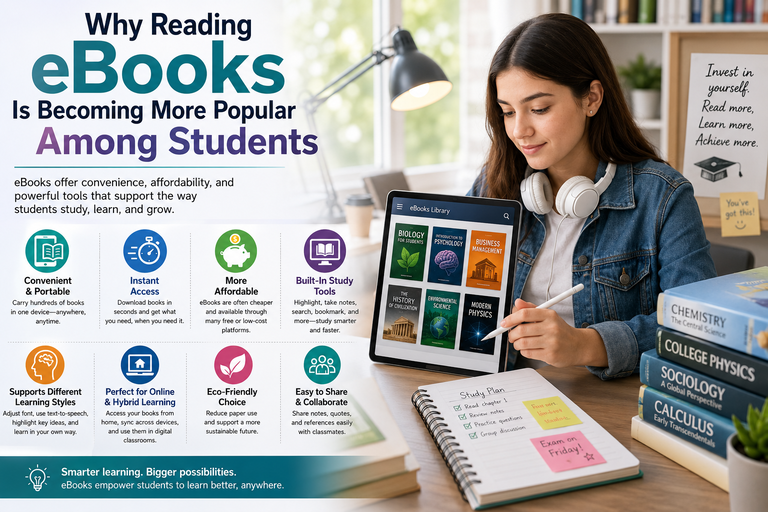
The way students access information and consume educational content has changed dramatically over the last decade. As technology continues to reshape education, eBooks have emerged as one of the most popular tools for learning. What was once considered a convenient alternative to printed books has now become a mainstream reading format used by millions of students worldwide.
From secondary school students to university researchers, learners are increasingly turning to digital books for academic study, personal development, and recreational reading. The rise of smartphones, tablets, laptops, and dedicated e-readers has made digital reading more accessible than ever before. Combined with affordable pricing, instant access, and interactive learning features, eBooks offer advantages that align perfectly with the needs of modern students.
While printed books continue to hold an important place in education, the growing popularity of eBooks reflects broader changes in technology, learning habits, and educational accessibility. Understanding why students are embracing digital reading helps explain how education is evolving in the digital age.
The Rise of Digital Learning
Education today is far more connected to technology than it was just a few years ago. Students regularly use digital platforms for research, assignments, communication, and collaboration. Online learning management systems, virtual classrooms, cloud-based storage, and educational applications have become standard tools in schools and universities.
As a result, reading has naturally become part of this digital ecosystem. Instead of carrying multiple textbooks or searching through physical libraries, students can access educational materials instantly from their devices. This integration of reading into digital learning environments has significantly contributed to the growth of eBook usage among students.
1. eBooks Are Convenient and Portable
One of the most significant advantages of eBooks is their portability.
Traditional textbooks can be heavy and difficult to carry, especially for students taking multiple courses. A single semester may require several books, creating a considerable physical burden. eBooks eliminate this problem by allowing students to store hundreds or even thousands of books on a single device.
Students can easily:
- Carry an entire library in their pocket
- Access course materials from anywhere
- Read while traveling or commuting
- Switch between different subjects instantly
- Study without carrying bulky textbooks
This convenience is particularly valuable for students who move between classrooms, libraries, dormitories, and workplaces throughout the day.
2. Instant Access Saves Valuable Time
In academic environments, timing often matters. Students frequently need immediate access to books for assignments, research projects, presentations, and exam preparation.
Unlike printed books, which may require visiting a bookstore or waiting for delivery, eBooks can be downloaded within seconds.
This instant availability benefits students by allowing them to:
- Access required readings immediately
- Obtain last-minute reference materials
- Begin research projects without delay
- Continue studying outside normal library hours
The ability to acquire information quickly supports more efficient learning and better academic performance.
3. eBooks Are Often More Affordable
Financial concerns are a reality for many students. Tuition fees, accommodation, transportation, and daily living expenses already place significant pressure on student budgets.
Textbooks can be particularly expensive, sometimes costing hundreds of dollars per semester. eBooks often provide a more affordable alternative.
Students can access digital books through:
- University libraries
- Public libraries
- Educational subscriptions
- Open-access platforms
- Discounted digital bookstores
- Rental services
Many institutions also provide free access to digital course materials, helping students reduce educational expenses while maintaining access to essential resources.
4. Built-In Study Tools Enhance Learning
Modern eBooks are much more than digital versions of printed books. Many include advanced features designed to support learning and improve comprehension.
Common study tools include:
Search Functions
Students can locate keywords, concepts, and passages instantly rather than manually flipping through pages.
Highlighting Features
Important information can be marked and reviewed later.
Digital Note-Taking
Students can add comments, explanations, and reminders directly within the text.
Bookmarking
Key sections can be saved for future reference.
Built-In Dictionaries
Unknown words can be defined immediately without leaving the book.
Text-to-Speech Technology
Books can be read aloud, helping students absorb information through listening.
These features create a more interactive learning experience and improve study efficiency.
5. eBooks Support Different Learning Styles
Every student learns differently. Some prefer visual learning, while others benefit from auditory or interactive approaches.
eBooks offer flexibility that helps accommodate diverse learning preferences.
For example:
Visual Learners
Can use color-coded highlights, annotations, and customized formatting.
Auditory Learners
Can take advantage of text-to-speech tools and audiobook integrations.
Students with Reading Difficulties
Can adjust text size, spacing, and contrast for improved readability.
Organized Learners
Can maintain notes, bookmarks, and references in a single digital location.
This adaptability makes eBooks suitable for a broad range of educational needs.
6. Essential for Remote and Hybrid Learning
The expansion of online and hybrid education has accelerated eBook adoption.
As schools and universities increasingly incorporate virtual learning environments, students require resources that can be accessed remotely. eBooks fit naturally into digital classrooms because they can be:
- Downloaded from home
- Shared through learning platforms
- Integrated into online courses
- Accessed across multiple devices
Students no longer need physical access to a campus library to obtain educational materials. This accessibility became particularly important during periods of remote learning and continues to support flexible education models today.
7. Reduced Physical Clutter
Student living spaces are often limited.
Dormitories, shared apartments, and small study areas may not provide enough room for large collections of books. Over time, printed materials can accumulate and create organizational challenges.
eBooks solve this problem by allowing students to:
- Store thousands of books digitally
- Eliminate shelf space requirements
- Reduce backpack weight
- Keep materials organized electronically
For students with limited space, digital libraries offer a practical solution.
8. Environmental Considerations
Sustainability has become an important concern for many young people. As environmental awareness grows, students increasingly consider the ecological impact of their choices.
Because eBooks do not require paper production, printing, or physical transportation, many students view them as a more environmentally friendly option.
Potential environmental benefits include:
- Reduced paper consumption
- Lower transportation emissions
- Less packaging waste
- Fewer discarded books
Although digital devices also have environmental costs, long-term eBook usage can contribute to more sustainable reading habits.
9. Easier Updates and Revisions
In rapidly changing fields such as technology, medicine, law, and business, information can become outdated quickly.
Printed textbooks may remain unchanged for years until a new edition is published. eBooks, however, can often be updated more efficiently.
Students benefit from access to:
- Updated statistics
- Revised research findings
- New case studies
- Current terminology
- Recent developments in their field
This helps learners stay informed and work with the most relevant information available.
10. Integration with Modern Technology
Today's students are digital natives. They routinely use cloud storage, online collaboration tools, note-taking apps, and digital research databases.
eBooks fit seamlessly into these existing workflows.
Students can:
- Synchronize reading progress across devices
- Save notes to the cloud
- Copy citations for academic writing
- Integrate reading with digital research tools
- Access content from multiple locations
This connectivity improves productivity and supports more efficient study practices.
11. Greater Access to Educational Resources
Digital platforms often provide access to a broader selection of materials than physical libraries or bookstores.
Students can explore:
- Academic textbooks
- Research publications
- Reference works
- Fiction and literature
- Professional development resources
- International publications
Many educational institutions subscribe to digital databases that provide students with access to vast collections of books and scholarly materials.
This expanded availability encourages broader learning and intellectual exploration.
12. Improved Accessibility for Students with Disabilities
Accessibility is one of the most significant advantages of digital reading.
Students with disabilities may face challenges when using traditional printed materials. eBooks provide features that make reading more accessible and inclusive.
Helpful accessibility tools include:
- Adjustable font sizes
- Screen readers
- Text-to-speech functionality
- High-contrast display options
- Searchable content
- Magnification tools
These features support students with visual impairments, dyslexia, mobility challenges, and other learning needs.
13. Easier Collaboration and Academic Sharing
Education increasingly emphasizes collaboration, particularly at the university level.
eBooks make it easier for students to work together by simplifying the sharing of information and references.
Students can:
- Share citations quickly
- Reference specific chapters and pages
- Compare notes
- Discuss highlighted passages
- Collaborate on group projects
Digital reading tools support more effective communication and teamwork among learners.
14. Better Suited to Modern Reading Habits
Modern students often read in short intervals throughout the day.
Whether waiting between classes, traveling, or taking study breaks, students frequently engage in brief reading sessions.
eBooks accommodate this behavior by allowing students to:
- Open books instantly
- Resume reading from the exact page they left off
- Access materials from multiple devices
- Study whenever time becomes available
This flexibility helps students maintain consistent reading habits despite busy schedules.
Challenges of eBooks
Despite their many advantages, eBooks are not without limitations.
Some common challenges include:
Eye Strain
Extended screen use can cause fatigue and discomfort.
Digital Distractions
Notifications, social media, and other apps can interrupt concentration.
Battery Dependence
Access to digital books depends on device power.
Technical Issues
File compatibility problems and software glitches can occasionally occur.
Preference for Physical Reading
Some students find printed books easier for deep reading, annotation, or long study sessions.
Because of these factors, many learners choose a hybrid approach, using both eBooks and printed books depending on the task.
The Future of eBooks in Education
As educational technology continues to evolve, eBooks are likely to become even more sophisticated and widely used.
Future developments may include:
- Interactive multimedia content
- AI-powered study assistance
- Personalized learning experiences
- Enhanced accessibility features
- Greater integration with virtual classrooms
As schools and universities continue embracing digital transformation, eBooks will play an increasingly important role in education worldwide.
Conclusion
The growing popularity of eBooks among students reflects the changing nature of learning in the digital age. Their portability, affordability, accessibility, and powerful study features make them an attractive alternative to traditional printed books.
From instant access and built-in learning tools to improved collaboration and environmental benefits, eBooks offer numerous advantages that support academic success. While printed books remain valuable for many learners, digital books provide flexibility and convenience that align closely with modern student lifestyles.
As technology continues to shape education, eBooks are not simply replacing traditional books they are expanding opportunities for students to learn, explore, and succeed in ways that were once impossible. For today's learners, having an entire library available at the touch of a screen is no longer a luxury; it is becoming the new standard.