How to Read More Books in Less Time (Student Guide)
For students, reading is not just a leisure activity it is a fundamental part of academic success. From textbooks and lecture notes to novels and research papers, the volume of reading can quickly become overwhelming. Many students want to read faster to keep up, but they worry that speed will come at the cost of understanding.
The reality is different. Reading more in less time is not about rushing it is about reading smarter. When you use the right strategies, you can improve both speed and comprehension while reducing stress and freeing up time for other priorities.
This guide breaks down exactly how to do that.
Why Students Struggle to Read Enough
Before improving your reading habits, it is important to understand what gets in the way. Most students struggle not because they are incapable readers, but because they lack effective strategies.
Common obstacles include:
- Heavy academic workloads
- Constant digital distractions
- Poor time management
- Slow or unfocused reading habits
- Lack of clear reading goals
- Treating all reading the same way
- Fatigue and burnout
- Difficulty with dense or technical material
- Procrastination due to overwhelm
The key issue is rarely just speed it is approach.
What “Reading More in Less Time†Really Means
Efficient reading does not mean skimming everything or sacrificing understanding. It means:
- Reading with clear intent
- Matching your reading style to the task
- Avoiding unnecessary rereading
- Improving focus and concentration
- Extracting key ideas quickly
In short, it is about doing the right kind of reading at the right time.
1. Start With a Clear Purpose
One of the biggest mistakes students make is reading without knowing why.
Before you begin, ask:
- Is this for an exam or assignment?
- Do I need deep understanding or just an overview?
- What specific information am I looking for?
Your purpose determines your strategy.
Example:
- For exams → focus on definitions, key concepts, and examples
- For essays → look for arguments and supporting evidence
- For discussions → analyze themes and interpretations
Reading without purpose wastes time. Reading with purpose saves it.
2. Preview Before You Read
Jumping straight into a chapter is inefficient. Instead, spend a few minutes previewing:
- Title and headings
- Subheadings
- Introduction and conclusion
- Bold terms and key concepts
- Charts, diagrams, and summaries
This creates a mental roadmap.
Benefits:
- Faster comprehension
- Better retention
- Less confusion
- Easier note-taking
A 5-minute preview can save 20 minutes of struggling later.
3. Adjust Your Reading Speed
Not all content should be read at the same pace.
Read slowly when:
- The material is complex or new
- You need deep understanding
- You are studying for exams
Read faster when:
- Reviewing familiar material
- Looking for specific information
- Reading examples or less important sections
Smart readers adjust speed. Inefficient readers don’t.
4. Use the Right Reading Method
Skimming
Quick reading for the main idea
Use for previews and reviews
Scanning
Searching for specific information
Use for keywords, dates, or definitions
Deep Reading
Careful, focused reading
Use for difficult or important material
Common mistake: Deep-reading everything.
Better approach: Choose the right method for each task.
5. Use Time Blocks
Reading without limits often leads to procrastination.
Try structured sessions:
- 25 minutes reading, 5-minute break
- 40 minutes reading, 10-minute break
This helps you:
- Stay focused
- Avoid burnout
- Start more easily
Instead of saying “I’ll read this chapter,†say:
“I’ll read for 25 minutes.â€
6. Eliminate Distractions
Distractions destroy reading efficiency.
To stay focused:
- Put your phone on silent or out of reach
- Close unnecessary tabs
- Avoid multitasking
- Study in a quiet environment
Even small interruptions can double your reading time.
7. Optimize Your Reading Environment
Your environment affects your focus.
Improve it by:
- Sitting upright (not lying in bed)
- Using good lighting
- Keeping your space clean
- Staying hydrated
Comfort matters but too much comfort leads to sleepiness.
8. Use a Pointer to Guide Your Eyes
Using your finger, pen, or cursor while reading can:
- Increase speed
- Reduce distractions
- Prevent losing your place
It keeps your eyes moving consistently and improves concentration.
9. Control Subvocalization
Subvocalization (silently saying words in your head) can slow you down.
To reduce it:
- Read in phrases, not word-by-word
- Increase pace slightly
- Focus visually on chunks of text
However, keep it for difficult material where understanding matters more than speed.
10. Avoid Unnecessary Rereading
Rereading wastes time when caused by poor focus.
Instead:
- Preview before reading
- Stay focused
- Summarize sections as you go
Ask yourself:
“What was the main idea?â€
If you can answer, you don’t need to reread.
11. Take Smart Notes
Avoid writing everything down.
Focus on:
- Main ideas
- Key definitions
- Important examples
- Questions
Effective methods:
- Cornell Notes
- Margin annotations
- Short summaries
- Concept maps
Good notes are concise and useful, not long and detailed.
12. Read Actively
Passive reading leads to poor retention.
Engage with the text by asking:
- What is the main idea?
- Why does this matter?
- How does it connect to what I know?
Active reading improves understanding and reduces review time.
13. Use the SQ3R Method
A proven system for textbooks:
- Survey – preview the material
- Question – turn headings into questions
- Read – read to answer them
- Recite – summarize key ideas
- Review – revisit important points
This method improves both speed and comprehension.
14. Match Strategy to Subject
Different subjects require different approaches:
- Literature: themes, characters, symbolism
- Science: processes, diagrams, cause-effect
- History: timelines, causes, patterns
- Philosophy: arguments, logic, definitions
- Math: examples and application
Using the same method for everything wastes time.
15. Read at the Right Time
Your brain works better at certain times.
Identify your peak hours and use them for:
- Difficult reading
- Deep study
Use low-energy times for:
- Review
- Light reading
16. Break Large Tasks Into Smaller Goals
Instead of:
“I need to read 100 pagesâ€
Try:
- 20 pages at a time
- One section per session
- 25-minute blocks
Small goals reduce overwhelm and increase consistency.
17. Build a Reading Routine
Consistency beats intensity.
Examples:
- 30 minutes after class
- 20 minutes before bed
- One focused session daily
Routine removes decision fatigue and builds momentum.
18. Use Audiobooks Strategically
Audiobooks can help you “read†more:
Useful for:
- Novels
- Biographies
- Commutes
Not ideal for:
- Technical or dense material
Combine audio and text for better results.
19. Improve Vocabulary Gradually
Slow reading often comes from unfamiliar words.
Improve by:
- Learning repeated terms
- Keeping a vocabulary list
- Practicing context understanding
Better vocabulary = faster reading.
20. Practice Regularly
Reading is a skill that improves with use.
Focus on:
- Daily reading
- Better focus
- Smarter strategies
Speed improves naturally over time.
21. Know When to Stop a Book
For non-essential reading:
It is okay to stop if a book is:
- Not useful
- Too difficult
- Poorly written
Your time is valuable.
22. Use Summaries Wisely
Summaries are helpful for:
- Previewing
- Reviewing
- Clarifying
But avoid relying on them when:
- Deep understanding is required
- Writing essays or analysis
23. Track Your Reading
Track:
- Pages read
- Time spent
- Chapters completed
This helps with:
- Motivation
- Planning
- Awareness
24. Prioritize Important Reading
When overwhelmed, ask:
- What is most important?
- What is due soon?
- What impacts my grades most?
Do high-value reading first.
25. Protect Your Energy
Reading requires mental effort.
Support it by:
- Sleeping well
- Eating properly
- Taking breaks
- Staying hydrated
Fatigue slows reading more than anything else.
Sample Student Reading Routine
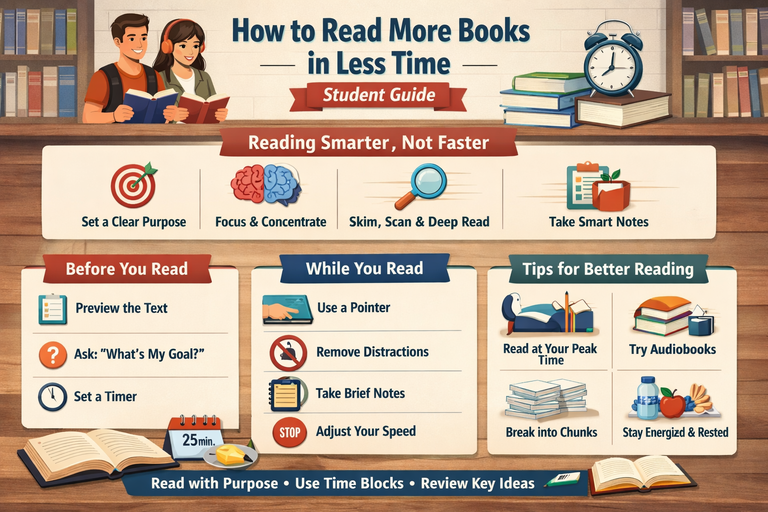
Before Reading
- Set your goal
- Preview the material
- Set a timer
During Reading
- Use a pointer
- Take brief notes
- Focus on main ideas
After Reading
- Write a short summary
- Review key points
Common Mistakes to Avoid
- Reading without a goal
- Treating all texts the same
- Highlighting everything
- Multitasking
- Reading for too long without breaks
- Taking excessive notes
Final Thoughts
Reading more books in less time is not about speed alone it is about strategy.
The most effective students:
- Read with purpose
- Adjust their approach
- Stay focused
- Use structured methods
If you apply even a few of these techniques consistently, you will:
- Finish more reading
- Understand more
- Feel less overwhelmed
Start simple:
- Preview before reading
- Set time blocks
- Remove distractions
- Focus on key ideas
Over time, reading becomes faster, easier, and far more manageable