Best Revision Timetable Template for Exams (Plus How to Stick to It)
A revision timetable doesn’t magically create more time but it does turn stress into structure.
When you’re anxious, your brain keeps a running list of everything you might need to do. A timetable moves that mental load onto paper, makes your next step obvious, and helps you revise consistently without last-minute panic.
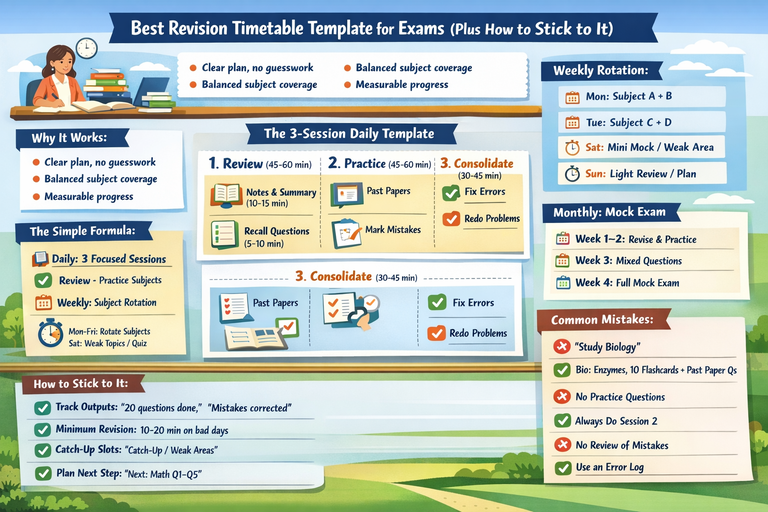
This guide gives you a ready-to-use revision timetable template built on a simple, powerful formula:
Daily: 3 focused sessions
Weekly: subject rotation
Monthly: mock exams
Then it shows you how to stick to it by tracking progress, not perfection.
Why a Revision Timetable Works (When “Study More” Doesn’t)
Most exam stress comes from:
-
Not knowing what to do next
-
Underestimating how long tasks take
-
Revising in an unbalanced way (only favourite subjects)
-
Doing lots of reading but very little testing
A timetable solves this by:
-
Assigning a time and place to each subject
-
Forcing full coverage (you don’t ignore weak topics)
-
Building spaced repetition (you revisit topics across weeks)
-
Making revision measurable and visible
The secret is simplicity:
simple enough to follow, structured enough to work.
The Simple Formula (Overview)
Daily: 3 Focused Sessions
-
Learn / Review (input)
-
Practice / Test (output)
-
Consolidate (fix mistakes + recap)
Weekly: Subject Rotation
Every subject gets time. Weak subjects get more time.
Monthly: Mock Exams
Timed practice to reveal gaps and shape the next timetable.
Step 1: Build Your Timetable in 30 Minutes
A) List Your Subjects and Topics
Create a simple table:
| Subject | Topics | Confidence (1–5) | Priority |
|---|---|---|---|
| Biology | Enzymes, Photosynthesis, Respiration | 2 | High |
| Maths | Algebra, Trigonometry, Probability | 3 | Medium |
Rule: Weak topics get more time — not just the “hard-looking” ones.
B) Count Your Available Revision Time
Be realistic. Include school, homework, travel, meals, sport, rest.
Example:
-
Weekdays: 60–120 minutes
-
Weekends: 2–4 hours
C) Decide Session Length
Choose a length you can repeat every day.
Common options:
-
25 min study + 5 min break (Pomodoro)
-
45 min study + 10 min break
-
60 min study + 10–15 min break
If you struggle to start → shorter sessions win.
Step 2: The Best Daily Template (3 Focused Sessions)
Daily 3-Session Template
Session 1 – Understand / Review (45–60 min)
-
Read notes briefly (10–15 min)
-
Create a one-page summary, mind map or flashcards (20–30 min)
-
End with 5 quick recall questions (5–10 min)
Session 2 – Practice / Exam Questions (45–60 min)
-
Do past-paper questions or problem sets
-
Mark your work
-
Highlight mistakes and their causes
Session 3 – Consolidate / Fix Weaknesses (30–45 min)
-
Relearn weak points from Session 2
-
Rewrite 5 key facts or steps
-
Redo 3–5 missed questions or write model paragraphs
Why this works:
Practice reveals gaps. Consolidation turns gaps into improvement.
If You Have Limited Time (Compressed Day)
-
25 min review
-
25 min practice
-
10–15 min error log / flashcards
Consistency beats long sessions once a week.
Step 3: The Weekly Subject Rotation Template
Option A: Balanced Rotation
| Day | Subjects |
|---|---|
| Mon | Subject 1 + Subject 2 |
| Tue | Subject 3 + Subject 4 |
| Wed | Subject 5 + Subject 1 |
| Thu | Subject 2 + Subject 3 |
| Fri | Subject 4 + Subject 5 |
| Sat | Weak topics + mini mock |
| Sun | Light review + planning |
Option B: Weighted Rotation (Weak Subjects First)
| Subject | Slots / Week |
|---|---|
| Maths (weak) | 3 |
| Chemistry (weak) | 3 |
| English (medium) | 2 |
| Biology (medium) | 2 |
| History (strong) | 1 |
Spread these 11 slots across the week.
Two-Touch Rule:
Every topic gets two touches each week:
1 learning/practice + 1 short review.
Step 4: The Monthly Mock Exam Template (Game-Changer)
Week 1–2: Topic revision + practice
Week 3: Mixed questions + timed sections
Week 4: Mock exam + review + timetable update
How to Review a Mock (Most Students Skip This)
Use a 3-Column Error Log:
| Mistake | Cause | Fix |
|---|---|---|
| Missed enzyme graph question | Didn’t understand rate factors | Relearn factors + redo 5 questions |
Feed this into next month’s timetable.
Ready-to-Use Example Timetable
Weekday
-
Session 1: Subject A — review + summary
-
Session 2: Subject A — exam questions
-
Session 3: Subject B — flashcards + error fixes
Weekend
-
Morning: Weak subject — focused practice
-
Late Morning: Second subject timed questions
-
Afternoon: Consolidation + planning
How to Stick to Your Timetable
1) Track Outputs, Not Hours
Instead of “2 hours studied,” track:
-
20 questions completed
-
15 flashcards reviewed
-
1 essay plan written
-
Errors corrected
2) Use a “Minimum Viable Revision Day”
On bad days, do 10–20 minutes only:
-
Flashcards
-
One exam question
-
Error-log review
This protects the habit.
3) Add Catch-Up Slots
Label 1–2 sessions per week:
“Catch-up / weak areas”
4) Plan the Next Session Before You Stop
Write one line:
“Next time I will do: Chemistry – acids Q1–Q8 past paper.”
5) Use Simple Accountability
-
Study buddy
-
Daily “done list” text
-
Weekly goals with a parent or mentor
Common Mistakes (And Fixes)
Mistake: “Study Biology”
Fix: “Biology: enzymes – 10 flashcards + Q1–Q6 past paper”
Mistake: No practice questions
Fix: Session 2 is non-negotiable
Mistake: Overloading weekdays
Fix: Keep weekdays light, weekends heavy
Mistake: No mistake review
Fix: Session 3 = error log + fixes
Final Checklist
Your best revision timetable includes:
✔ Daily 3-session structure
✔ Weekly subject rotation
✔ Monthly mock exams
✔ Buffers and minimum days
✔ Progress tracking by outputs
A timetable turns stress into structure —
but sticking to it comes from flexibility and consistency, not perfection.