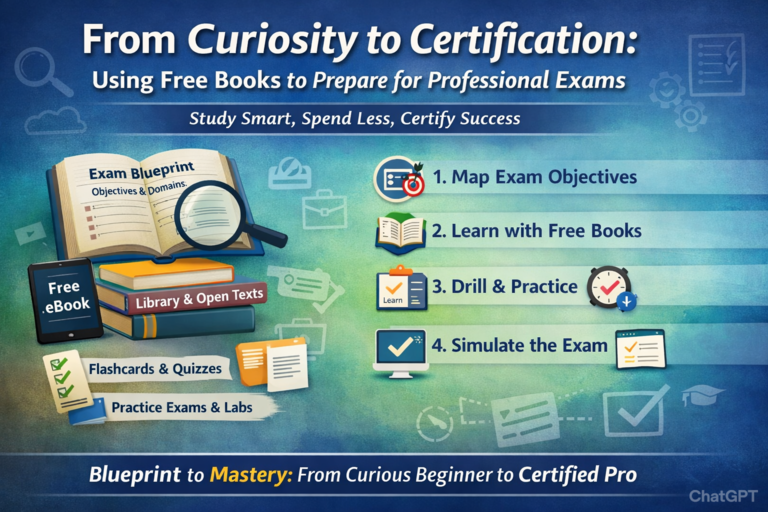
From Curiosity to Certification: Using Free Books to Prepare for Professional Exams
Professional certifications can change careers opening doors to interviews, promotions, client trust, and higher pay. Whether it’s IT, project management, cloud computing, finance, or data science, credentials signal verified competence.
The obstacle is often cost. Official courses, premium learning platforms, bootcamps, and exam prep books can cost hundreds or even thousands of dollars.
The good news? Many certifications can be prepared for effectively using free (legal) books and book-like materials open textbooks, public library eBooks, standards documents, vendor documentation, and university course materials if you follow a structured approach.
This guide shows you how to go from “I’m curious about this field” to “I’m exam-ready” using free books as the backbone of your study system.
1) Start With the Exam Blueprint (Not the Book)
Most candidates fail not because they lack intelligence but because they study broadly instead of studying to the specification.
Certifications are not general knowledge tests. They are objective-based assessments.
Do this first:
-
Download the official exam objectives/blueprint (usually a PDF from the certifying body).
-
List each domain and sub-objective.
-
Set a target exam date.
-
Decide your weekly study hours.
-
Define your pass criteria (e.g., “I consistently score 80%+ on timed practice exams”).
Your blueprint becomes your master table of contents.
Free books become the raw materials you map into it.
Without this step, you risk reading interesting content that never appears on the exam.
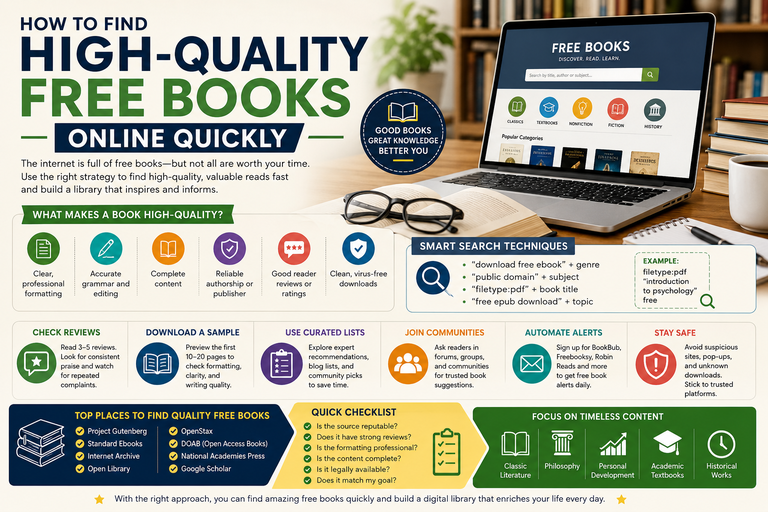
2) What Counts as a “Free Book” (and What to Avoid)
“Free” should mean legal, reliable, and sustainable not pirated PDFs.
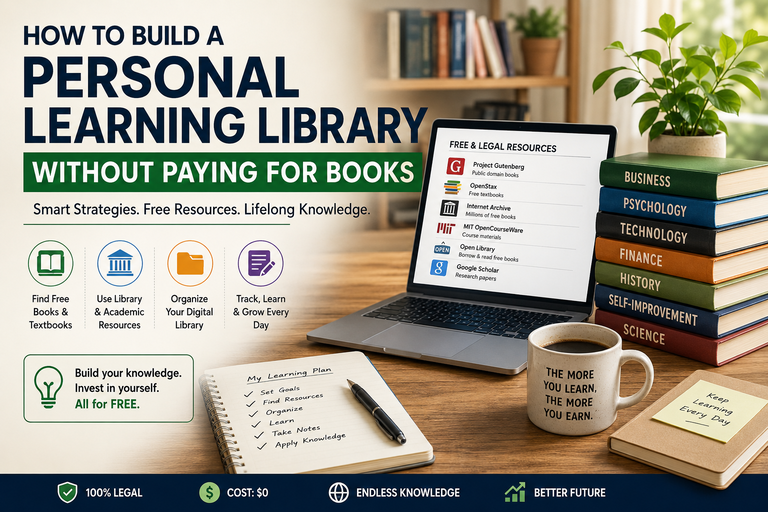
Legitimate Free Book Sources
-
Public libraries (physical books + eBook lending via Libby, OverDrive, Hoopla)
-
Open textbooks (Creative Commons / Open Educational Resources)
-
Government & standards bodies (e.g., National Institute of Standards and Technology publications)
-
Vendor documentation (e.g., Amazon Web Services docs, Microsoft Learn content, Google Cloud documentation)
-
University open courseware (lecture notes + recommended reading)
-
Open-access publishers and research archives
Many vendor documentation portals are essentially full textbooks—updated more frequently than printed exam guides.
Avoid
-
Pirated exam guides
-
“Braindumps” (often illegal and can get certifications revoked)
-
Anonymous PDFs with no authorship or update history
Ethically and practically, legitimate sources protect you from outdated or incorrect material and ensure your certification remains valid.
3) The Economics of Free Prep: Why This Works
Exam preparation relies on four pillars:
-
Coverage – You studied every objective.
-
Understanding – You can explain and apply concepts.
-
Recall under pressure – You retrieve information quickly.
-
Familiarity with exam style – You understand timing and question patterns.
Free books excel at (1) and (2).
You then build (3) and (4) using:
-
Flashcards
-
Self-made quizzes
-
Free practice questions
-
Timed mock exams
-
Hands-on labs (where applicable)
The result? A preparation system that is comprehensive without being expensive.
4) Choose Your Certification Track and Match It to Free Materials
Different certifications rely on different “book ecosystems.”
Strong Free-Book Ecosystems
IT & Cybersecurity
-
Standards publications
-
Networking textbooks
-
Security frameworks
-
Vendor technical documentation
Cloud Certifications
-
Vendor documentation
-
Architecture whitepapers
-
Service reference guides
Data Science & Computer Science
-
Open math and statistics textbooks
-
University programming notes
-
Free algorithm and systems materials
Project Management
-
Framework documentation
-
Library access to foundational texts
-
Public standards and methodology guides
Some niche exams (advanced finance, medical, legal) may have fewer complete open textbooks. In those cases, build a strong core with free materials and consider selective paid practice tests later.
5) Build Your “Objective-to-Book Map” (The Step That Changes Everything)
This is the most powerful technique in your preparation.
Create a mapping document like this:
| Exam Objective | Resource (Free Book/Section) | Notes | Confidence (1–5) |
|---|---|---|---|
| Domain 1.1 | Open Textbook, Ch. 3 | Key formulas + pitfalls | 2 |
| Domain 1.2 | Standards Doc, Sec. 2 | Definitions to memorize | 3 |
How to Map Efficiently
-
Use eBook search with objective keywords.
-
Prefer sources with examples and exercises.
-
If one resource is weak, add a second source.
-
Update your confidence score weekly.
This map prevents over-studying and reveals gaps early.
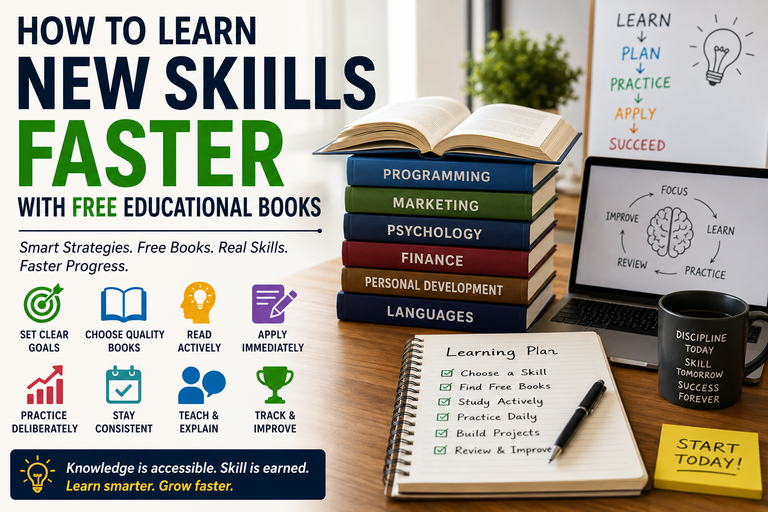
6) Turn Reading Into Exam Readiness: The 3-Layer Study System
Many candidates read extensively and still fail because reading is passive.
You need a progressively active system.
Layer 1: Learn (Free Books)
Goal: Understand each objective clearly enough to teach it.
Method:
-
Study in small chunks aligned to objectives.
-
Write a 3–5 line summary after each section.
-
Capture decision rules (“When to use X vs Y”).
Layer 2: Remember (Retrieval + Spaced Repetition)
Goal: Recall quickly without the book.
Method:
-
Convert summaries into flashcards.
-
Focus on “why/when/how” questions.
-
Use spaced repetition daily (10–20 cards minimum).
Example flashcard:
When should protocol A be used instead of protocol B?
What problem does control X solve?
Layer 3: Perform (Practice + Simulation)
Goal: Execute under exam conditions.
Method:
-
Do timed sets (20–40 questions).
-
Review every incorrect answer.
-
Map mistakes back to the specific book section.
-
For technical exams: complete hands-on labs.
Even if you rely entirely on free books, repeated exam simulation is non-negotiable.
7) A Practical 6–10 Week Study Plan
Here’s a flexible framework:
Weeks 1–2: Orientation
-
Read overview materials.
-
Build your objective map.
-
Start flashcards immediately.
Weeks 3–6: Deep Coverage
-
Cover 1–2 domains weekly.
-
End each week with a timed quiz.
-
Update confidence scores.
Weeks 7–8: Weak-Spot Repair
-
Revisit only low-confidence objectives.
-
Increase timed practice.
-
Create a “last-mile sheet” (formulas, thresholds, steps).
Final 7–10 Days: Simulation Mode
-
Full-length timed mocks.
-
Tight error-review loop.
-
Practice pacing and stress control.
8) Use Free Books Like a Pro
Free books are tools. Use them strategically.
Leverage eBook Features
-
Search – Treat the book like a database.
-
Highlights – Mark only flashcard-worthy content.
-
Notes – Write exam-style warnings (“Common trap…”).
-
Bookmarks – Create a weak-area review list.
Make Exam-Usable Notes
Avoid long summaries. Instead write:
-
Decision rules (“If X, choose Y”)
-
Step sequences (“Order of operations”)
-
Comparisons (“A vs B”)
-
Pitfalls (“Don’t confuse…”)
Build a Personal Glossary
Certification exams are vocabulary-dense.
Maintain a glossary you can review in 10 minutes daily.
9) Quality Control: Evaluating Free Books
Not all free resources are equal.
Credibility
-
Is the author reputable?
-
Is the institution known?
-
Are references provided?
Alignment
-
Does it match your blueprint topics?
-
Does terminology match exam language?
Practice Value
-
Are examples and exercises included?
Freshness
-
Is it updated for current tools and versions?
If unsure, use two sources and defer to official terminology.
10) Common Pitfalls (and Fixes)
Pitfall: Studying interesting topics outside the blueprint
Fix: Use your objective map as a guardrail.
Pitfall: Reading without retrieval
Fix: Every session ends with closed-book recall.
Pitfall: Delaying practice exams
Fix: Start practice early even imperfectly.
Pitfall: Using outdated materials
Fix: Verify exam version and cross-check vendor docs.
Pitfall: Ignoring hands-on skills
Fix: Pair books with labs and real-world application.
11) When “Free Books Only” Isn’t Enough
Sometimes strategic spending improves efficiency.
Consider paying for:
-
One reputable practice exam pack
-
A lab environment if hardware/software access is limited
-
The official exam guide (only if persistent gaps remain)
The principle:
Use free books for knowledge coverage. Spend money only to close exam-format or hands-on gaps.
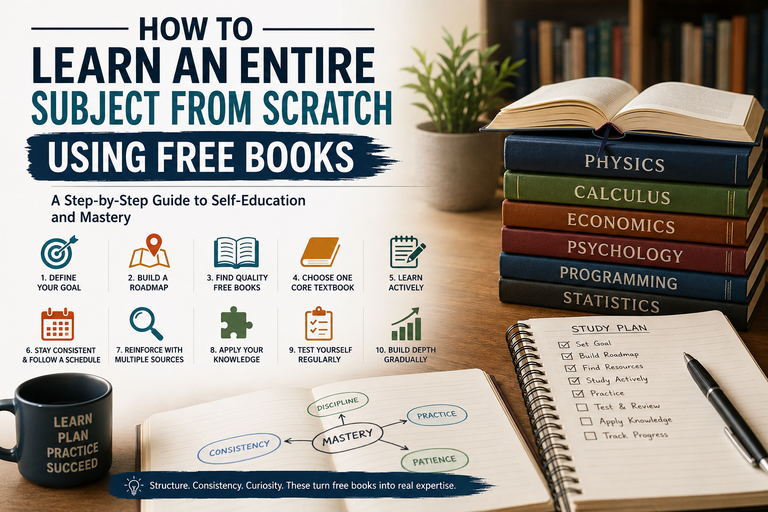
12) The Curiosity → Certification Checklist
✔ Pick certification and download objectives
✔ Set timeline and weekly hours
✔ Gather free books/docs (library + open + vendor + standards)
✔ Build objective-to-resource map
✔ Study by objectives not chapters
✔ Convert highlights into flashcards
✔ Start timed practice early
✔ Track confidence per objective
✔ Simulate full exams in final week
✔ Sit exam with calm, practiced pacing
Conclusion
Free books can absolutely take you from beginner curiosity to certification readiness if you treat them as a structured curriculum tied to the exam blueprint and combine reading with active recall and realistic exam simulation.
The winning approach isn’t finding one perfect free book.
It’s building a system:
-
Objective mapping
-
Active retrieval
-
Practice loops
-
Targeted gap-filling
Curiosity starts the journey.
Structure earns the certification