
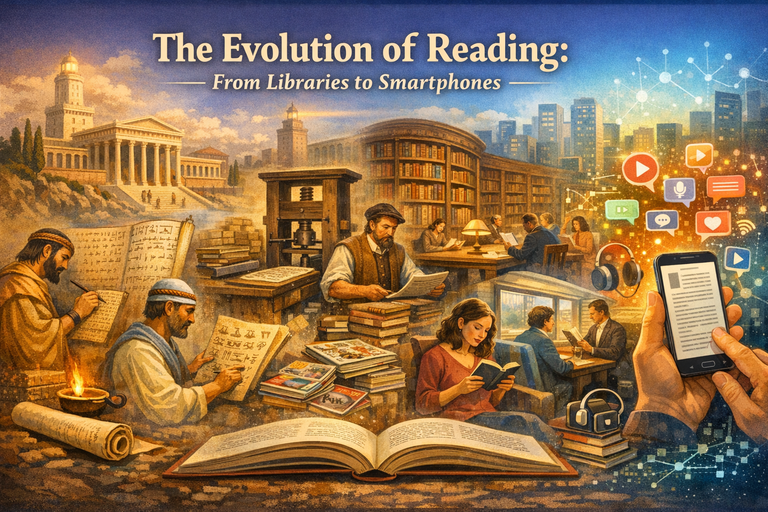
The Evolution of Reading: From Libraries to Smartphones
Reading is both a private act and a public technology shaped by materials, institutions, economics, and culture. Across thousands of years, it has moved from rare, communal encounters with scarce texts to constant, on-demand access carried in a pocket. This transformation has changed not only what we read, but how we read, why we read, and who gets to participate.
1) Reading Before “Books”: Oral Culture and Early Writing
For most of human history, knowledge traveled through speech, memory, and performance. Stories, laws, and spiritual teachings were recited and adapted across generations. Oral culture was communal and dynamic meaning lived in repetition and shared experience.
The emergence of writing layered permanence onto this oral world.
Early Writing Systems
-
In ancient Mesopotamia, Mesopotamia developed cuneiform for administration and trade.
-
In Egypt, hieroglyphs served religious, political, and ceremonial purposes.
Early texts were tools of institutions temples, courts, and merchant networks rather than personal possessions.
Reading as a Specialized Skill
Literacy was rare. Scribes and elites guarded access to texts. Reading was often performed aloud even when done privately because text was still intertwined with speech.
Key shift: Reading moved from performance and memory toward permanence and record-keeping, laying the groundwork for archives and libraries.
2) Libraries as Knowledge Infrastructure
Ancient Libraries: Preservation and Prestige
Libraries were not originally public services. They were symbols of authority.
The legendary Library of Alexandria embodied the ambition to gather and organize the world’s knowledge. Yet it was also a political project tied to empire and power.
Collections were curated, selective, and vulnerable to war and decay.
Manuscript Culture and Access
In medieval Europe, reading and books were closely linked to:
-
Monasteries
-
Religious institutions
-
Royal courts
-
Scholarly communities
Each manuscript was copied by hand slow, expensive, and labor-intensive.
Key shift: Libraries became guardians of knowledge, but access remained narrow. Reading was prestigious and gatekept.
3) The Printing Press and the Rise of Mass Text
The 15th-century introduction of movable-type printing in Europe often associated with Johannes Gutenberg revolutionized text production.
What Printing Changed
-
Scale: Books could be reproduced in large quantities.
-
Consistency: Texts became standardized.
-
Distribution: Commercial networks expanded readership beyond elites.
Social Effects
-
The Protestant Reformation spread through vernacular pamphlets and printed Bibles.
-
The Scientific Revolution accelerated as scholars shared replicable findings.
Key shift: Text became reproducible at scale. Reading began transitioning from elite practice to broader participation.
4) Literacy, Public Libraries, and Reading as a Civic Ideal
Between the 18th and 20th centuries, literacy expanded dramatically due to:
-
Compulsory education
-
Industrialization and urbanization
-
Newspapers and periodicals
-
Political movements promoting citizenship
The Modern Public Library
Public libraries transformed reading access by:
-
Reducing cost barriers
-
Providing community spaces
-
Supporting lifelong learning
-
Curating collections through catalog systems
They also introduced children’s programs and literacy initiatives, embedding reading into civic life.
Key shift: Reading became associated with social mobility, public debate, and mass education not just private study.
5) The 20th Century: Paperbacks and Everyday Reading
As printing grew cheaper, reading became an everyday activity.
New Formats, New Audiences
-
Affordable paperbacks democratized novels and nonfiction.
-
Newspapers and magazines created habitual reading cycles.
-
Comics and genre fiction broadened cultural acceptance of entertainment reading.
Reading on the Move
Trains, buses, and commutes turned reading into a portable companion. Long before digital devices, reading was already integrating into daily life.
Key shift: Reading became mass-market behavior serving pleasure, news, identity, and self-improvement.
6) The Digital Transition: From Screens to Search
The late 20th century introduced a shift as transformative as printing: text became digital.
Early Digital Reading
CD-ROM encyclopedias and early web pages introduced searchable, hyperlinked content. Email and forums reshaped reading into conversational, fragmented exchanges.
Search and Hyperlinking
Search engines changed the starting point of reading:
-
Readers begin with a query, not a shelf.
-
Hyperlinks encourage nonlinear navigation.
Key shift: Reading became less linear and more networked moving through webs of information rather than bounded texts.
7) E-Readers and the “Book” as Software
Dedicated e-readers brought long-form reading into digital ecosystems with:
-
Adjustable fonts and lighting
-
Built-in dictionaries
-
Instant purchasing and downloading
-
Annotation and highlighting tools
E-books also reshaped publishing:
-
Self-publishing expanded access for authors.
-
Global distribution simplified reach.
-
Digital Rights Management (DRM) complicated ownership.
Key shift: The book became both product and service embedded in platforms and ecosystems.
8) Smartphones: The Most Radical Reading Device Yet
Smartphones unified communication, entertainment, and reading into a single device. No previous technology integrated text so fully into daily life.
1) Ubiquity and Immediacy
A reading device is almost always present. Micro-moments—waiting in line, commuting, between tasks become reading opportunities.
2) Fragmentation and Brevity
Smartphones encourage:
-
Shorter texts
-
Rapid scanning
-
Frequent app-switching
Long-form reading persists, but attention must be actively protected.
3) Social Discovery
Reading is shaped by platforms:
-
Online book communities
-
Influencer-driven trends
-
Algorithmic recommendations
Discovery increasingly comes from feeds rather than shelves.
4) Multimedia Convergence
Text now competes and blends with:
-
Video
-
Audio
-
Interactive graphics
-
Notifications
Key shift: Reading becomes ambient and continuous but also interrupted.
9) Audiobooks and the Expanded Meaning of “Reading”
Smartphones normalized audiobooks and text-to-speech.
For many, listening is the most practical way to engage with long-form content during busy routines. Audiobooks also expand accessibility for people with visual impairments, dyslexia, or attention challenges.
Debates continue about whether listening “counts” as reading, but culturally the definition has broadened: reading is engagement with language and ideas not only decoding print.
Key shift: Reading becomes multimodal.
10) Benefits of Smartphone Reading
Greater Access
-
Instant access to classics, research, and global news
-
Open-access resources and public-domain texts
-
Library apps reducing cost barriers
Personalization
-
Adjustable text size and contrast
-
Translation tools
-
Built-in dictionaries
-
Reading streaks and habit trackers
Democratized Publishing
-
Writers publish without traditional gatekeepers
-
Marginalized voices find communities
-
Niche topics thrive
11) Challenges: Attention, Quality, and Ownership
The Attention Economy
Smartphones compete for engagement through:
-
Notifications
-
Infinite scrolling
-
Rapid reward cycles
This can encourage surface-level skimming and reduce sustained focus.
Misinformation
With expanded access comes noise. Readers must constantly evaluate credibility.
Ownership and Platform Dependence
Digital reading often involves licensing rather than ownership. Content can be removed or restricted. Printed books, by contrast, remain durable and transferable.
Trade-off: Convenience often replaces permanence.
12) Libraries in the Smartphone Era
Far from disappearing, libraries have evolved:
-
Digital lending (e-books and audiobooks)
-
Community internet access
-
Workshops and maker spaces
-
Privacy-respecting information access
-
Archival stewardship
Libraries remain one of the few institutions organized around equitable access rather than profit.
Continuity: Reading remains a public good.
13) The Future of Reading
Hybrid Habits
Most readers blend:
-
Paper for immersive focus
-
Phones for convenience and discovery
-
Audio for multitasking
-
Tablets or e-ink devices for travel
Interactive and Adaptive Texts
Growth is likely in:
-
Embedded multimedia
-
Interactive textbooks
-
Living documents that update
-
AI-assisted summaries and tutoring
Renewed Deep Reading
As distraction rises, deep reading may become intentional practice supported by:
-
Distraction-free modes
-
Dedicated reading devices
-
Personal rituals for focused attention
Conclusion: From Scarcity to Saturation
The evolution of reading is a journey from scarcity to saturation:
-
In the library age, texts were limited and institutionally guarded.
-
In the print age, texts became affordable and central to civic life.
-
In the smartphone age, texts are abundant, searchable, social and constantly competing for attention.
Yet the core purpose remains unchanged. Reading helps us learn, imagine, question, connect, and construct meaning.