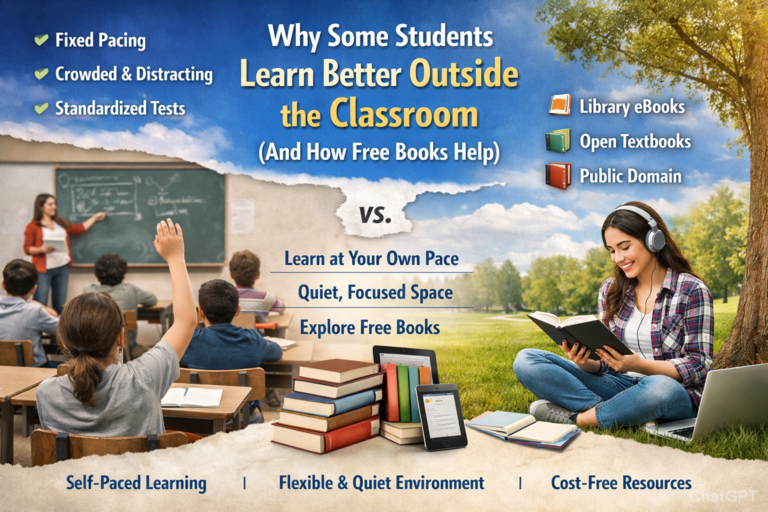
Why Some Students Learn Better Outside the Classroom (And How Free Books Help)
Classrooms are designed for scale. They bring together dozens of students, one teacher, and a shared curriculum within fixed time limits. That structure has real advantages: expert guidance, peer interaction, accountability, and social learning. But structure also creates constraints fixed pacing, standardized instruction, public evaluation, and limited personalization.
For a significant group of learners, those constraints interfere with how they concentrate, process information, and build confidence. Outside the classroom where students can control pace, environment, and materials learning often becomes clearer, calmer, and more effective.
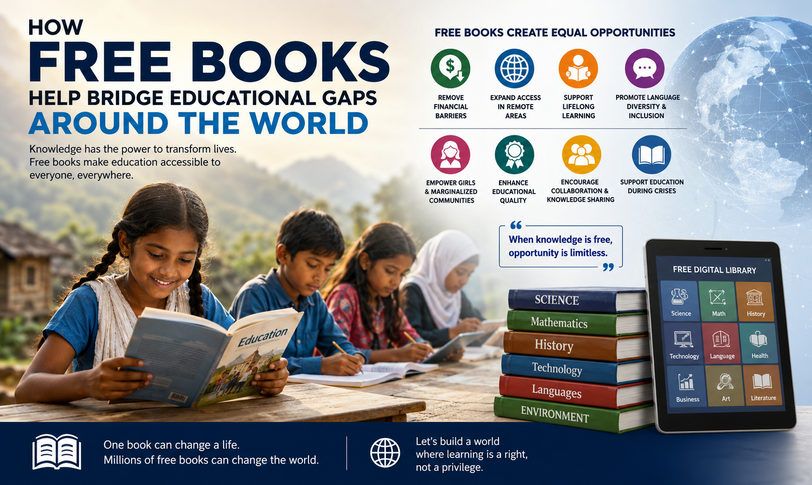
Free books whether through library eBooks, open textbooks, or public-domain works amplify this effect by removing one of the biggest barriers to independent learning: cost. When access is no longer restricted by price, students can shape learning around how their minds actually work.
1) The Classroom Advantage and Its Built-In Limits
A classroom typically optimizes for:
-
Coverage (finishing required content on schedule)
-
Uniform assessment (grading fairly and efficiently)
-
Group management (behavior, transitions, time constraints)
-
Shared instruction (one explanation delivered to many learners)
These goals are practical but they don’t always align with how individual learning unfolds.
Many students need:
-
more time to process,
-
more repetition,
-
fewer distractions,
-
alternative examples,
-
or a greater sense of psychological safety before participating.
When those needs are not met, learning friction increases. Outside the classroom, many of these friction points can be reduced or removed.
2) Why Some Students Learn Better Outside the Classroom
A) They Learn Best at Their Own Pace (Mastery Beats Coverage)
In many classrooms, pacing is fixed. The class moves forward whether or not each student has mastered the concept. Independent learning changes that dynamic.
Outside the classroom, students can:
-
reread a paragraph three times,
-
pause to look up unfamiliar vocabulary,
-
revisit earlier chapters,
-
spend an entire week on one difficult concept.
This supports mastery learning, which is strongly associated with deeper understanding and long-term retention. When students truly grasp a concept before moving on, confidence builds instead of erodes.
B) They Think Better With Fewer Distractions
A classroom is socially and cognitively busy: conversations, movement, group work, announcements, shifting attention. For students who are easily overstimulated whether due to temperament, anxiety, ADHD, or sensory sensitivity attention becomes a scarce resource.
At home, in a library, or in a quiet study space, students can control:
-
noise level,
-
lighting,
-
break timing,
-
seating position,
-
device notifications.
Small environmental adjustments can significantly improve concentration and reduce cognitive fatigue.
C) They’re More Willing to Be “Bad at It” in Private
Learning requires mistakes. But public mistakes can feel risky. Many students hesitate to ask questions or attempt difficult problems because embarrassment carries social cost.
Outside the classroom:
-
there’s no audience during struggle,
-
restarts happen without judgment,
-
improvement can happen before performance.
This psychological safety increases persistence. Students who are reluctant participants in class often become more exploratory learners in private.
D) Their Learning Style or Neurotype Doesn’t Match the Default
Whole-class instruction often relies on listening, rapid note-taking, and timed assessments. Yet students vary widely in how they absorb and process information.
Some learn best through:
-
reading and rereading,
-
visual explanations,
-
step-by-step worked examples,
-
project-based experimentation,
-
verbal reasoning and reflection.
Independent book-based learning allows students to choose formats and methods aligned with their strengths particularly important for neurodivergent learners whose cognitive rhythms differ from classroom norms.
E) Autonomy Increases Motivation
Motivation is not just about discipline it’s closely tied to autonomy and relevance.
Outside the classroom, students can:
-
choose topics that genuinely interest them,
-
explore side paths sparked by curiosity,
-
connect learning to real-world goals (a hobby, career aspiration, personal problem).
Self-directed learning often increases effort and engagement especially for students who disengage from mandatory instruction but thrive when curiosity drives the process.
F) Time Becomes More Efficient
Classroom learning includes necessary overhead: attendance, transitions, classroom management, waiting for others. Independent study can be more concentrated.
A focused 25-minute self-study session can sometimes accomplish more than a full class period, particularly for students who already grasp portions of the material and want to move faster.
3) How Free Books Specifically Help (Not Just “Any Resource”)
Not all learning resources offer the same advantages. Free books combine three essential elements: access, depth, and repeatability.
A) They Remove the Price Barrier to Exploration
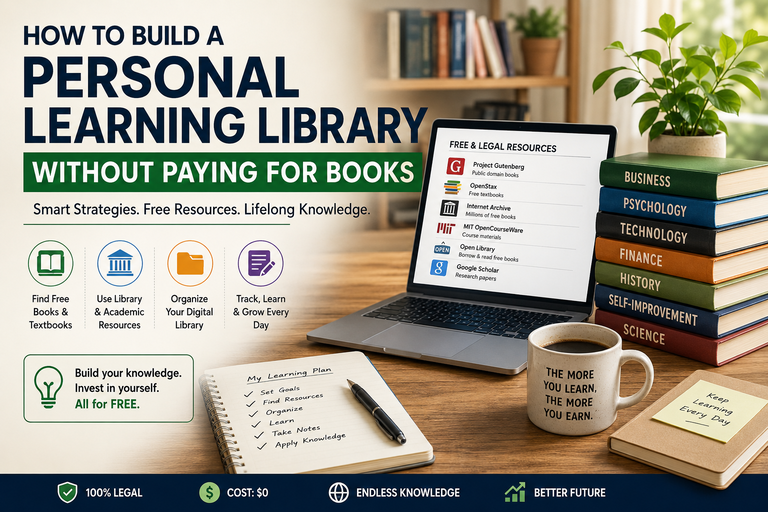
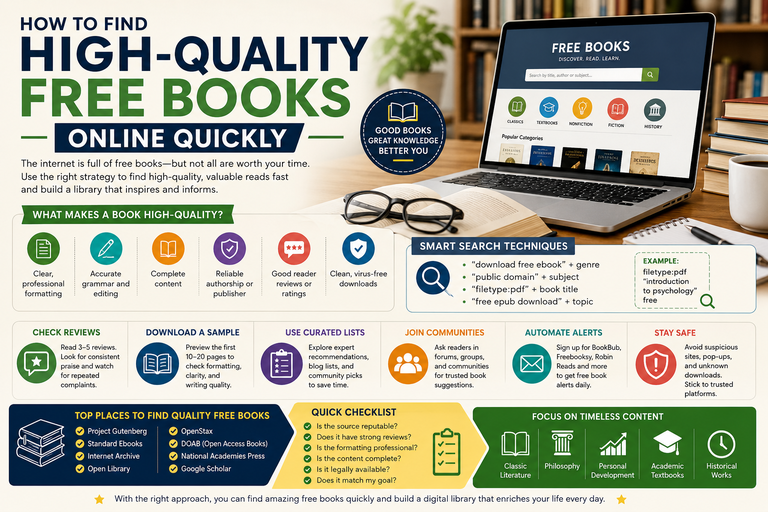
Students cannot develop interests if every new topic requires purchasing materials. Free access through public libraries, open textbooks, and platforms like Project Gutenberg or OpenStax allows students to:
-
sample broadly (science, philosophy, coding, art),
-
discover what “clicks,”
-
deepen exploration without financial pressure.
Exploration fuels identity formation: I’m someone who learns. I’m someone who explores ideas.
B) They Enable Repetition Without Penalty
Learning is rarely one-pass. Students benefit from revisiting examples and rereading difficult sections. With free digital books, they can review:
-
without worrying about edition changes,
-
without time-limited paid access,
-
without additional cost.
Repetition strengthens neural pathways and supports long-term retention.
C) They Support Self-Pacing and Personalization
Books allow:
-
slow reading for deep comprehension,
-
skipping familiar sections,
-
focusing intensely on weak areas,
-
keyword searches (in digital formats).
Unlike lectures, books are inherently adjustable. Students can shape the learning tempo to fit their cognitive needs.
D) They Offer Built-In Accessibility
Many free-book ecosystems provide:
-
adjustable font sizes,
-
screen-reader compatibility,
-
audiobooks,
-
translation tools,
-
high-contrast modes.
For some learners, these features transform access from frustrating to empowering.
E) They Strengthen Libraries and Community Access
Libraries are one of the most powerful equity mechanisms in education. Platforms such as Internet Archive expand access to millions of texts globally.
Free books allow families to build robust home learning environments even when tutoring, prep courses, or premium materials are financially out of reach.
Access becomes less dependent on income and more dependent on initiative.
4) The Learning Psychology Behind “Books Outside Class”
Independent book-based learning naturally aligns with evidence-based principles:
-
Spaced repetition – revisiting material across days improves retention.
-
Retrieval practice – summarizing from memory strengthens recall.
-
Cognitive load management – students can slow down to prevent overload.
-
Metacognition – self-study reveals what is and isn’t understood.
Ironically, the book format encourages learning habits that classrooms often struggle to cultivate at scale.
5) Practical Ways Students Can Learn Outside the Classroom
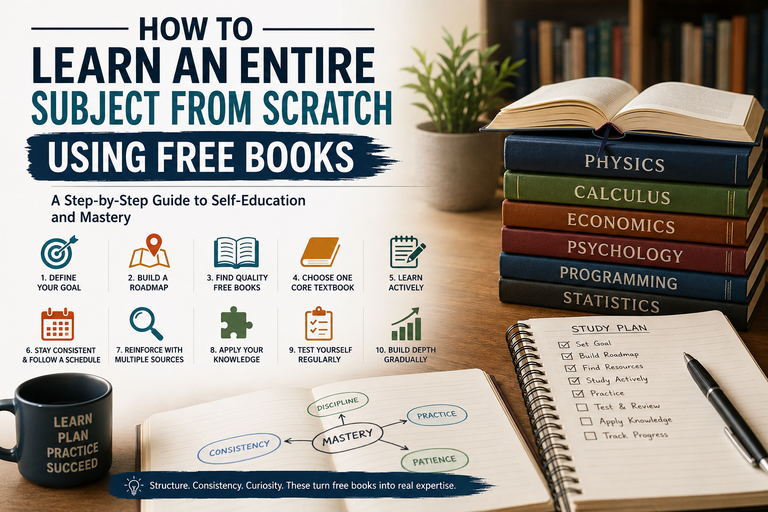
A) The “15–5” Study Block (20 Minutes)
-
15 minutes reading
-
5 minutes recall (close the book and write: “What were the 3 main points?”)
This prevents passive reading and strengthens retention.
B) Build a Personal Difficulty Ladder
For any subject:
-
Start with an introductory text (easy).
-
Move to a standard textbook (medium).
-
Add advanced problems or primary sources (hard).
Free books make it easier to find the right level instead of being stuck with one resource that’s too advanced.
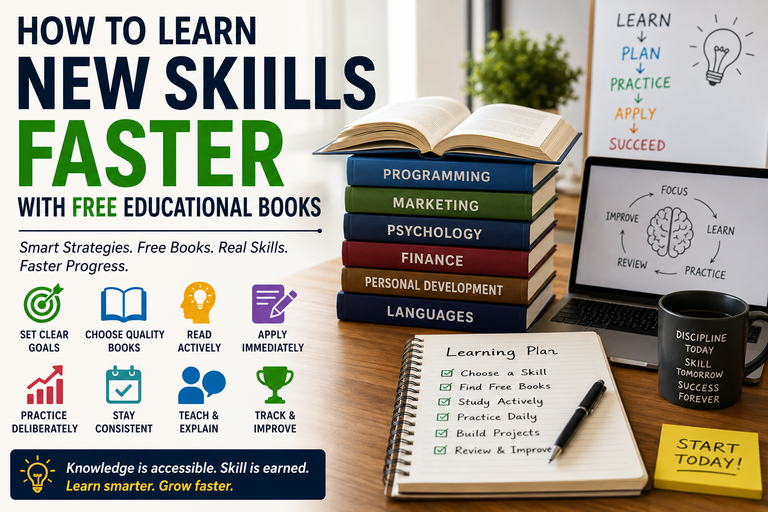
C) Combine Books With Projects
Books provide sequence. Projects provide purpose.
Examples:
-
Learn statistics by analyzing personal data.
-
Improve writing by imitating one stylistic technique per chapter.
-
Learn coding by implementing and modifying examples.
Active application converts knowledge into skill.
D) Replace Highlighting With “Exam-Style Notes”
After each chapter, record:
-
key definitions,
-
processes or steps,
-
common errors,
-
one example problem and solution outline.
Short, structured notes are easier to review than heavily highlighted pages.
6) What Educators and Parents Can Do (Without Undermining School)
Encourage Parallel Learning
Instead of competing with school, independent reading can reinforce it:
-
“Read anything related to this unit your choice for 15 minutes a day.”
-
“Bring one interesting idea back each week.”
This builds ownership while supporting curriculum goals.
Curate, Don’t Control
Students benefit from:
-
leveled reading lists,
-
recommendation pathways (“If you liked this, try that”),
-
library orientation,
-
basic training on evaluating sources.
Guidance reduces overwhelm without restricting curiosity.
Validate Different Learning Profiles
Some students thrive in discussion. Others thrive in reflection and reading. Recognizing both as legitimate learning modes increases persistence and confidence.
7) Real Challenges and How to Address Them
Challenge: Lack of structure
Solution: Fixed study time, visible progress tracking, short sessions.
Challenge: Misconceptions without feedback
Solution: Practice questions, teaching someone else, periodic check-ins.
Challenge: Quality variation
Solution: Use libraries, reputable OER collections, and university-published materials.
Challenge: Limited space or devices
Solution: Strengthen community study spaces, offline formats, and school lending programs.
Free only helps when it’s usable.
Conclusion
Some students learn better outside the classroom because independent learning removes constraints that can block attention, confidence, and mastery. It allows self-pacing, private struggle, personalized methods, and autonomy conditions under which many learners thrive.
Free books amplify these benefits by making exploration affordable, repetition unlimited, and access scalable. When paired with simple routines short daily sessions, retrieval practice, and periodic feedback free books can transform evenings, weekends, and summers into a powerful second classroom.
Not a replacement for school but a complement built around the learner.
If you share the student’s age range and subject (math, reading, science, coding, history, etc.), I can design a practical outside-class routine and recommend the most effective types of free book sources to use