
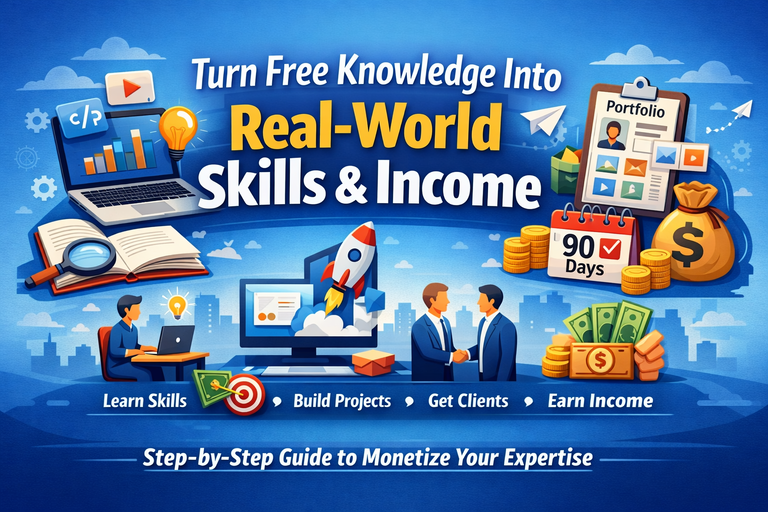
How to Turn Free Knowledge Into Real-World Skills and Income
Free knowledge has never been more abundant. You can learn almost anything programming, design, accounting, marketing, languages, data analysis, even advanced engineering concepts through free courses, tutorials, articles, open-source communities, and public libraries.
The barrier is no longer access.
The real challenge is conversion: turning information into skill and skill into income.
This guide provides a practical, end-to-end framework for transforming free learning into real capability and reliable earnings without relying on expensive degrees, “secret” masterminds, or overpriced programs.
1) Understand the Gap: Information vs. Skill vs. Income
Before anything else, clarify the difference:
-
Information is what you read, watch, or save.
-
Skill is what you can consistently execute to a measurable standard.
-
Income is what someone repeatedly pays you for because your skill creates value.
Most people get stuck in the information stage:
-
Dozens of bookmarked videos
-
Detailed notes
-
Saved courses
-
“I’ll start soon” plans
But the market doesn’t pay for what you know. It pays for what you can produce.
The mental shift is simple but powerful:
Treat learning like job training, not entertainment.
That means:
-
Outcome-focused learning
-
Project-based execution
-
Visible proof of competence
2) Choose a Skill That Can Pay (Not Just One That’s Interesting)
Interest matters but market demand matters more.
A profitable skill usually sits at the intersection of:
-
Market demand – People actively pay for it.
-
Aptitude/interest – You can practice consistently.
-
Clear output – There’s a deliverable you can show.
-
Accessible entry path – You can start small and improve quickly.
High-Demand, Output-Based Skills You Can Learn for Free
-
Web Development (landing pages, Shopify, WordPress fixes)
-
Data Analysis (Excel dashboards, Google Sheets, SQL reporting)
-
Digital Marketing (SEO, paid ads, email campaigns)
-
Graphic Design (social media creatives, brand kits)
-
Video Editing (short-form clips, YouTube edits, captions)
-
Copywriting (product pages, ads, email sequences)
-
Virtual Assistance / Operations (CRM updates, automation, scheduling)
-
Tutoring and Teaching (languages, math, exam prep)
Tip: Prioritize skills tied to measurable business outcomes:
-
More leads
-
More sales
-
Time saved
-
Fewer errors
-
Clearer reporting
Outcomes are easier to monetize than general knowledge.
3) Build a Skill Roadmap (So You Don’t Drown in Content)
Free knowledge is chaotic. Without structure, you’ll consume endlessly without producing anything.
Use this simple roadmap for almost any skill:
Phase 1: Foundations (1–2 Weeks)
-
Core concepts
-
Basic terminology
-
Essential tools
Phase 2: Core Workflows (2–6 Weeks)
-
Repeatable tasks professionals actually perform
-
Tool proficiency
-
Speed and accuracy development
Phase 3: Portfolio Projects (2–8 Weeks)
-
Real outputs
-
Simulated client scenarios
-
Increasing complexity
Phase 4: Real-World Practice (Ongoing)
-
Deadlines
-
Feedback
-
Iteration
-
Client communication
Rule:
If you cannot clearly state what you’re building in the next 7 days, your roadmap is too vague.
4) Use Project-Based Learning (The Fastest Way to Become Employable)
Watching tutorials feels productive. Building projects creates competence.
Good practice includes:
-
A specific deliverable
-
A constraint (deadline, style guide, audience)
-
A success metric (clarity, speed, engagement, conversion)
Portfolio Project Ideas by Skill
Web Development
-
Build a one-page landing site for a local business
-
Optimize it for mobile responsiveness
Data Analysis
-
Analyze a public dataset
-
Build a dashboard with 3 actionable insights
Digital Marketing
-
Create a 7-day content plan
-
Write 5 posts with a performance hypothesis
Design
-
Redesign 10 Instagram posts using a unified brand system
Copywriting
-
Write a product page
-
Create a 5-email welcome sequence
Video Editing
-
Turn raw footage into 3 short-form clips
-
Add captions and hook-driven intros
No clients yet?
Simulate real ones. Choose existing businesses and improve their current assets. Document your decisions.
5) Add Feedback Loops (Because Practice Without Feedback Plateaus)
Practice alone doesn’t guarantee improvement. Correction does.
Free or low-cost feedback sources:
-
Online communities (forums, Discord servers, GitHub)
-
Peer review groups
-
Public posting (LinkedIn, X, Reddit)
-
Volunteer mentors in open communities
Ask specific questions:
-
“Is this headline clear?”
-
“Is this chart readable?”
-
“Does this design match the brand tone?”
-
“What would make this more persuasive?”
Specific questions get actionable feedback.
6) Turn Skills Into Proof (Portfolios Beat Certificates)
Income requires trust. Trust requires evidence.
Build proof in three layers:
1. Portfolio
5–10 strong examples with short explanations.
2. Process
Show how you think:
-
Before and after
-
Tools used
-
Strategy decisions
3. Results
Even small wins matter:
-
Improved clarity
-
Time saved
-
Engagement increase
-
Positive feedback
Where to Host Your Work
-
A simple website
-
Notion portfolio
-
GitHub (for code)
-
Behance or Dribbble (for design)
-
LinkedIn with pinned posts
Certificates may help credibility but portfolios close deals.
7) Convert Proof Into Income: Practical Paths
Path A: Employment (Entry-Level or Apprenticeship)
Best if you want structure and stability.
What works:
-
Focused portfolio aligned with the role
-
Tailored applications
-
Demonstrable projects similar to job tasks
Path B: Freelancing (Fastest Route for Many)
Start small with clearly defined services:
-
“Edit 10 short videos per week”
-
“Build a one-page landing page”
-
“Create a 5-email sequence”
-
“Set up a dashboard in Excel”
Package your services:
-
Defined scope
-
Fixed price
-
Clear timeline
Clarity increases trust.
Path C: Gig Platforms
Useful for:
-
Building reviews
-
Learning client communication
-
Improving speed
But don’t stay dependent. Use them as a launchpad.
Path D: Create Products
Once your process becomes repeatable, productize:
-
Templates (Canva, Excel, Notion)
-
Checklists
-
Script packs
-
Mini-courses
-
Presets
-
Niche workshops
Products scale better than services.
Path E: Teach What You Can Do
Teaching works when you:
-
Have real project experience
-
Can explain your process clearly
-
Document your system
Tutoring, workshops, and corporate training can become major income streams.
8) Learn Basic Marketing and Sales (Even If You’re Not “Salesy”)
Skills alone don’t generate income. Visibility does.
Create a simple positioning statement:
“I help [type of client] achieve [outcome] using [skill].”
Examples:
-
“I help local gyms generate more leads with landing pages.”
-
“I help creators grow using short-form video editing systems.”
-
“I help small businesses understand their numbers through simple dashboards.”
Outreach That Works
-
Identify a business with a visible problem.
-
Suggest one specific improvement.
-
Share one relevant sample.
-
Propose a small next step (15-minute call or fixed-price task).
Consistency beats intensity.
10 thoughtful messages per week > 100 spam messages once.
9) Price by Deliverables (Not Hours) When Possible
Hourly pricing punishes beginners who are slower.
Package by deliverable:
Starter
-
1 landing page + basic SEO
Standard
-
Landing page + revisions + analytics setup
Premium
-
Landing page + email capture + A/B testing plan + support
As you improve:
-
Increase rates
-
Narrow your niche
-
Raise standards
10) Avoid the Biggest Traps
Trap: Endless learning without output
Fix: Ship something weekly.
Trap: Trying to learn everything
Fix: Choose one role and niche for 60–90 days.
Trap: No public proof
Fix: Publish—even simulated work.
Trap: Fear of judgment
Fix: Ship smaller, iterate faster.
Trap: Undercharging forever
Fix: Raise prices every 3–5 successful projects.
Trap: Using pirated or low-quality materials
Fix: Use legitimate free resources and open licenses.
11) A 30/60/90-Day Action Plan
Days 1–30: Foundations + First Proof
-
Choose one skill and one service
-
Follow one structured free curriculum
-
Ship 2 small projects
-
Publish a simple portfolio page
Days 31–60: Build Portfolio + Speed
-
Ship 3–5 stronger projects
-
Get weekly feedback
-
Write short case studies
-
Improve workflow efficiency
Days 61–90: Start Monetizing
-
Package your service (scope, timeline, price)
-
Do weekly outreach or apply to focused roles
-
Close 1–3 paid projects
-
Collect testimonials
-
Improve one measurable metric
By Day 90, you should have:
-
A clear offer
-
A portfolio with proof
-
Client communication experience
-
A repeatable learning-to-earning system
Conclusion
Free knowledge becomes real-world skill when you:
-
Turn learning into projects
-
Add feedback loops
-
Build visible proof
It becomes income when you:
-
Package your work into a clear offer
-
Put it in front of the right people
-
Deliver results consistently
Information is everywhere.
Skill is rare.
Reliable value is rarer still.
If you focus on producing outcomes instead of collecting content, free knowledge can become one of the most powerful economic tools available today